
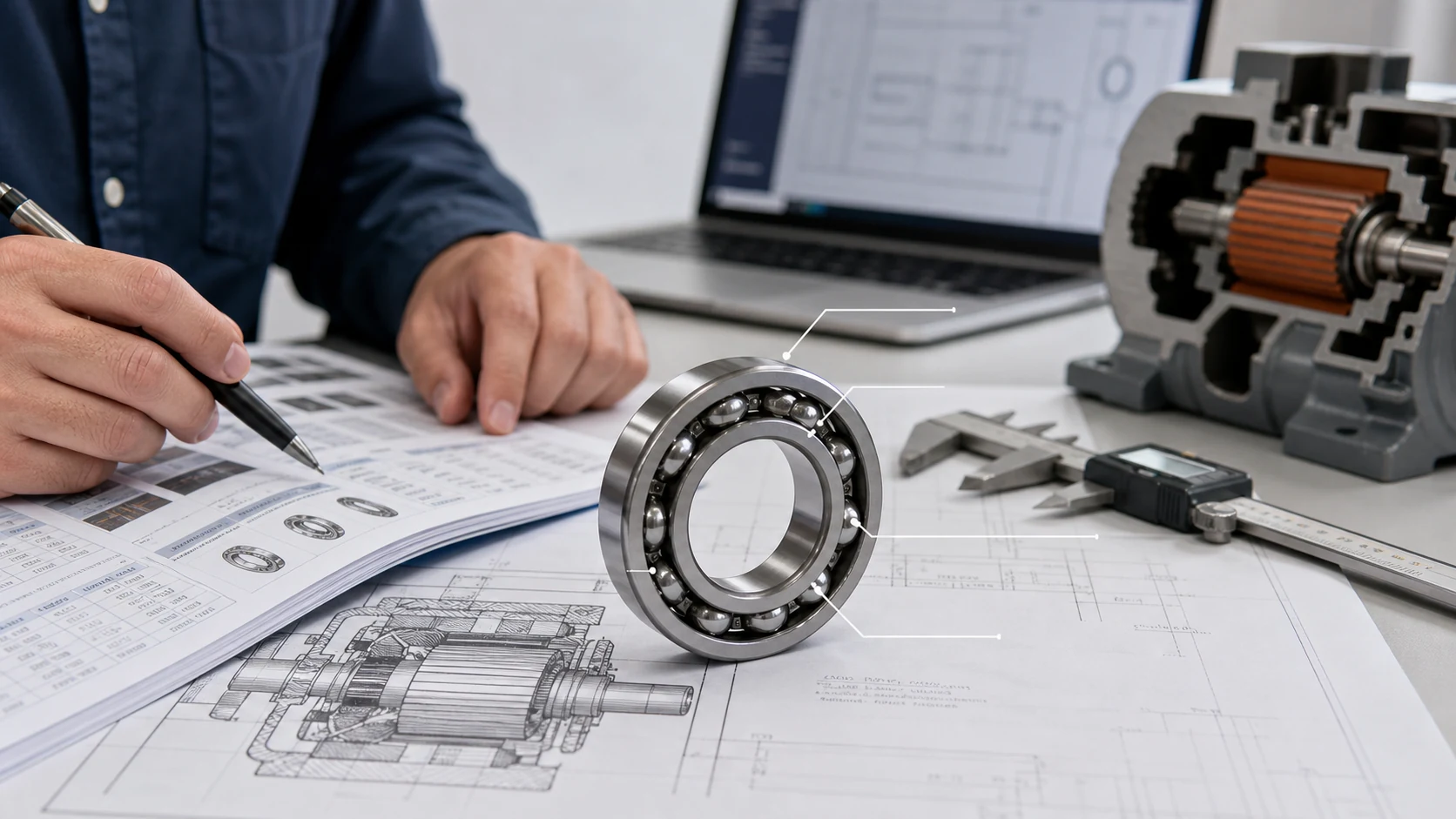
Quick answer: Use deep groove ball bearings when the application needs a compact, economical, high-speed bearing for mainly radial load, and any axial load stays within the manufacturer’s catalog limits for the selected bearing size, series, clearance, speed, lubrication, and load ratio. They are a strong default choice for electric motors, pumps, fans, conveyors, appliances, gearboxes, rollers, and general machinery when alignment is good, loads are not severe, and the bearing position benefits from low friction, low noise, and simple mounting.
This guide focuses on radial deep groove ball bearings, especially single-row deep groove ball bearings commonly used in motors, pumps, fans, rollers, gearboxes, appliances, and general machinery.
Do not choose a deep groove ball bearing only because the bore size fits. The right choice still depends on radial load, axial load, speed, life target, shaft and housing fit, internal clearance, lubrication, sealing, temperature, contamination, and installation accuracy. A deep groove ball bearing is versatile, but it is not a substitute for angular contact bearings, roller bearings, thrust bearings, or self-aligning bearings when the application clearly needs those functions.
Where Deep Groove Ball Bearings Fit Best
Deep groove ball bearings fit well in rotating equipment where radial load is the main load, axial load is limited, speed is relatively high, and friction or noise must stay low. Their raceway geometry supports point contact between balls and raceways, which helps them run at high speeds with lower torque than many roller bearing arrangements.
For many OEM and MRO buyers, the practical appeal is simple: deep groove ball bearings are widely available, easy to source in many sizes, available with open, shielded, or sealed designs, and suitable for many standard shaft positions. That makes them a common first bearing family to evaluate before moving to a more specialized bearing type.
| Use Deep Groove Ball Bearings When… | Why They Fit |
|---|---|
| The load is mostly radial | Deep groove geometry is well suited to radial support. |
| Axial load is present but not dominant | They can accommodate axial load in both directions within catalog limits. |
| Speed is important | Ball contact and low friction make them suitable for high-speed duty. |
| Noise and vibration matter | They are commonly used in motors, appliances, fans, and precision rotating equipment. |
| Space is limited | Standard series give compact options across many bore sizes. |
| Maintenance access is limited | Shielded and sealed designs can help retain grease and reduce contamination entry. |
| The shaft and housing are well aligned | They work properly when mounting alignment is controlled. |
Common Applications for Deep Groove Ball Bearings
Deep groove ball bearings are often used in electric motors, pumps, fans, conveyors, gearboxes, small industrial machines, appliances, power tools, agricultural equipment, and general-purpose rotating shafts. They are popular because many of these applications have the same basic need: support a shaft at speed with moderate load, low friction, and predictable availability.
In electric motors, the usual priorities are speed, noise, vibration, grease life, internal clearance, and electrical or thermal environment. In pumps and fans, the bearing may also see axial force from hydraulic thrust, impeller geometry, belt tension, or thermal growth. In conveyors and rollers, sealing, contamination resistance, and static loading during storage or shutdown may matter as much as calculated running load.
The bearing family may be common, but the specification should still be application-specific. A sealed bearing for a dusty conveyor roller is not the same selection problem as an open bearing in a clean, oil-lubricated gearbox or a low-noise bearing in a small motor.
Electric Motors and Small Rotating Machines
Deep groove ball bearings are widely used in electric motors because they support high speed, low torque, and low noise when the shaft and housing are properly aligned. For motor duty, the buyer should review clearance, grease, shields or seals, temperature rise, vibration requirement, and whether electrical erosion is a risk.
If the motor uses an inverter drive, has repeated bearing current issues, or runs in a high-temperature environment, the bearing specification may need insulating features, a different grease, or a supplier engineering review. Do not treat a standard deep groove bearing number as enough information for every motor application.
Pumps, Fans, Blowers, and Gear-Driven Shafts
Deep groove ball bearings can work well in pumps, fans, blowers, and gear-driven shafts when the axial load is limited and the bearing arrangement controls the shaft correctly. They are especially useful where the equipment needs smooth rotation, moderate load capacity, and readily available replacement sizes.
The risk is underestimating axial load. Hydraulic thrust, belt pull, gear reaction, thermal growth, or assembly preload can shift the bearing from a simple radial-load case into a combined-load problem. If axial load becomes high or stiffness must be controlled, angular contact ball bearings, paired bearings, or another bearing arrangement may be more appropriate.
Conveyors, Rollers, Appliances, and General Machinery
Deep groove ball bearings are a practical choice for conveyors, rollers, appliances, and general machinery when the load is moderate and the bearing must run smoothly with limited maintenance. Shielded and sealed versions are often considered when dust, handling contamination, or grease retention matters.
For these applications, the bearing failure often comes from the system around the bearing: poor sealing, water, abrasive dust, incorrect press fit, misalignment, overgreasing, undergreasing, or shock load at rest. A higher catalog load rating may not solve those problems if the operating environment is the true cause.
Load Direction: Radial Load First, Axial Load Second
Deep groove ball bearings should usually be considered first for radial-load applications with limited axial load. They can carry axial load in both directions, but only within the catalog limits for the selected bearing size, series, clearance, speed, lubrication, and load ratio. Do not treat a radial deep groove ball bearing as a high-thrust bearing.
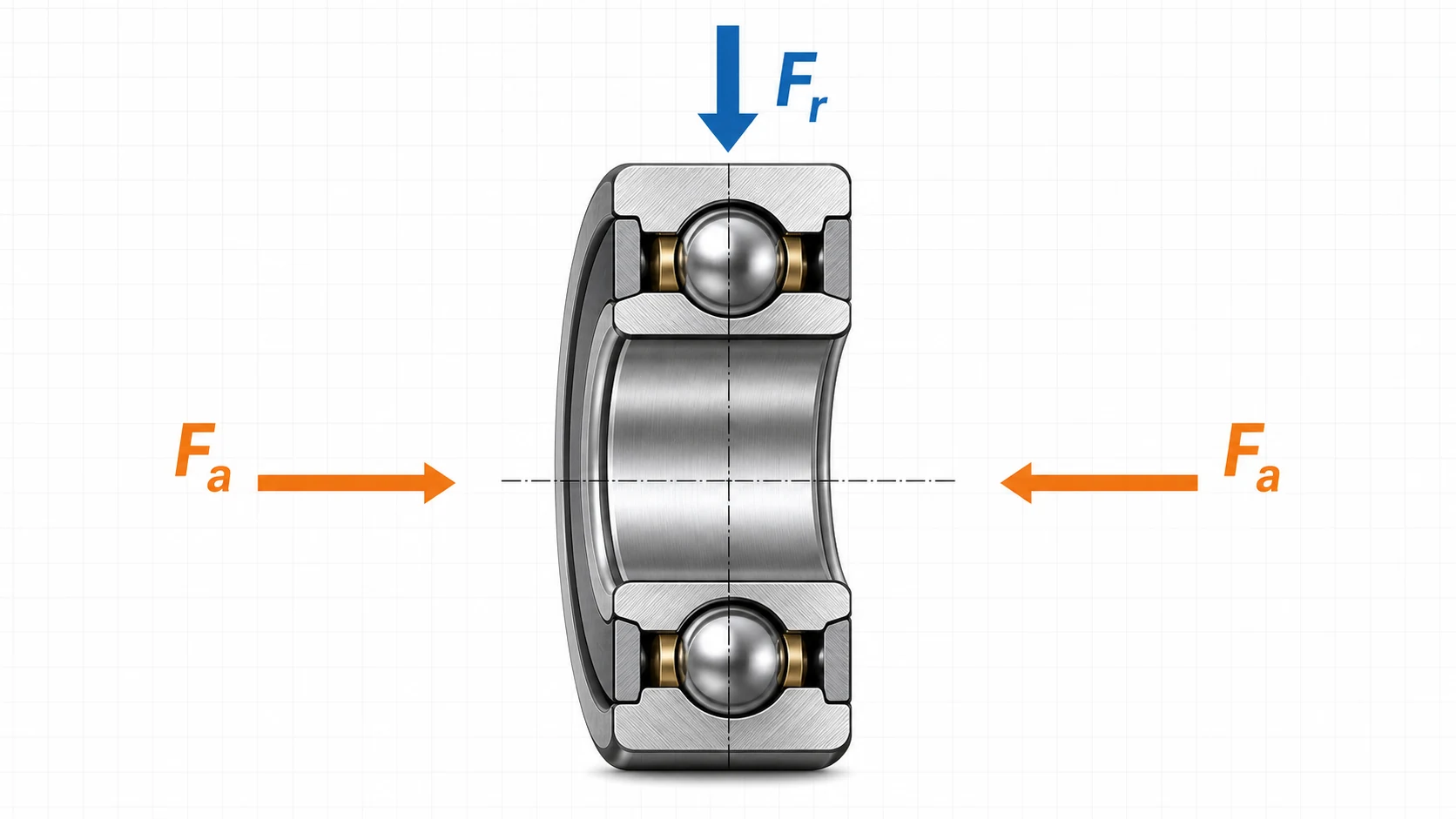
For combined radial and axial loads, the selection should be checked with the manufacturer catalog method. A common dynamic equivalent load form is:
Formula: P = XFr + YFa
Fr is radial load, Fa is axial load, and X and Y are catalog factors selected by bearing type, geometry, and load ratio. For deep groove ball bearings, P may be close to Fr when axial load is small. When the axial-to-radial load ratio becomes significant, the catalog threshold and X/Y factors must be checked.
For single-row radial deep groove ball bearings, axial load capacity is not a fixed percentage that applies to every size. It depends on bearing series, internal clearance, groove geometry, speed, lubrication, and the Fa/Fr ratio. Always check the catalog threshold and X/Y factors before treating axial load as acceptable.
If the application has continuous high axial load, heavy thrust, or a controlled preload requirement, do not force the selection into a deep groove bearing. Review single row angular contact ball bearings, thrust ball bearings, tapered roller bearings, or a paired bearing arrangement depending on the load direction and stiffness requirement.
Speed, Noise, and Friction Advantages
Deep groove ball bearings are often selected for high-speed and low-noise operation because their ball contact produces relatively low friction. This makes them useful in motors, fans, appliances, instruments, power tools, and other equipment where heat, noise, vibration, and energy loss matter.
Speed capability is not defined by bearing type alone. Seal type, grease, cage, clearance, preload, fit, load, temperature, and lubrication method can all change the practical speed limit. A non-contact shield may run with less friction than a contact seal, but it may also provide less protection against contamination. A contact seal may improve contamination resistance, but it can add seal drag and heat.
| Design Choice | Practical Tradeoff |
|---|---|
| Open bearing | Lower friction potential, but needs a clean environment and external lubrication control. |
| Shielded bearing | Helps protect against larger particles and retain grease with less drag than many contact seals. |
| Contact sealed bearing | Better contamination and grease retention, but more friction and heat than open or shielded options. |
| Higher internal clearance | May help where fits or temperature reduce operating clearance, but can affect noise and vibration. |
| Low-noise specification | Useful for motors and appliances, but must be matched with fit, grease, cleanliness, and handling. |
When Not to Use Deep Groove Ball Bearings
Do not use deep groove ball bearings when the application needs a bearing function they are not designed to provide. A deep groove bearing can be very useful in the right place, but it should not be stretched into a severe-duty bearing by habit.
Choose another bearing type or arrangement when the application has:
- High continuous axial load.
- Heavy shock or impact load.
- Severe radial load where a roller bearing is more suitable.
- Significant shaft misalignment or housing misalignment.
- Very high stiffness or controlled preload requirement.
- Predominantly thrust load.
- Poor mounting accuracy that cannot be corrected.
- Oscillation or very slow movement where static load and lubrication behavior dominate.
- Harsh contamination, washdown, corrosion, or high temperature beyond standard bearing and grease limits.
Self-aligning ball bearings or spherical roller bearings may be better when misalignment is unavoidable. Angular contact ball bearings may be better when axial load and stiffness are important. Cylindrical, tapered, or spherical roller bearings may be better for higher radial load. Thrust bearings may be better when the load is mainly axial.
| Application Need | Better Bearing Type to Review | Why |
|---|---|---|
| High continuous axial load | Angular contact ball bearing or thrust bearing | Better axial load capacity and axial stiffness. |
| Heavy radial load | Cylindrical roller, spherical roller, or tapered roller bearing | Higher radial load capacity. |
| Combined radial and high axial load | Angular contact pair or tapered roller bearing | Better combined-load control. |
| Misalignment cannot be corrected | Self-aligning ball bearing or spherical roller bearing | Designed to tolerate angular misalignment. |
| Mostly thrust load | Thrust ball bearing or thrust roller bearing | Designed for axial load as the main load. |
| Harsh contamination or washdown | Sealed bearing unit, stainless bearing, or special sealing arrangement | Standard closures may not be enough. |
Sealed, Shielded, or Open: Which Version Should You Use?
Choose the closure style based on contamination, lubrication, speed, heat, and maintenance access. The same bearing size can behave very differently depending on whether it is open, shielded, or sealed.
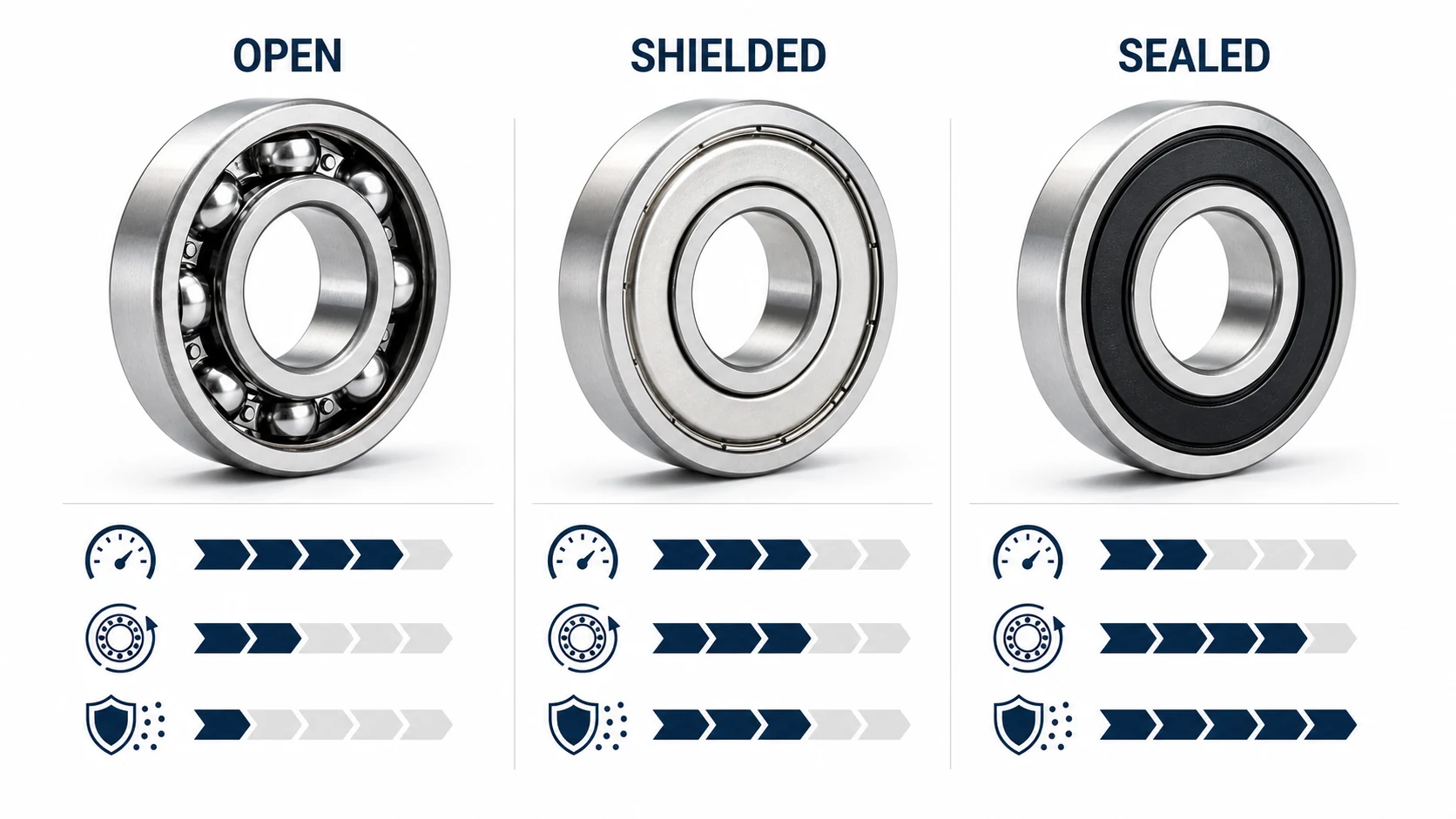
Open deep groove ball bearings are useful when the equipment provides clean lubrication and the environment is controlled. Shielded bearings are often selected for grease retention and moderate debris protection with relatively low drag. Contact sealed bearings are useful when contamination protection matters more, but the added seal friction should be considered in high-speed or heat-sensitive duty.
The closure choice should not be treated as an afterthought. Many early bearing failures are not caused by the basic bearing type. They are caused by the wrong seal choice, wrong grease, contaminated handling, poor storage, or operating conditions that the closure style cannot handle.
Closure suffixes are not identical across all manufacturers. For example, ZZ, 2RS, DDU, VV, LLU, or other suffixes may indicate different sealing structures depending on the manufacturer. Always confirm the supplier’s suffix table before replacing or substituting bearings.
Fit, Clearance, and Alignment Matter
Deep groove ball bearings are sensitive to poor fits, lost clearance, and misalignment. Even though they are robust for general machinery, they are not meant to hide a bad shaft, distorted housing, or cocked installation.
Interference fits can reduce internal clearance. Heat can change operating clearance. Misalignment can concentrate stress and raise noise or temperature. If the bearing runs hot immediately after startup, check grease fill, seal drag, shaft fit, housing fit, mounted clearance, and alignment before switching to a different bearing type.
For high-speed motors or noise-sensitive equipment, small handling and installation errors can matter. Clean handling, correct mounting tools, controlled press force, and proper storage are part of the bearing selection, not separate details.
A deep groove ball bearing is not a self-aligning bearing. If shaft or housing misalignment cannot be corrected, review self-aligning ball bearings or spherical roller bearings instead.
Quick Selection Examples
A small electric motor that runs at high speed, has mainly radial load, limited axial locating force, clean grease lubrication, controlled shaft and housing fits, and a low-noise requirement is a reasonable first review case for a sealed or shielded deep groove ball bearing.
A belt-driven pump with high belt tension, hydraulic thrust, heat, washdown, and repeated early bearing failures should not be selected only by bore size. The axial load, seal, grease, clearance, static load, and possible angular contact or paired arrangement should be reviewed before confirming a deep groove ball bearing.
Selection Checklist Before You Specify a Deep Groove Ball Bearing
Use a deep groove ball bearing only after the application data supports it. A good review starts with load direction and operating conditions, then moves into size and suffix details.
If you are not sure whether the axial load, speed, seal type, or clearance is suitable for a deep groove ball bearing, send CXE Bearing the bore size, Fr, Fa, rpm, temperature, lubrication method, and environment for a selection review.
| Selection Question | What to Confirm |
|---|---|
| What is the main load direction? | Mostly radial, combined radial/axial, or mostly axial. |
| How much axial load exists? | Whether the axial load is within catalog limits for the bearing and arrangement. |
| What is the speed range? | Whether bearing type, seal, grease, and clearance fit the speed. |
| What life is required? | Required C rating, equivalent dynamic load P, and target L10 or operating hours. |
| Is the bearing ever heavily loaded at rest? | Static load rating C0, equivalent static load P0, and static safety factor. |
| What is the environment? | Dust, water, chemicals, washdown, temperature, and storage risk. |
| How will it be lubricated? | Grease type, oil method, relubrication interval, and heat behavior. |
| What are the mounting conditions? | Shaft fit, housing fit, shoulders, alignment, and installation tools. |
| Is noise or vibration critical? | Precision, clearance, grease cleanliness, and handling requirements. |
When Not to Change the Bearing Type
Do not change from a deep groove ball bearing to another bearing type until the failure evidence supports the change. If the current bearing failed from contamination, poor mounting, wrong grease, excessive fit, electrical erosion, or misalignment, changing the bearing family may not solve the real problem.
Keep the deep groove bearing type under review when the application is fundamentally radial, high-speed, low-friction, compact, and well aligned. In that case, the better improvement may be a different seal, grease, clearance, cage, material, precision class, supplier quality level, or installation procedure rather than a completely different bearing family.
The useful engineering question is not “Is a deep groove ball bearing good?” The better question is: “Does this bearing type match the load direction, speed, environment, mounting accuracy, and life target of this specific position?”
RFQ Checklist for Deep Groove Ball Bearing Selection
Send these details when asking CXE Bearing to confirm a deep groove ball bearing selection:
- Existing bearing number and suffix, if replacing a current bearing.
- Bore, outside diameter, width, seal or shield type, and available space.
- Radial load
Fr, axial loadFa, and how those loads were estimated. - Speed range, duty cycle, and target service life.
- Whether axial load is constant, reversing, intermittent, or caused by startup conditions.
- Static load, shock load, transport vibration, or standstill load risks.
- Lubrication method, grease or oil type, relubrication practice, and temperature.
- Shaft fit, housing fit, clearance class, shoulders, and mounting method.
- Dust, water, washdown, chemicals, corrosion, or storage conditions.
- Noise, vibration, runout, or inspection requirements.
- Failure photos if the request is related to short service life.
With those details, CXE Bearing can help compare suitable deep groove ball bearing options by size series, seal or shield design, clearance, grease, cage, dynamic load rating, static load rating, speed limit, and application risk.
FAQ
Are deep groove ball bearings good for axial load?
Deep groove ball bearings can carry limited axial load in both directions when radial load remains the main load. For Fa/Fr ratio, X/Y factors, heat symptoms, and when to use angular contact or thrust bearings, use a dedicated deep groove ball bearing axial load review.
Are deep groove ball bearings good for high speed?
Yes, they are commonly used in high-speed applications because they have low friction compared with many heavier bearing types. The practical speed limit still depends on seal type, grease, clearance, load, temperature, and manufacturer data.
Should I use sealed or shielded deep groove ball bearings?
Use sealed bearings when contamination protection and grease retention are more important. Use shielded bearings when lower drag is important and the environment is less severe. Use open bearings when the machine provides clean lubrication and external sealing.
When should I choose another bearing instead?
Choose another bearing type when the application has high axial load, heavy shock, severe radial load, significant misalignment, high stiffness requirements, or predominantly thrust load. Deep groove ball bearings are versatile, but they are not universal.