
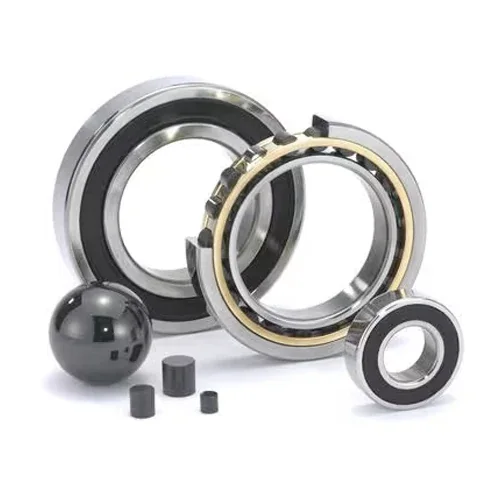
High-speed bearings are rolling bearings designed or selected to operate reliably when rotational speed, heat generation, lubricant behavior, cage stability, and internal clearance become critical. They are not defined by RPM alone. A small bearing at 30,000 rpm may be easier to manage than a much larger bearing at 10,000 rpm because rolling element speed, lubricant shear, and heat are very different.
The practical answer is this: a high-speed bearing is a bearing whose geometry, precision, cage, material, lubrication, sealing, clearance, and mounting arrangement are suitable for the required speed and temperature balance. If those details are wrong, a bearing with a high catalog speed can still overheat, make noise, damage grease, or fail early.
High Speed Is Not Just RPM
RPM is only the shaft speed. Bearing speed capability also depends on bearing size. Engineers often use a speed factor such as dmn or Dpw x n, where dm or Dpw is a representative bearing pitch diameter and n is speed in revolutions per minute.
That distinction matters because a larger bearing has rolling elements traveling a longer path at the same RPM. The bearing may see higher centrifugal effects, greater lubricant churning, and more heat even though the shaft speed looks identical.
| Speed Question | Why It Matters |
|---|---|
| What is the maximum RPM? | Defines the top operating condition, but not the full speed risk. |
| What is the bearing pitch diameter? | Larger bearings become harder to run at high speed. |
| Is the speed continuous or intermittent? | Short bursts and continuous duty create different heat loads. |
| Is there rapid acceleration or stop-start cycling? | Cage stability and lubricant behavior become more important. |
| Is the bearing grease- or oil-lubricated? | Lubrication method often controls the practical speed limit. |
| Are seals contacting the rings? | Contact seals add drag and heat at speed. |
For this reason, the best high-speed bearing selection starts from speed, size, load, lubrication, temperature, and mounting condition together.
Reference Speed vs Limiting Speed
Bearing catalogs may show different speed values, and they should not be treated as the same thing. A reference speed is generally related to thermal balance under defined reference conditions. A limiting speed is closer to a mechanical or practical operating boundary affected by cage design, lubrication, seals, heat, and bearing construction.
The catalog number is not permission to run every application at that speed. Real speed capability changes with load, grease fill, oil viscosity, seal drag, clearance, preload, heat dissipation, shaft fit, housing fit, ambient temperature, contamination, and installation accuracy.
Use catalog speed data as a screening value, then confirm the actual operating condition.
Common Types of High-Speed Bearings
High-speed applications can use several bearing families. The right choice depends on the load direction, stiffness requirement, speed factor, lubrication method, and environment.
| Bearing Type | Where It Fits | Main Advantage | Main Caution |
|---|---|---|---|
| Deep groove ball bearings | Motors, fans, blowers, pumps, light-duty high-speed shafts | Low friction, compact design, good availability | Limited axial stiffness and limited tolerance for misalignment. |
| Angular contact ball bearings | Spindles, precision motors, pumps with thrust, high-stiffness shafts | Handles combined radial and axial load with defined contact angle | Requires correct orientation, preload, pairing, and heat control. |
| Super-precision spindle bearings | Machine tool spindles, grinding spindles, precision equipment | High running accuracy and controlled stiffness | Sensitive to preload, lubrication, contamination, and mounting accuracy. |
| Hybrid ceramic bearings | High-speed motors, EV motors, electrical-risk applications, low-friction upgrades | Ceramic balls can reduce centrifugal load and interrupt electrical current paths | Higher cost; rings, cage, grease, and mounting still control final performance. |
| Thin-section ball bearings | Compact high-speed assemblies with limited space | Low mass and compact envelope | Load capacity and stiffness must be checked carefully. |
| Full ceramic bearings | Special electrical, corrosion, vacuum, non-magnetic, or chemical environments | Corrosion and electrical advantages in selected applications | Not the default upgrade for normal high-speed machinery. |
For most general high-speed rotating equipment, deep groove ball bearings and angular contact ball bearings are the first two families to review. Hybrid ceramic bearings become more attractive when speed, heat, electrical insulation, or seizure resistance is a major concern.
What Makes a Bearing Suitable for High Speed?
A high-speed bearing is a system, not just a part number. The bearing has to manage motion, load, heat, and lubricant behavior at the same time.
Precision and Raceway Quality
High speed magnifies geometric errors. Raceway waviness, ball variation, poor roundness, and rough surfaces can become noise, vibration, heat, or unstable motion. Precision class can matter, but it is not the only quality factor. Clean assembly, raceway finish, ball grade, internal geometry, and inspection also affect high-speed performance.
Cage Design
The cage separates and guides the rolling elements. At high speed, cage stability becomes more important because the cage experiences centrifugal force, lubricant drag, and repeated contact with rolling elements or guide surfaces. Steel cages, brass cages, phenolic cages, and engineered polymer cages can all be used depending on speed, temperature, lubrication, and bearing type.
A cage problem may appear as noise, wear particles, heat, vibration, or sudden failure. Do not select a high-speed bearing without confirming the cage material and guidance method.
Lubrication
Lubrication often determines the practical speed limit. Grease is convenient and common, but at high speed the wrong grease or too much grease can churn, heat, purge, or break down. Oil lubrication can remove heat better in many high-speed systems, but it requires the correct method and delivery control.
Common lubrication methods include:
| Lubrication Method | Best Fit | Watch Point |
|---|---|---|
| Grease lubrication | Motors, fans, sealed bearings, moderate high speed | Grease type, fill quantity, thickener, base oil viscosity, noise behavior. |
| Oil bath | Gearboxes and some enclosed systems | Churning loss can rise if oil level is too high. |
| Oil mist | Some high-speed industrial systems | Requires controlled delivery and clean air/oil management. |
| Oil-air lubrication | Spindles and precision high-speed equipment | Good control of oil quantity; needs proper equipment. |
| Oil jet lubrication | Very high-speed or heat-critical systems | More complex, used when heat removal is critical. |
If a high-speed bearing runs hot, first check lubricant type, lubricant quantity, seal drag, and installed clearance before assuming the bearing material is wrong.
Clearance and Preload
Internal clearance changes after mounting. Shaft fits, housing fits, operating temperature, and thermal expansion can reduce clearance. A bearing that feels correct before installation can become tight in operation.
Preload can improve stiffness and running accuracy, especially in angular contact bearing arrangements. But preload also raises contact force and heat. Too much preload is one of the fastest ways to make a high-speed bearing overheat.
Seals and Shields
Contact seals protect against contamination but add drag. Shields and non-contact seals usually run cooler but do not protect as well against water or fine contamination. In high-speed applications, the closure choice should be made from the actual environment, not from habit.
Clean spindle or motor applications may prefer open, shielded, or non-contact designs. Dirty or wet equipment may require seals, but speed and heat must be checked.
Material Choices for High-Speed Bearings
Material selection should start from speed, load, temperature, corrosion, lubrication, and electrical conditions. The most common bearing ring material for many high-speed ball bearings is high-carbon chromium bearing steel. Stainless steel bearings may be selected when corrosion matters. Hybrid ceramic designs use steel rings with ceramic rolling elements, often for high speed or electrical insulation needs.
| Material Option | When It Helps | Boundary |
|---|---|---|
| Chrome bearing steel | General high-speed bearings with good load capacity | Needs proper lubrication and corrosion control. |
| Stainless steel | Moisture, mild corrosion, washdown, medical or food-adjacent equipment | May not match chrome steel load capacity in every design. |
| Hybrid ceramic | High speed, electrical insulation, low friction, poor lubrication resistance | Does not fix wrong preload, bad grease, misalignment, or contamination. |
| Full ceramic | Special corrosion, non-magnetic, electrical, or chemical applications | Application-specific; not a universal high-speed replacement. |
The common mistake is to treat ceramic as automatically better. Ceramic balls can help in the right design, but the rings, cage, lubricant, fit, heat path, and load still decide whether the bearing works.
Where Are High-Speed Bearings Used?
High-speed bearings appear in equipment where rotational speed, low friction, low heat, and stable motion are important.
| Application | Common Bearing Direction |
|---|---|
| Electric motors | Deep groove, low-noise, insulated, or hybrid ceramic bearings. |
| EV and e-mobility motors | High-speed deep groove or hybrid ceramic bearings. |
| Machine tool spindles | Super-precision angular contact bearing sets. |
| Dental and medical handpieces | Miniature high-speed precision bearings. |
| Turbochargers and small turbines | Specialized high-speed bearing systems. |
| Fans and blowers | Low-friction ball bearings with grease, shield, and noise control. |
| Pumps and compressors | Deep groove or angular contact bearings depending on thrust. |
| Robotics and precision instruments | Miniature, thin-section, or precision angular contact bearings. |
Different applications fail in different ways. A fan bearing may fail from grease aging or imbalance. A spindle bearing may fail from preload, contamination, or lubrication error. An inverter motor bearing may fail from electrical erosion. A pump bearing may fail from axial thrust. The bearing type should match the failure risk.
Field Scenario: A High-Speed Motor Bearing Runs Hot
A maintenance team replaces a motor bearing with the same basic size. The new bearing runs quietly at first, then heats up near top speed. The first reaction is to ask for a more expensive high-speed bearing.
The better review starts with the complete bearing condition. Does the new bearing have contact seals where the original had shields? Was it filled with too much grease? Did the shaft fit reduce clearance? Is the motor inverter-driven? Is there axial preload from the assembly? Did the fan, coupling, or belt alignment change?
If the raceway shows washboard-like fluting, electrical current may be involved. If the bearing shows heat discoloration and grease stress without electrical marks, lubricant, seal drag, clearance, fit, and preload should be reviewed first. Changing to ceramic or angular contact bearings without finding the cause may only move the failure to a new part.
Common Failure Modes in High-Speed Bearings
High-speed bearing failures often leave useful evidence. Inspect the old bearing before choosing a replacement.
| Evidence | Possible Cause | What to Review |
|---|---|---|
| Heat discoloration | Excess friction, insufficient heat removal, preload, wrong lubricant | Grease/oil, clearance, preload, fit, speed factor. |
| Grease leakage or hard grease | Overfilling, high temperature, incompatible grease, aging | Grease type, fill quantity, operating temperature. |
| Cage wear or cage fracture | Cage instability, poor lubrication, acceleration, misalignment | Cage design, lubricant flow, mounting accuracy. |
| Smearing or skidding marks | Poor load condition, acceleration, low load at high speed, lubrication problem | Minimum load, lubricant film, bearing type, preload. |
| Fluting or frosting | Electrical erosion | Insulated or hybrid bearing, grounding, drive system. |
| Noise after installation | Contamination, handling damage, fit error, preload | Clean mounting, shaft/housing fit, raceway condition. |
Failure analysis does not need to be complicated at the first stage. Photograph the raceways, cage, grease, seals, and shaft seats before discarding the bearing. That evidence can prevent the wrong replacement choice.
How to Choose a High-Speed Bearing
Use a selection sequence instead of choosing by the highest catalog RPM.
- Define the machine: motor, spindle, fan, pump, turbine, medical tool, robot, or instrument.
- Confirm speed: maximum rpm, continuous rpm, acceleration, start-stop frequency, and duty cycle.
- Calculate or estimate speed factor: bearing pitch diameter times rpm.
- Define loads: radial load, axial load, belt tension, rotor weight, thrust, shock, and minimum load.
- Select bearing family: deep groove, angular contact, hybrid ceramic, precision spindle, thin-section, or special design.
- Check lubrication: grease, oil bath, oil-air, oil mist, oil jet, relubrication, and cooling.
- Confirm cage: material, guidance method, speed suitability, temperature limit, and lubricant compatibility.
- Review clearance or preload: installed clearance, thermal reduction, preload target, locating/floating arrangement.
- Check closures: open, shielded, non-contact seal, contact seal, or external sealing.
- Confirm material and electrical risk: chrome steel, stainless, hybrid ceramic, full ceramic, insulated bearing, grounding.
- Validate with catalog data: load rating, reference speed, limiting speed, temperature guidance, lubrication limits.
This process is slower than choosing a bearing by size, but it prevents the most common high-speed failure: a bearing that fits dimensionally but cannot manage the heat and motion of the application.
When Not to Use a High-Speed Bearing Upgrade
A high-speed bearing upgrade is not always the right answer. If the current bearing overheats because of wrong grease, overfilling, contact seal drag, tight fit, too much preload, misalignment, contamination, or bearing current, a higher-spec bearing may still fail.
Do not change bearing type until these points are checked:
- The shaft and housing fits are correct.
- Operating clearance or preload is understood.
- Lubrication type and quantity match the speed.
- The closure style matches both speed and environment.
- The bearing is mounted cleanly and squarely.
- Electrical damage has been ruled in or out.
- The load direction and axial thrust are known.
The safest upgrade is based on the failure mechanism, not on price or material alone.
RFQ Checklist for High-Speed Bearings
Send these details when asking CXE Bearing to recommend or quote a high-speed bearing:
- Bearing number and suffix, if replacing an existing bearing.
- Bore, outside diameter, width, and available space.
- Maximum speed, normal speed, acceleration, and duty cycle.
- Radial load, axial load, belt load, thrust load, and shock load.
- Bearing position: locating end, floating end, paired set, preload-controlled assembly.
- Required precision, noise, vibration, or runout level.
- Lubrication method: grease, oil, oil-air, oil mist, oil jet, relubrication interval.
- Seal or shield requirement and contamination exposure.
- Clearance class or preload requirement.
- Shaft fit, housing fit, operating temperature, and cooling condition.
- Material preference: chrome steel, stainless steel, hybrid ceramic, full ceramic, insulated.
- Failure photos if replacing a failed bearing.
With this information, CXE Bearing can compare bearing families instead of guessing from RPM.
FAQ
What is considered a high-speed bearing?
A high-speed bearing is a bearing selected or designed so that speed, heat, lubrication, cage stability, clearance, and load remain controlled at the required operating rpm. There is no single universal RPM that makes every bearing “high speed.”
Are high-speed bearings always ceramic?
No. Many high-speed applications use precision steel deep groove or angular contact ball bearings. Hybrid ceramic bearings are useful when speed, electrical insulation, low friction, or seizure resistance justifies the design and cost.
Why do high-speed bearings overheat?
Common causes include excess grease, wrong lubricant viscosity, contact seal drag, too much preload, reduced operating clearance, poor fits, contamination, high axial load, cage instability, or electrical erosion.
Are shielded bearings better than sealed bearings at high speed?
Shielded or non-contact designs often run cooler because they create less drag, but they protect less against water and fine contamination. The best choice depends on speed, environment, heat limit, and maintenance plan.
Which bearing type is best for high-speed applications?
Deep groove ball bearings are common for motors and fans. Angular contact bearings are better when axial load, preload, and stiffness matter. Hybrid ceramic bearings help in selected high-speed or electrical-risk applications. Spindle bearings are used for precision machine tools.
Can I replace a standard bearing with a high-speed version?
Sometimes, but the replacement must match dimensions, load, clearance, cage, lubrication, seal style, material, and mounting conditions. If the original failure was caused by installation or lubrication, changing to a high-speed version may not solve the problem.
Conclusion
High-speed bearings are defined by operating conditions, not by a single RPM number. Speed factor, lubrication, cage stability, heat generation, clearance, preload, material, and sealing all decide whether a bearing can run reliably.
For high-speed bearing selection, start with the machine, speed range, load direction, lubrication method, temperature, and failure evidence. Then compare deep groove, angular contact, hybrid ceramic, spindle, stainless, or special bearing designs against the full operating condition.