
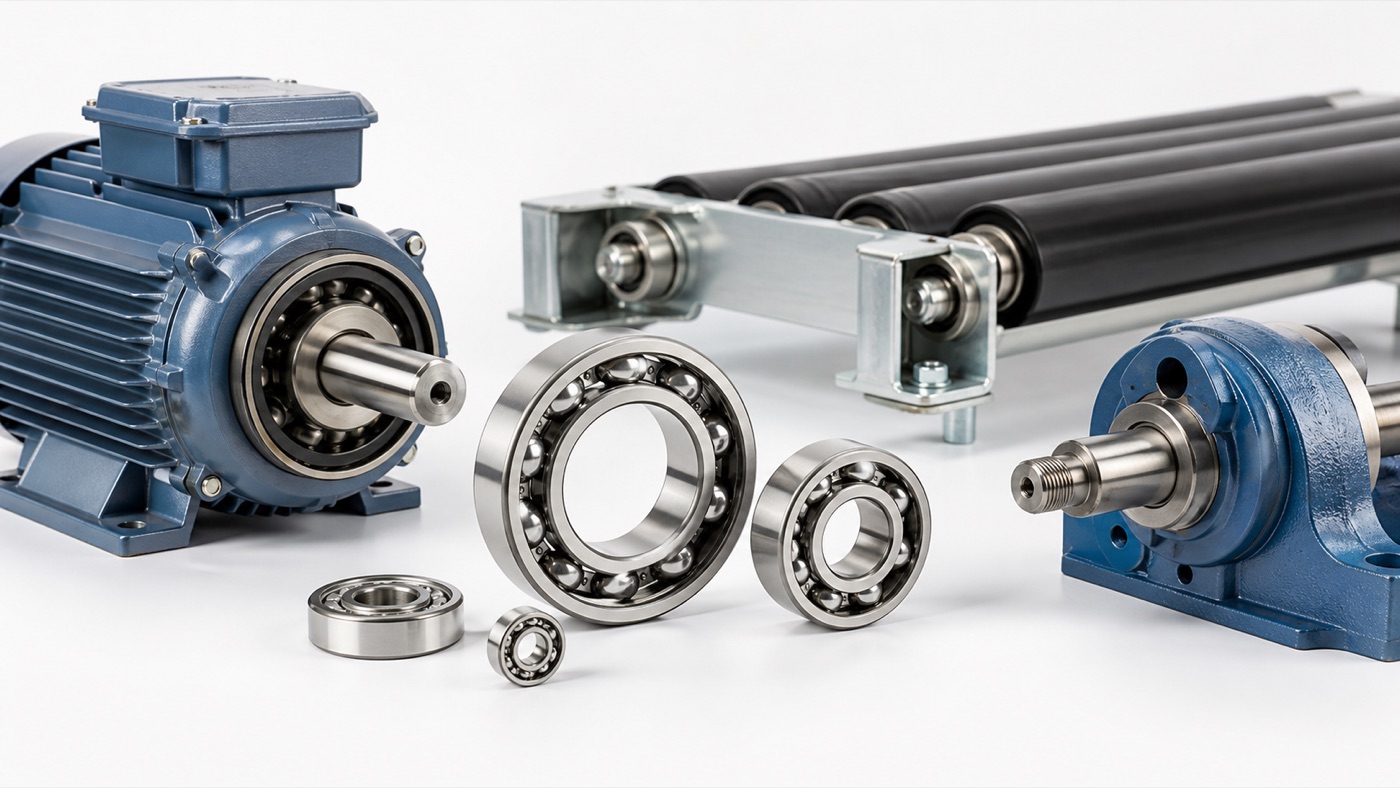
Bearings are used anywhere a machine part needs to move while still being supported.
You can find bearings in electric motors, wheels, conveyors, pumps, fans, gearboxes, bicycles, power tools, packaging machines, agricultural equipment, and many other products. Their job is usually simple to describe:
Bearings help moving parts turn, slide, or roll with less friction and less wear.
The details change from machine to machine. A tiny bearing in a small motor does not have the same job as a bearing inside a conveyor roller or a pump. But the basic purpose is the same: support motion under load.
Common Places Bearings Are Used
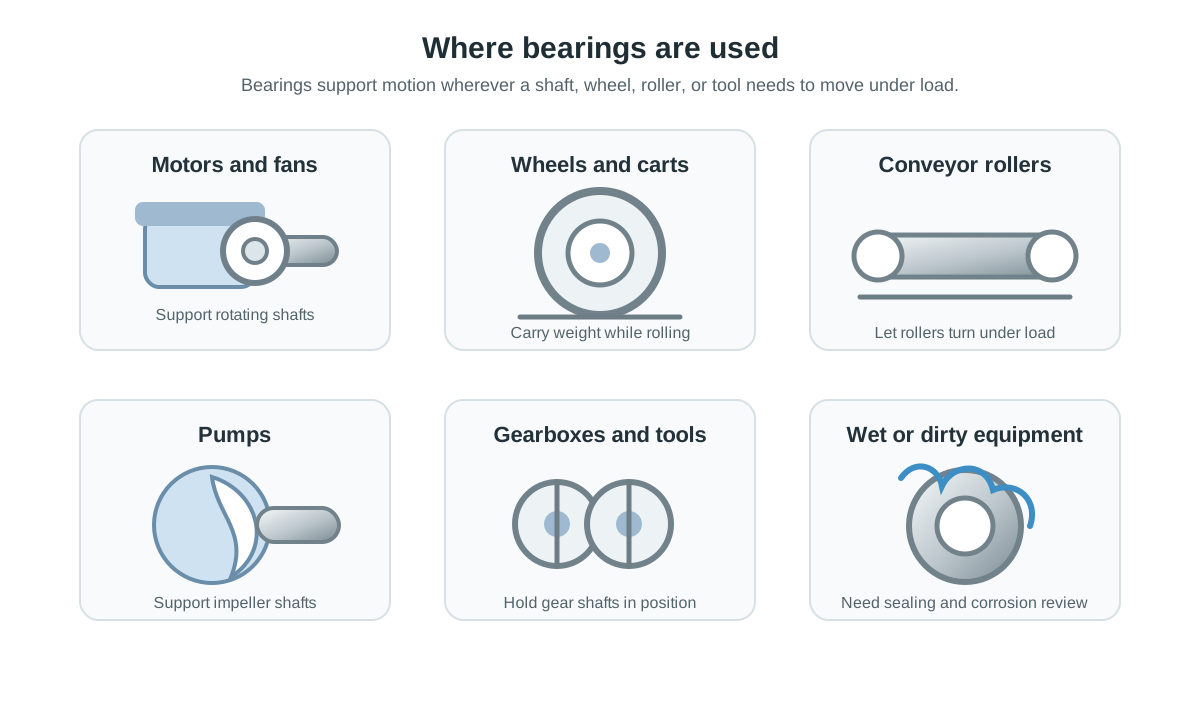
If a part rotates, rolls, swings, or slides, there is a good chance a bearing is involved.
| Machine or Product | What the Bearing Helps Do |
|---|---|
| Electric motors | Supports the rotor shaft so it can spin smoothly. |
| Fans and blowers | Lets the impeller or fan wheel rotate with less friction. |
| Conveyor rollers | Supports rollers that carry boxes, parts, or material. |
| Pumps | Supports the shaft and helps control radial or axial load. |
| Wheels and carts | Lets the wheel rotate around an axle. |
| Gearboxes | Supports shafts that carry gears. |
| Power tools | Supports high-speed shafts, spindles, and gears. |
| Agricultural machines | Supports rotating discs, wheels, rollers, and shafts. |
| Food and packaging equipment | Supports moving parts near moisture, cleaning, or contamination risk. |
| Robots and small instruments | Helps control precise motion in compact assemblies. |
This is why the word “bearing” can mean many things. The right bearing depends on the machine position, not only the bearing size.
Motors and Fans
Motors are one of the easiest places to understand bearing use. A motor has a shaft that spins. The shaft must stay supported while the rotor turns inside the motor body.
Bearings help the rotor spin smoothly and keep it in the correct position. In many standard motors and fans, deep groove ball bearings are a common starting point because they are compact and suitable for many radial-load positions.
For a motor, the buyer should not only ask for a number such as 6203 or 6205. The suffix, seal type, grease, clearance, speed, noise requirement, and operating temperature can also matter.
Wheels, Rollers, and Conveyors
Wheels and rollers need bearings because the wheel or roller must turn while carrying weight.
A cart wheel carries weight from above. A conveyor roller may carry boxes, parts, or packaged goods. A guide roller may keep material moving in the right direction.
In these applications, the bearing often has to deal with:
- radial load from weight
- dust or dirt
- occasional impact
- water or cleaning exposure
- long running time
- easy replacement needs
The best bearing is not always the one that spins most freely in your hand. A bearing for a dirty conveyor may need better sealing. A bearing for a wet area may need better corrosion resistance. A bearing for a heavy roller may need a different bearing family.
Pumps and Shafts
Pumps use bearings to support the rotating shaft. The shaft may carry the impeller, coupling, and other rotating parts.
Pump bearings can see side load and thrust load. This is one reason pump bearing problems are not always solved by replacing the same size again. If the shaft alignment, lubrication, seal leakage, or thrust direction is wrong, the new bearing may fail in the same way.
For pump applications, it helps to describe the bearing position, speed, lubrication method, and failure marks. CXE Bearing also has a separate guide on selecting bearings for centrifugal pumps when the application needs a more detailed review.
Gearboxes and Reducers
Gearboxes use bearings to hold gear shafts in position. The gears push on the shafts as they transmit torque. That force becomes load on the bearings.
Different gear designs create different load directions. Some positions mainly need radial support. Others also need axial support. A gearbox may also need one bearing position to locate the shaft and another position to allow small thermal movement.
For a gearbox RFQ, the bearing number is useful, but the shaft position and load direction are also important.
Food, Packaging, and Wet Equipment
Bearings used near water, cleaning, packaging dust, or food production areas may need extra attention. The main concerns are corrosion, contamination, seal performance, grease retention, and easy cleaning.
In these environments, buyers may review stainless steel bearings, sealed bearings, polymer parts, or special housing designs. The right choice depends on the exact exposure. “Stainless” alone does not answer every question because seals, grease, cage material, and housing design also affect performance.
Tools, Instruments, and Small Equipment
Small machines often use small bearings. Examples include power tools, dental tools, office equipment, small motors, measuring devices, and compact automation.
These bearings may not carry heavy load, but they may need:
- low noise
- smooth rotation
- compact size
- controlled runout
- clean grease
- good sealing for the application
For small equipment, a tiny change in seal drag, grease, or precision can affect the feel of the machine.
Agricultural and Outdoor Equipment
Agricultural equipment often works in dust, soil, moisture, shock, and outdoor storage. Bearings may be used in disc harrows, planters, rollers, wheels, pulleys, and mounted units.
The bearing is not only selected for smooth rotation. It also needs to survive dirt, water, impact, and maintenance conditions. Sealing and housing protection may matter more than a high precision class.
How to Choose a Bearing by Use
Start with the job the bearing must do.
| If the machine needs… | Start by reviewing… |
|---|---|
| General shaft rotation | Deep groove ball bearings |
| Heavy radial load | Roller bearings |
| Load along the shaft | Thrust or angular contact bearings |
| Limited radial space | Needle or thin-section bearings |
| Wet or corrosive environment | Stainless, sealed, or corrosion-resistant options |
| Very small equipment | Miniature or instrument bearings |
| Mounted shaft support | Pillow block or flange bearing units |
This table is only a starting point. Final selection still depends on load, speed, size, lubrication, fit, temperature, sealing, and the surrounding machine.
Questions to Ask Before Buying a Bearing
If you are new to bearings, these questions are more useful than guessing from appearance:
- What machine is the bearing used in?
- Does the part rotate, roll, slide, or support a shaft?
- Is the load mainly across the shaft or along the shaft?
- What are the bore, outside diameter, and width?
- Is the bearing open, shielded, or sealed?
- Does the area have water, dust, chemicals, heat, or outdoor exposure?
- Is the machine high speed or low speed?
- Was the old bearing noisy, hot, rusty, loose, or seized?
- Do you have photos of the old bearing and where it was installed?
These details help the CXE Bearing team understand the application instead of only matching a part number.
Common Mistakes
The first mistake is thinking all bearings with the same size are the same. They are not. Seal type, clearance, grease, cage, material, and precision can all change how the bearing works.
The second mistake is ignoring the load direction. A bearing that works well for radial load may not be right for strong axial thrust.
The third mistake is choosing the smoothest free-spinning bearing for a dirty or wet machine. In a real application, protection may matter more than hand feel.
The fourth mistake is replacing a failed bearing without checking why it failed. Misalignment, contamination, wrong grease, tight fit, shaft damage, housing damage, overload, or wrong installation can damage a correct bearing.
FAQ
What are bearings used for in simple words?
Bearings are used to support moving parts and reduce friction. They help shafts, wheels, rollers, fans, motors, and other machine parts move smoothly under load.
What products use bearings?
Motors, wheels, conveyors, pumps, fans, gearboxes, tools, agricultural machines, bicycles, robots, and packaging equipment all use bearings.
Are bearings only used for rotation?
No. Many bearings support rotation, but some bearings support linear motion, oscillating motion, or axial thrust.
Why are there so many bearing types?
Different machines create different loads, speeds, spaces, environments, and motion requirements. A bearing for a motor may not be right for a conveyor roller, pump, or wet processing area.
Can I choose a bearing by size only?
Not safely. Size is important, but you should also check bearing type, seal, clearance, material, grease, load direction, speed, and environment.
Conclusion
Bearings are used to help machines move smoothly while carrying load. They are found in everyday products and industrial equipment because moving parts need support, friction control, and protection from wear.
For buyers, the best starting point is not only the bearing number. Start with the machine, the bearing position, the load direction, and the working environment. That makes it much easier to choose a bearing that fits the application, not just the shaft.