
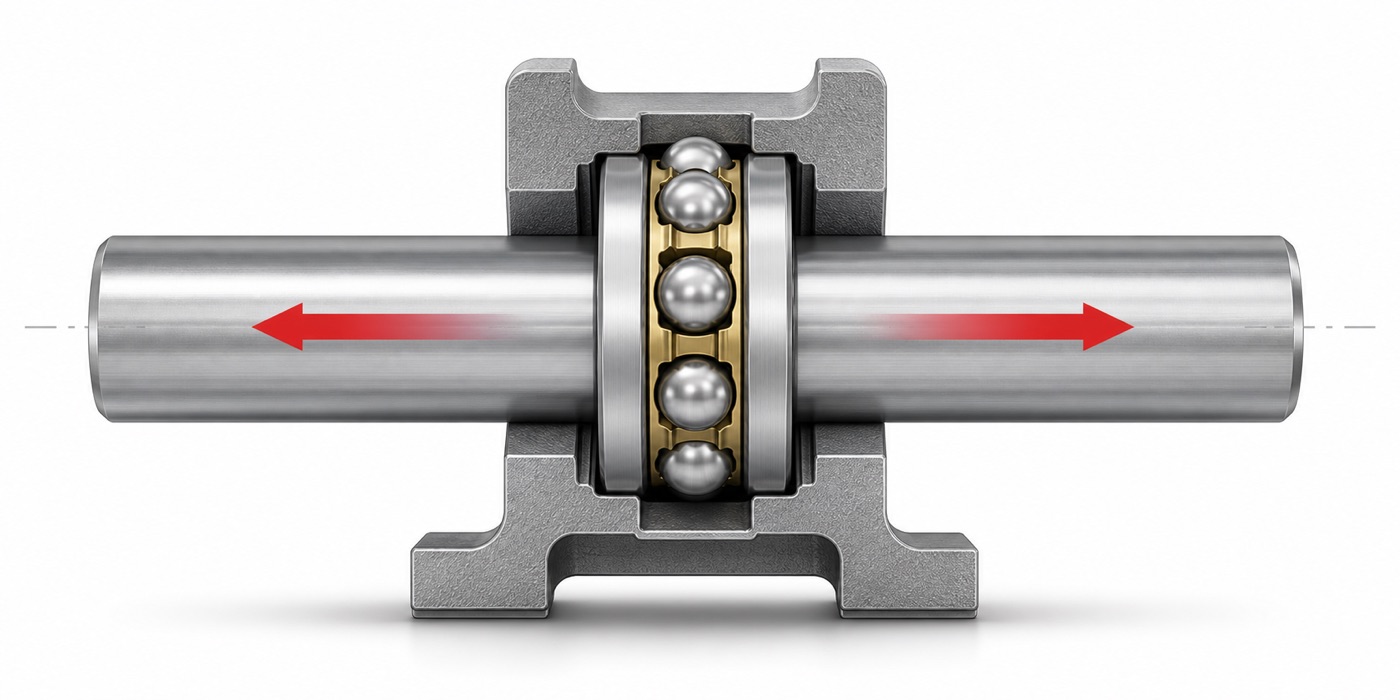
When a shaft wants to move lengthwise, the bearing arrangement has to stop that movement without creating heat, rubbing, or uncontrolled endplay. That is the real job of a thrust bearing.
Most buyers first search by product name: thrust bearing, thrust ball bearing, thrust roller bearing, axial bearing, or bearing thrust washer. That is understandable, but it is not the safest way to select the part. The better starting point is the load path: where the axial force comes from, which direction it acts, whether it reverses, and which bearing in the machine is supposed to control shaft position.
A thrust bearing is not simply “a bearing for vertical shafts.” It can appear in a pump, gearbox, screw jack, clutch release system, rotary table, crane hook, antenna mast, marine shaft line, or heavy industrial drive. In practical selection work, the families that most often need to be separated are thrust ball bearings, needle roller thrust bearings, cylindrical roller thrust bearings, tapered roller thrust bearings, and spherical roller thrust bearings.
This guide is organized as a selection path. Read the machine first, then narrow the thrust bearing type.
Start With the Force Pushing the Shaft
Axial load is force acting along the shaft centerline. A thrust bearing supports that force while allowing rotation.
In the field, axial load usually comes from one of these sources:
| Source of Axial Force | Common Machine Example | Why the Bearing Choice Changes |
|---|---|---|
| Helical gears | Gearboxes and reducers | Gear tooth angle creates side thrust that must be located by the shaft arrangement. |
| Screw motion | Ball screws, lead screws, screw jacks | The bearing may need stiffness, low endplay, and support for reversing force. |
| Hydraulic or air pressure | Pumps, fans, blowers, compressors | Thrust can vary with operating condition and may load one end of the shaft heavily. |
| Vertical shaft weight | Vertical motors, pumps, turntables | The bearing may carry dead weight plus operating thrust. |
| Actuation force | Clutch release bearings, presses, mechanisms | Load may be intermittent but high during engagement. |
| Process or handling load | Rotary tables, cranes, indexing equipment | Shock load, moment load, and uneven support can matter as much as catalog load rating. |
If the machine drawing or maintenance record shows which bearing is the locating bearing, start there. If that information is missing, inspect the shaft shoulders, locknuts, spacers, housing seats, and wear marks. A thrust bearing often fails because the surrounding arrangement changed, not because the bearing name was wrong.
Axial Only or Combined Load?
The first decision is whether the bearing is carrying pure axial load or a mix of axial and radial load.
Standard thrust ball bearings are designed for axial load and should not be used as radial-load bearings. Many needle and cylindrical roller thrust bearings also need separate radial support. If the shaft is also carrying belt pull, gear mesh radial load, rotor weight, pulley load, or overhung load, another bearing in the arrangement must handle that radial force.
Some thrust bearing families are more tolerant of combined loading. Spherical roller thrust bearings can carry heavy axial load and also accommodate some radial load when axial load is present. Tapered roller arrangements may also be used where combined loads are part of the design. These are not casual substitutions; they require catalog review, correct support geometry, and suitable lubrication.
Use this early filter:
| Load Situation | Better Starting Point |
|---|---|
| Axial load only, light to moderate, speed matters | Thrust ball bearing. |
| Axial load only, very limited axial height | Needle roller thrust bearing with suitable washers or raceways. |
| Axial load only, high stiffness or heavier load | Cylindrical roller thrust bearing. |
| Heavy axial load with shock or special equipment arrangement | Tapered roller thrust bearing or spherical roller thrust bearing. |
| Heavy axial load with shaft deflection or housing misalignment | Spherical roller thrust bearing. |
| High-speed precision positioning | Axial angular contact ball bearing or paired angular contact arrangement. |
| Very large high-speed turbomachinery | Fluid-film or tilting-pad thrust bearing, usually OEM-designed. |
This table is a starting point, not a final selection. Bearing series, dimensions, load rating, speed, lubrication, cage, internal geometry, shaft support, and housing support still decide the final part.
How a Rolling Thrust Bearing Controls Position
A rolling-element thrust bearing transfers axial force through washers and rolling elements.
In a thrust ball bearing, a shaft washer, a housing washer, and a ball-and-cage assembly form the basic load path. The shaft washer is usually located against the rotating shaft or shaft shoulder. The housing washer is supported by the stationary housing. The ball set rolls between the raceways so the shaft can rotate while axial force is carried.
If the application needs a compact rolling thrust bearing and the load is primarily axial, CXE Bearing can review options such as three-part thrust ball bearings when the washer arrangement, bore, outside diameter, and height are confirmed.
In a thrust roller bearing, the rolling elements are rollers instead of balls. Rollers create line contact, so they are often used when axial load or stiffness requirements are higher. That extra capacity usually comes with stricter requirements for alignment, washer support, lubrication, speed, and heat control.
Needle roller thrust bearings are a special compact case. They can be very thin, but they are unforgiving if the surrounding raceways are soft, rough, or distorted. If the machine uses its own shaft face or housing face as a raceway, that surface must be suitable for rolling contact. Otherwise, a complete assembly with matching thrust washers may be safer. For compact axial-space designs, compare the thrust requirement with the broader needle roller bearings family before assuming the cage-and-roller assembly alone is enough.
Plain thrust washers work differently. They support axial load by sliding contact. They can be useful in low-speed, oscillating, dirty, compact, or cost-sensitive mechanisms, but they are not interchangeable with rolling thrust ball or roller bearings without reviewing friction, wear, lubrication, and temperature.
Single Direction, Double Direction, and Reversing Thrust
Single direction thrust bearings support axial load in one direction. Double direction thrust bearings support axial load in both directions.
This seems basic, but it is one of the most common replacement traps. A single direction thrust ball bearing may fit the shaft and housing, but it cannot locate a shaft when thrust reverses. A double direction arrangement usually includes a central shaft washer and two rolling element assemblies. If that center washer, spacer, or locknut is omitted during repair, the shaft may move even though the new bearing looks correct.
Ask three questions before replacing any thrust bearing:
- Does the axial load act in one direction or both directions?
- Does the machine need controlled endplay or preload?
- Which component prevents the shaft from walking during startup, shutdown, or reverse operation?
Screw drives, clutches, rotary tables, and gearboxes often make this question more important than the bearing name.
Choose by Machine Situation
Pump or Vertical Shaft
A pump or vertical shaft often needs thrust control because hydraulic force and rotor weight act along the shaft. A thrust ball bearing may work in lighter duty, while spherical roller thrust bearings or angular contact arrangements may be reviewed in heavier or more demanding machines.
The key is to identify whether the thrust is constant, intermittent, reversing, or affected by operating condition. Also check how radial load is supported. A thrust bearing forced to handle both shaft location and radial support without the proper arrangement can overheat quickly.
Gearbox
Helical gears create axial force. That force has to pass through the shaft, locating shoulders, bearing, housing, and fasteners. If a gearbox repeatedly damages a thrust bearing, look beyond the bearing itself. Gear mesh, shaft endplay, housing stiffness, oil level, spacer condition, and shaft alignment can all affect the load path.
Needle roller thrust bearings, cylindrical roller thrust bearings, tapered roller thrust arrangements, and angular contact arrangements may all appear in gear-related equipment. The best choice depends on how the gearbox already supports radial load and axial location.
Screw Jack, Ball Screw, or Actuator
Screw mechanisms convert rotation into axial force, so thrust bearing stiffness and endplay control can become more important than general load capacity. Precision systems may use angular contact thrust ball bearings or paired angular contact bearings rather than a loose general thrust bearing.
For a replacement, do not change the arrangement until you understand preload, endplay, locknut position, spacer stack, and mounting sequence. A bearing that is dimensionally similar can still change stiffness or heat behavior.
Rotary Table or Turntable
A rotary table may place axial load, moment load, and radial guidance into the same assembly. A simple thrust bearing may support the downward load, but another bearing or guide surface may be needed to control radial movement and tilting moment.
Flatness matters here. A thrust bearing mounted against an uneven support surface can show edge loading even when the catalog load rating looks adequate.
Automotive or Clutch-Related Equipment
Automotive thrust bearing searches often lead to clutch release bearings, throwout bearings, transmission thrust washers, and tapered roller thrust arrangements. These parts are application-specific. Matching only dimensions may miss release travel, seal design, grease, temperature, noise, and fit.
For industrial purchasing, treat automotive-style thrust parts as a separate replacement path unless the bearing number and application are confirmed.
Large Marine or Turbomachinery Equipment
Large ships, turbines, compressors, and power equipment may use fluid-film or tilting-pad thrust bearings instead of standard rolling-element bearings. These designs support axial load on an oil film and are normally tied to the machine lubrication and monitoring system.
This category is important for understanding the word “thrust,” but it should not be mixed with standard rolling bearing selection unless the product family is confirmed.
Thrust Bearing Families in Plain Language
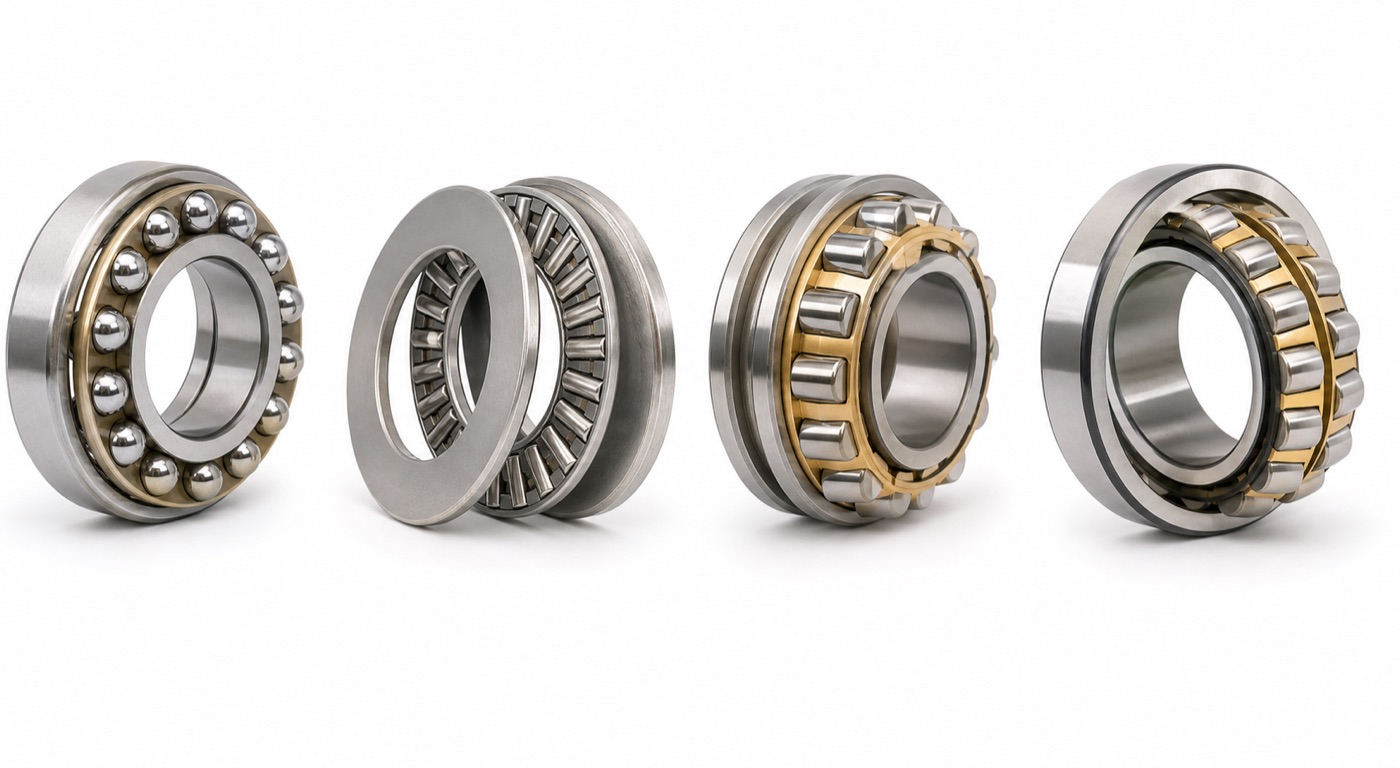
| Bearing Family | What It Is Good At | What to Watch |
|---|---|---|
| Thrust ball bearing | Axial load with relatively low friction and good speed potential in suitable sizes | Not for radial load; sensitive to alignment and washer support. |
| Needle roller thrust bearing | Compact axial space with useful axial load capacity | Needs proper washers or hardened raceways; no radial support by itself. |
| Cylindrical roller thrust bearing | High axial load and axial rigidity | Alignment and lubrication are critical; usually not for radial load. |
| Tapered roller thrust bearing | Heavy thrust, shock load, and demanding industrial arrangements | Requires correct geometry, mounting practice, and catalog review. |
| Spherical roller thrust bearing | Heavy axial load with misalignment tolerance | Can carry some radial load with axial load present, but load ratio and lubrication matter. |
| Axial angular contact ball bearing | Precision, stiffness, speed, and controlled axial positioning | Preload and arrangement details are important. |
| Plain thrust washer | Simple sliding thrust support in low-speed or compact mechanisms | Friction and wear replace rolling fatigue as the main concerns. |
| Fluid-film thrust bearing | Very large, high-speed, high-load rotating equipment | Requires oil system, pads, instrumentation, and machine-level design. |
| Magnetic thrust bearing | Non-contact support in specialized high-speed or low-drag equipment | Specialized control system; not a standard commodity bearing. |
Common Thrust Bearing Forms in Product Photos
Thrust bearings can look similar in a product photo, but the construction details are different. The examples below show common forms that may appear in axial-load applications. Use them as a visual reference only; final selection still depends on the bearing number, bore, outside diameter, height, washer style, material, cage, lubrication, and load direction.
| Product photo | What the photo helps distinguish |
|---|---|
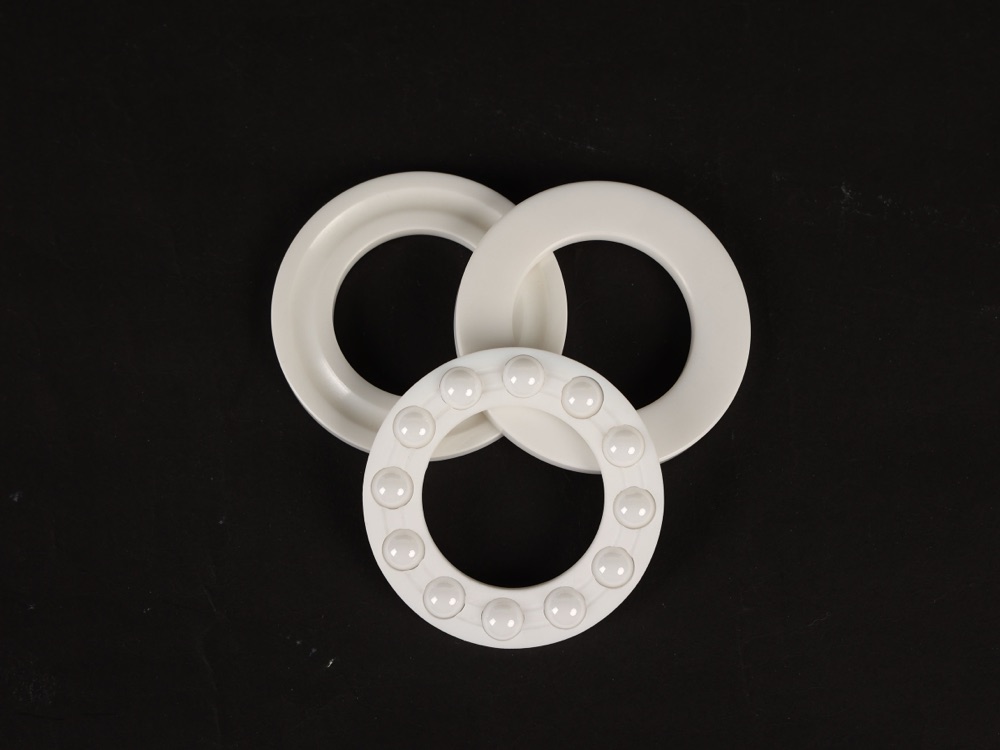 | Ceramic or plastic thrust ball bearing sets need material confirmation, washer shape, ball material, shaft speed, temperature, and chemical exposure before substitution. |
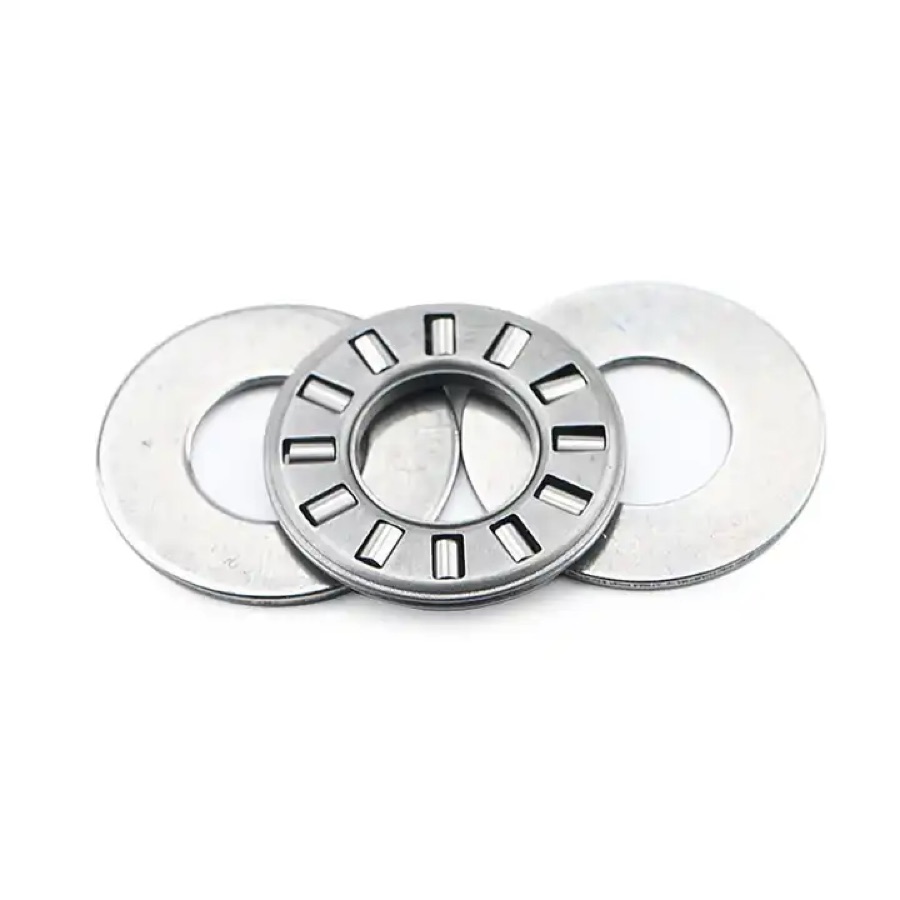 | Needle roller thrust bearings need washer/raceway confirmation. The roller cage and the matching thrust washers should be identified separately. |
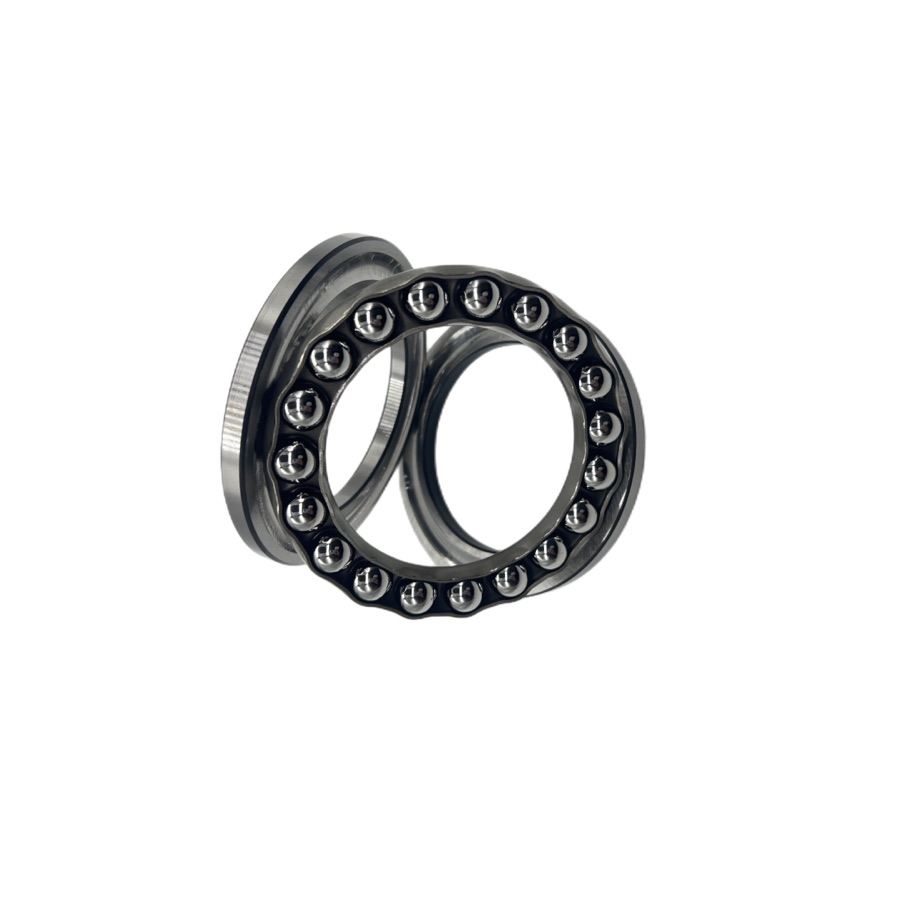 | Single-direction thrust ball bearings need bore, OD, height, washer style, cage type, and one-way axial load direction confirmed. |
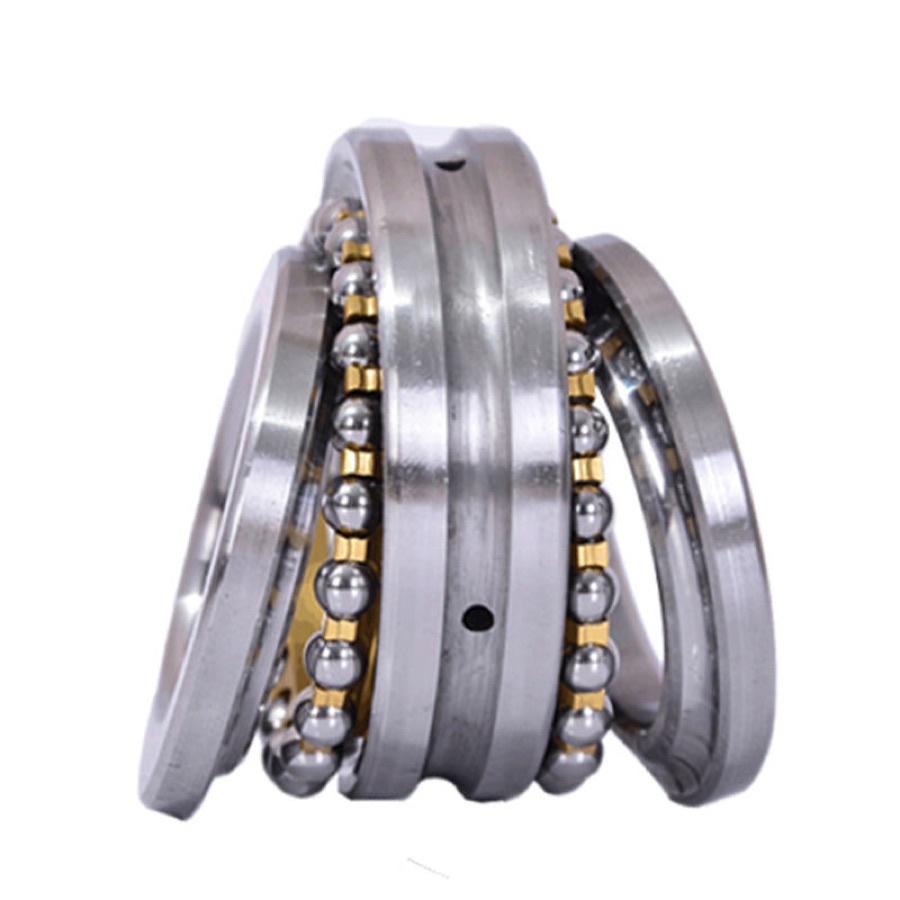 | Double-direction thrust ball bearing assemblies need center washer, spacer stack, preload/endplay condition, and shaft location details checked carefully. |
Dimensions That Matter More Than Bore Size
Bore size is only the first dimension.
For a thrust ball bearing, confirm bore, outside diameter, total height, single direction or double direction design, flat or spherical seat, washer arrangement, cage, and suffix. If the old bearing used an aligning seat washer, do not assume a flat washer version will behave the same.
For a needle roller thrust bearing, confirm whether the part is the cage-and-roller assembly only or a complete set with thrust washers. If the machine uses its own hardened surfaces as raceways, note that clearly. If you are unsure, compare both contact faces before replacing the part.
For thrust roller bearings, confirm the roller type, bore, OD, height, load direction, housing support, lubrication method, and whether radial load is present. In heavy equipment, the bearing is only one part of the thrust system. Where the load is heavy and combined, the selection may need to be compared with tapered roller bearings rather than a simple axial-only part.
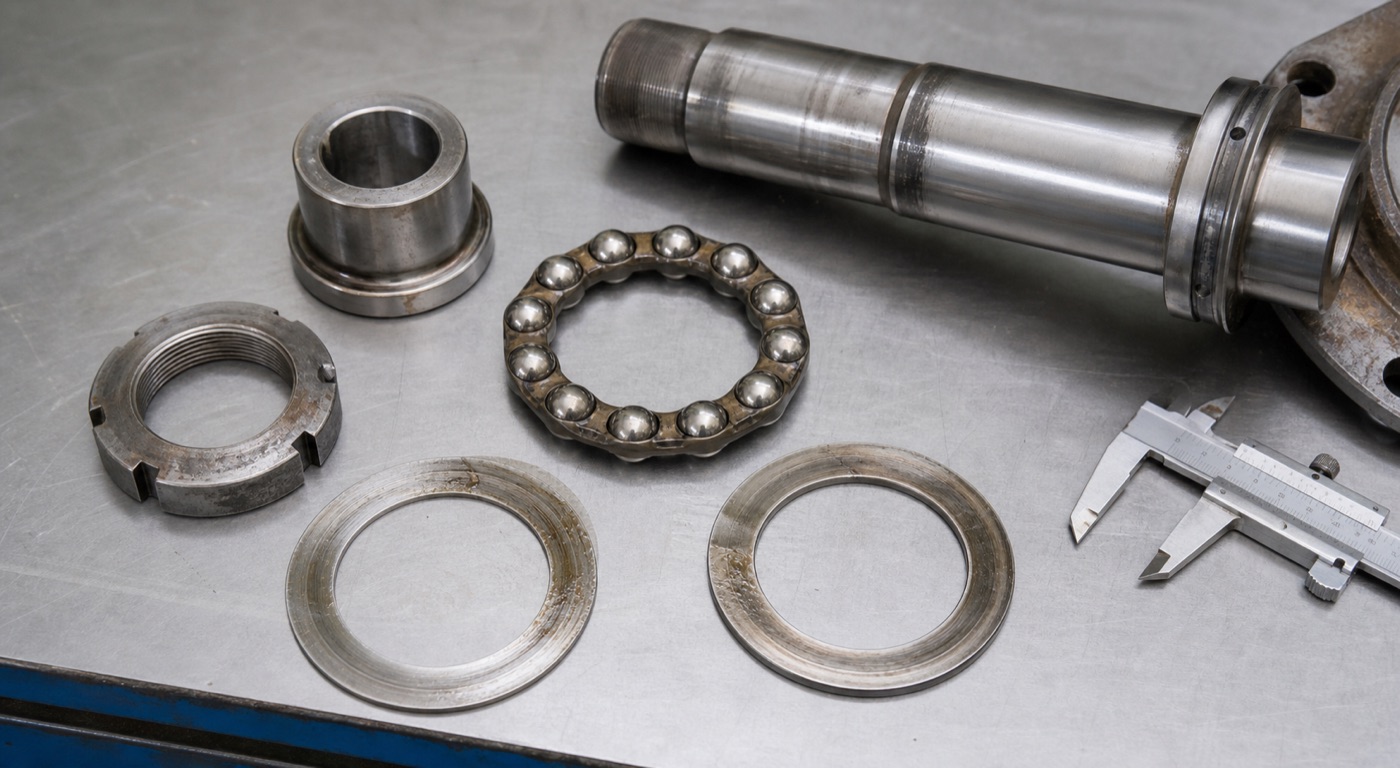
For replacement work, photos often beat partial measurements. A photo of the removed washer face, cage, locknut, spacer stack, and housing seat can prevent a bore-only mistake.
Failure Clues Worth Looking At Before Reordering
Do not reorder a thrust bearing before looking at the failed parts. The marks usually tell you whether the bearing was overloaded, misaligned, under-lubricated, or installed in the wrong load path.
| Evidence on Removed Parts | Possible Meaning |
|---|---|
| One-sided raceway marking | Misalignment, uneven support, shaft deflection, or housing distortion. |
| Blue, dark, or discolored washers | Heat from lubricant failure, speed, preload, or rubbing. |
| Cage damage | Skidding, poor lubrication, incorrect load, or handling damage. |
| Dented raceways | Shock load, static overload, contamination, or rough mounting. |
| Polished spacer or shoulder faces | Shaft movement, loose locknut, wrong stack height, or endplay issue. |
| Repeated failure after short service | The bearing may be correct dimensionally but wrong for the actual arrangement. |
The question is not only “which bearing failed?” It is “why was that bearing asked to carry that load?”
Mistakes That Make Thrust Bearings Look Bad
The bearing often gets blamed after the machine arrangement has already made success unlikely.
- Using a thrust ball bearing where radial load is also present.
- Replacing a double direction thrust bearing with a single direction type.
- Ignoring whether the original bearing used a flat seat or aligning seat.
- Installing a needle thrust assembly against a soft or worn raceway surface.
- Changing the washer height and altering preload or endplay.
- Assuming spherical roller thrust bearings forgive all misalignment.
- Running a thrust bearing without enough minimum load for stable rolling contact.
- Reusing distorted spacers, worn shoulders, or damaged housing seats.
- Changing grease or oil path without checking compatibility and delivery.
- Selecting from dimensions alone when the application actually needs a bearing arrangement review.
These are not rare edge cases. They are the normal reasons a replacement thrust bearing runs hot, becomes noisy, or fails before the buyer expected.
When a Thrust Bearing Is Not the Answer
Sometimes the correct answer is a different bearing arrangement, not a different thrust bearing.
Use caution when the shaft has high radial load and high axial load at the same time. A paired angular contact bearing arrangement, tapered roller bearing arrangement, or separate radial-plus-thrust layout may be more appropriate. If thermal expansion needs one end of the shaft to float, a thrust bearing that fixes both directions can create heat and preload. If the support surface cannot be made flat and rigid, a larger bearing will not solve the geometry problem.
For high-speed precision systems, preload and temperature behavior can matter more than the word “thrust.” For very large turbomachinery, fluid-film bearing design is usually part of the machine oil system and cannot be replaced with a standard rolling bearing.
Information Needed Before Selecting a Replacement
Good thrust bearing selection depends on the load path, not only the part size. Before changing the bearing family or ordering a replacement, collect the details below.
| Information | Why It Helps |
|---|---|
| Existing bearing number and suffix | Confirms series, design, cage, washer style, and special features. |
| Bore, OD, and height | Basic dimensional fit. |
| Single or double direction | Confirms axial support direction. |
| Washer style | Flat seat, spherical seat, aligning washer, or special support. |
| Machine type and bearing position | Explains where thrust is coming from. |
| Axial load direction | Prevents one-way support in a reversing-load machine. |
| Radial load presence | Shows whether a separate radial bearing is required. |
| Speed and duty cycle | Affects heat, cage, and lubrication. |
| Lubrication method | Grease, oil bath, oil circulation, or unknown. |
| Photos of removed parts | Reveals wear marks, stack order, and support condition. |
| Quantity and documentation needs | Clarifies packaging, certificate, labeling, and traceability requirements. |
If you do not know the load, say what the machine is and where the bearing sits. That is usually more useful than guessing.
Short FAQ
What is a thrust bearing used for?
A thrust bearing is used to support axial load and control lengthwise shaft movement while rotation continues.
Can a thrust bearing handle radial load?
Standard thrust ball bearings and many thrust roller bearings should not carry radial load. Spherical roller thrust bearings and some tapered roller arrangements can handle combined load in the right conditions, but the catalog and machine arrangement must be checked.
What is the difference between a thrust bearing and a radial bearing?
A thrust bearing supports force along the shaft. A radial bearing supports force perpendicular to the shaft. Many machines need both functions in the same shaft arrangement.
When should I choose a needle roller thrust bearing?
Choose a needle roller thrust bearing when axial space is limited and the raceway surfaces or matching washers are suitable for rolling contact.
Why does a thrust bearing run hot after replacement?
Common causes include wrong load direction, radial load on a thrust-only design, too much preload, poor lubrication, distorted washers, misalignment, or a changed spacer stack.
What is the safest way to identify a replacement thrust bearing?
Use the old bearing number, dimensions, washer style, direction of thrust, machine position, photos, and wear marks. Do not rely on bore size alone.