
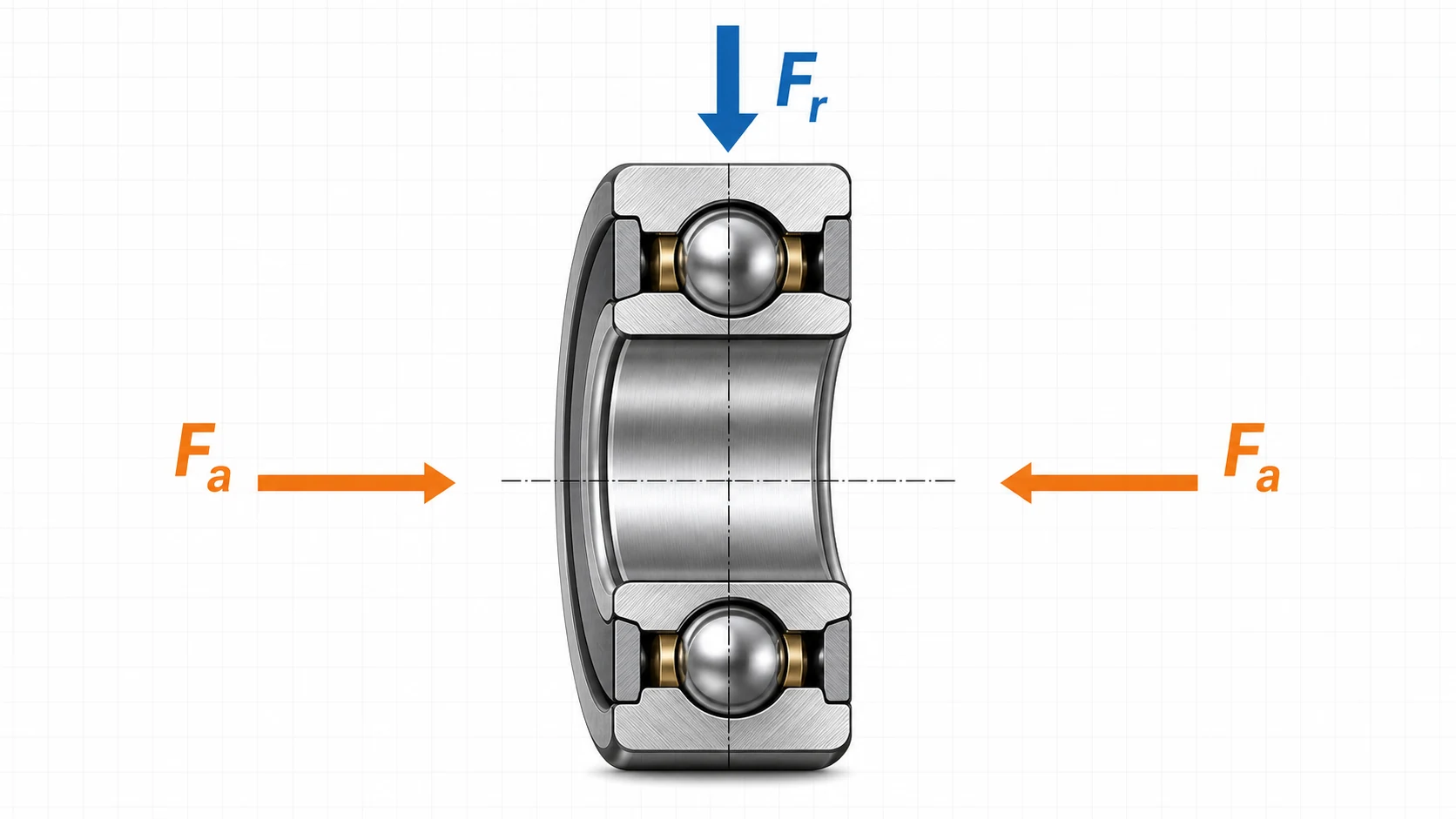
Quick answer: Static load rating and dynamic load rating answer different bearing selection questions. Static load rating C0 checks whether a bearing can resist permanent deformation when it is stationary, very slow, shock-loaded, or heavily loaded at rest. Dynamic load rating C is used to estimate fatigue life when the bearing rotates under load.
The common mistake is treating both ratings as simple “maximum load” numbers. They are not. A bearing can have an acceptable dynamic load rating and still be damaged by standstill shock, press-fit force, transport vibration, or heavy load at startup. A bearing can also have a sufficient static load rating but still fail early from fatigue, contamination, poor lubrication, misalignment, excessive temperature, or an underestimated duty cycle.
Static vs Dynamic Load Rating: The Practical Difference
Static load rating is about permanent deformation risk. Dynamic load rating is about rotating fatigue life. In bearing catalogs, the values are usually shown separately because they are calculated for different failure mechanisms.
| Rating | Common Symbol | Main Question | Typical Risk Checked |
|---|---|---|---|
| Static load rating | C0 | Can the bearing withstand this load without unacceptable permanent deformation? | Brinelling, raceway indentation, ball or roller contact damage |
| Dynamic load rating | C | Can the bearing meet the required rotating fatigue life under the equivalent load? | Rolling-contact fatigue, spalling, short calculated L10 life |
For a rotating ball bearing, dynamic rating is normally used with the basic life equation:
Formula: L10 = (C / P)^3
L10 is basic rating life in millions of revolutions, C is the basic dynamic load rating, and P is the equivalent dynamic bearing load. For ball bearings, the life exponent is normally 3. For roller bearings, the exponent is normally 10/3, so the bearing type must be confirmed before applying the formula.
For a static load check, engineers often review the static safety factor:
Formula: S0 = C0 / P0
C0 is the basic static load rating, and P0 is the equivalent static bearing load. P0 is not the same value as P in the dynamic life equation. It must be calculated from the static-load rules for the selected bearing type and load direction.
For many radial bearings under combined radial and axial static load, the equivalent static load is reviewed with a catalog form such as:
Formula: P0 = X0Fr + Y0Fa
X0 is the static radial load factor, and Y0 is the static axial load factor. These values must be selected from the manufacturer table for the bearing type and load direction. Some catalogs also require comparing the calculated value with Fr and using the greater value.
What Dynamic Load Rating C Means
Dynamic load rating C is a fatigue-life rating for a bearing rotating under load. It is not a proof load, shock-load limit, installation-force limit, or guarantee that the bearing will survive every real-world condition.
In practical selection, C becomes useful only after the application load is converted into equivalent dynamic bearing load P. For many bearing types, combined radial and axial load is handled through a structure such as:
Formula: P = XFr + YFa
Fr is radial load, Fa is axial load, and X and Y are catalog factors based on bearing type, contact geometry, and load ratio. For deep groove ball bearings, P may equal or closely follow Fr under pure radial load or light axial load. Once axial load becomes meaningful, the manufacturer table must be checked instead of assuming X = 1 and Y = 1.
Dynamic load rating is especially important in applications such as electric motors, pumps, conveyor rollers, fans, gear-driven shafts, and other equipment where the bearing turns for many hours. If the equivalent dynamic load is underestimated, calculated life can look acceptable while the bearing is actually undersized.
When Dynamic Rating Controls the Selection
Dynamic rating usually controls the selection when the bearing rotates for long periods and fatigue life is the main concern. This is common in continuous-duty motors, pumps, blowers, industrial rollers, and automated equipment.
The buyer or engineer should define the equivalent dynamic load, speed, target life, lubrication method, operating temperature, contamination level, fit, clearance, and duty cycle before judging whether the catalog C value is enough. A larger C value may improve calculated fatigue life, but it does not fix poor lubrication, misalignment, unsuitable clearance, or contamination.
What Static Load Rating C0 Means
Static load rating C0 is used to evaluate the risk of permanent deformation at the rolling contact when the bearing is stationary, very slow, oscillating, shock-loaded, or exposed to heavy load at rest. In rolling bearings, static damage often appears as raceway indentation, ball marks, roller marks, brinelling, noise, vibration, or rough rotation after the equipment starts.
Static load rating matters even if the bearing normally rotates. Many machines experience their most severe bearing load during startup, shutdown, handling, transport, pressing, indexing, or short overload events. The bearing may not rotate enough during that event for a dynamic life calculation to describe the damage risk.
When Static Rating Controls the Selection
Static rating often controls the selection when the bearing sees high load with little or no rotation. Examples include:
- A conveyor roller loaded during shipping or storage before it ever runs.
- A motor bearing exposed to shock during transport or installation.
- A wheel or pulley bearing carrying belt tension while stationary.
- A turntable or indexing mechanism that moves only in short steps.
- A bearing pressed into place with force passing through the rolling elements.
- A machine that receives impact load before the shaft completes a full revolution.
In these cases, a bearing can fail the static safety check even if its dynamic C value looks attractive. Static damage may then create noise, heat, and early fatigue after the bearing begins running.
Static rating should not be used to justify poor mounting practice. During installation, pressing force should be applied through the ring being fitted, not through the balls or rollers.
Transport vibration may create true brinelling under high static impact, but small oscillatory motion can also create false brinelling or fretting marks. In that case, packaging, preload, lubrication, and handling control may matter as much as C0.
Simple Static Safety Factor Example
Assume a bearing position has these simplified static inputs:
| Input | Value |
|---|---|
Basic static load rating C0 | 8.0 kN |
Equivalent static load P0 | 4.0 kN |
Formula: S0 = C0 / P0
Example: S0 = 8.0 / 4.0
Result: S0 = 2.0
This means the static safety factor is 2.0. Whether that is enough depends on the bearing type, shock level, noise requirement, accuracy requirement, mounting condition, and manufacturer guidance.
Why C and C0 Should Not Be Compared as Better or Worse
C and C0 are not two versions of the same capacity. They are ratings for different engineering questions. A buyer should not choose a bearing simply because one rating is higher than another.
For some bearings, the dynamic rating may be higher than the static rating. For others, the relationship can look different depending on bearing type, internal geometry, number of rolling elements, contact angle, material, and design series. The catalog values must be interpreted in context.
The better comparison is application-driven:
| Application Condition | Rating to Check First | Why |
|---|---|---|
| Continuous high-hour rotation | Dynamic rating C | Fatigue life and L10 life are usually the main concern. |
| Heavy load at standstill | Static rating C0 | Permanent deformation can occur before fatigue life matters. |
| Shock or impact load | Static rating C0, then dynamic rating C | Indentation or brinelling can happen during the peak event. |
| Combined radial and axial load | Dynamic P and static P0 | Both load conversions may be needed. |
| Very slow indexing motion | Static rating C0 plus application review | Slow movement may not distribute contact stress like continuous rotation. |
| High-speed clean duty | Dynamic rating C plus speed and lubrication checks | Heat, grease, and clearance may limit practical life. |
Applications with meaningful axial load may require single row angular contact ball bearings or another bearing arrangement instead of assuming a radial bearing can handle the full load path alone.
Field Example: Why Both Ratings Matter
Consider a belt-driven fan using deep groove ball bearings. During normal operation, the bearing rotates continuously and the engineer calculates dynamic life from C, P, and speed. The result may show enough L10 life for the planned service interval.
The same bearing may also see high belt tension at standstill, shipping vibration, and startup shock. Those events should be checked against static load rating C0 and equivalent static load P0. If the static safety factor is too low, the bearing can develop indentations before fatigue life becomes the controlling issue.
This is why a good bearing review does not ask only, “Is the dynamic load rating high enough?” It asks whether the bearing has enough dynamic fatigue life and enough static safety margin for the real duty cycle.
Common Mistakes When Reading Load Ratings
The most common load-rating mistake is treating C as the maximum load the bearing can carry. Dynamic rating is a fatigue-life calculation input, not a maximum working load.
Another mistake is ignoring C0 because the machine normally rotates. Many failures begin during handling, installation, transport, shock, or startup, when the bearing is stationary or moving too slowly for the dynamic life equation to be the main protection.
A third mistake is using the wrong load value. Dynamic equivalent load P and static equivalent load P0 may be calculated differently. Combined radial and axial loads should not be compared separately against catalog ratings unless the manufacturer method says so.
Finally, buyers sometimes request “a bearing with a higher load rating” without describing the duty. A higher C value may not solve a static indentation problem. A higher C0 value may not solve a lubrication or contamination problem. Load ratings must be reviewed with the application conditions.
How to Decide Which Rating to Use
Use dynamic load rating when the bearing rotates under load and the main question is fatigue life. Use static load rating when the bearing may see high load at rest, very slow movement, shock, pressing, vibration, or short overload events.
For many industrial applications, the correct answer is to check both. A motor, pump, conveyor, gearbox, or packaging machine bearing can have a rotating life requirement and a separate static or shock-load risk.
Before selecting a bearing, collect these inputs:
| Required Data | Why It Matters |
|---|---|
| Bearing type and size envelope | Defines the possible catalog C and C0 values. |
Radial load Fr | Needed for dynamic and static equivalent load calculations. |
Axial load Fa | May change P, P0, bearing family, or arrangement. |
| Speed and operating hours | Needed for dynamic life calculation. |
| Startup, shutdown, and shock events | May make static rating the limiting issue. |
| Duty cycle or load spectrum | Prevents one average load from hiding damaging peaks. |
| Fit, clearance, and mounting method | Can change internal load distribution and preload. |
| Lubrication and temperature | Affect film thickness, heat, wear, and practical life. |
| Contamination and sealing | Particles and water can shorten real life beyond the rating calculation. |
When the load path is compact but high, needle roller bearings may be part of the review because bearing family, envelope, load direction, and speed all affect which rating limits the design.
When Not to Solve the Problem With a Higher Load Rating
Do not assume a higher C or C0 rating automatically solves a bearing problem. A larger or heavier bearing may create new issues such as higher friction, limited speed, fit changes, reduced clearance, seal drag, or space conflicts.
If the failure pattern shows corrosion, contamination, grease breakdown, electrical fluting, poor installation, misalignment, or excessive preload, increasing the load rating may not address the root cause. In those cases, the better fix may be cleaner handling, a different seal, a different grease, corrected shaft or housing fits, improved alignment, or a different bearing arrangement.
The load rating should guide selection, but it should not replace failure analysis or application review.
RFQ Checklist for Static and Dynamic Load Rating Review
Send these details when asking CXE Bearing to review bearing load rating:
- Existing bearing number and suffix, if replacing a current bearing.
- Bore, outside diameter, width, and available space.
- Radial load
Fr, axial loadFa, and how they were estimated. - Speed range, operating hours, and target service life.
- Whether the machine sees shock, impact, transport vibration, or standstill load.
- Startup and shutdown conditions.
- Lubrication method, grease or oil type, and relubrication practice.
- Shaft fit, housing fit, clearance class, and mounting method if known.
- Temperature, dust, water, washdown, chemicals, or contamination risk.
- Failure evidence, including photos of raceways, balls, seals, grease, and mounting surfaces.
With those details, CXE Bearing can help compare candidate bearings by catalog C, catalog C0, equivalent dynamic load, equivalent static load, speed limit, seal or shield type, grease, clearance, and application risk.
FAQ
Is static load rating the maximum load a bearing can carry?
No. Static load rating is a catalog rating used to evaluate permanent deformation risk under static or very slow loading. It should be checked with equivalent static load P0 and an appropriate static safety factor.
Is dynamic load rating the same as working load?
No. Dynamic load rating C is used for fatigue-life calculation when the bearing rotates under load. The real working load must first be converted into equivalent dynamic load P.
Which is more important, C or C0?
Neither is universally more important. C is important for rotating fatigue life, while C0 is important for standstill, shock, slow movement, and permanent deformation risk. Many applications require both checks.
Can a bearing pass dynamic life calculation and still fail?
Yes. A bearing can pass a dynamic L10 calculation and still fail from static indentation, contamination, poor lubrication, incorrect fit, loss of clearance, misalignment, shock, or installation damage.