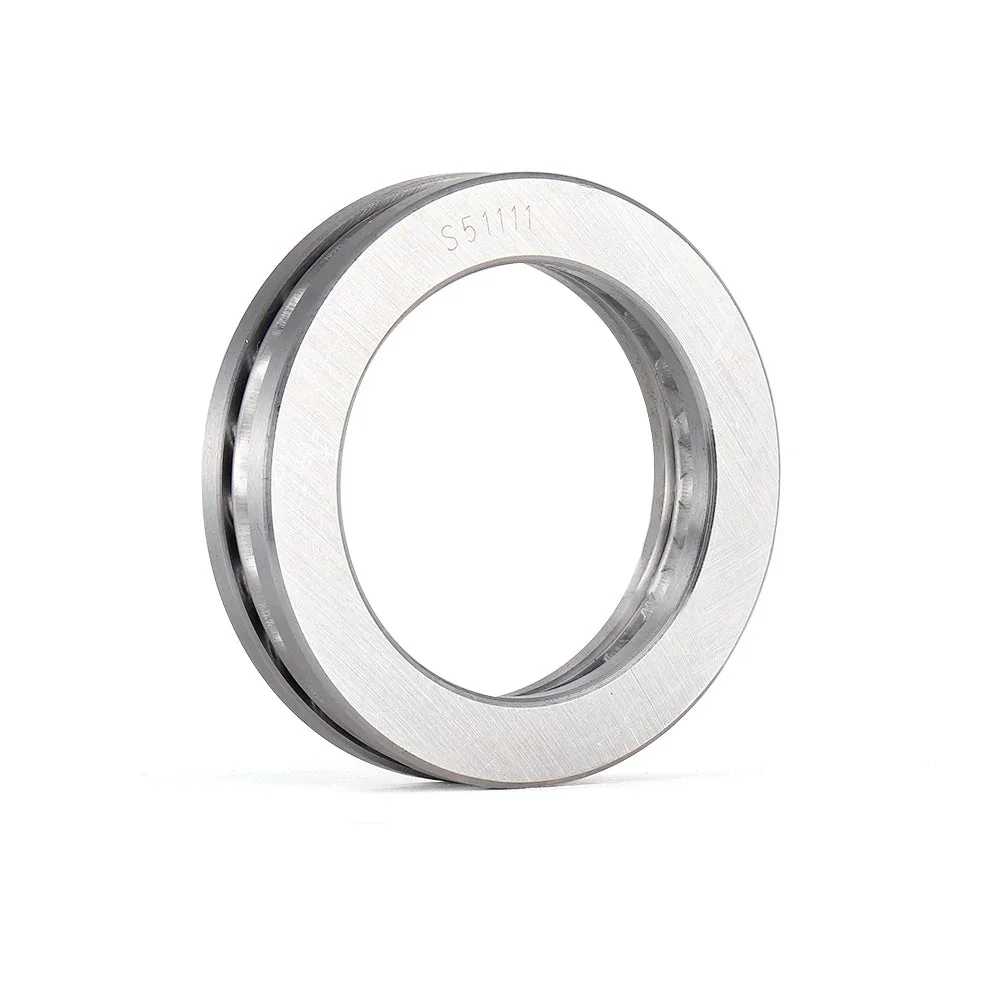
Stainless steel thrust ball bearings are used when the bearing position must carry axial load along the shaft direction and the surrounding environment has moisture, corrosion, or cleanliness concerns. They are not a direct substitute for radial deep groove ball bearings; the load direction, washer support, shaft shoulder, and housing face must be reviewed before replacement.
Use this chart to compare S51100 and S51200 series bore size, outside diameter, height, axial load rating, limiting speed, and weight before RFQ review. For axial-load applications, use this table alongside CXE Bearing collections for stainless thrust ball bearings, stainless steel bearings, and deep groove ball bearings; it keeps thrust selection separate from radial deep groove bearing selection.
How to Use the Stainless Thrust Bearing Chart
All dimensions are listed in millimeters. The d value is the bore, D is the outside diameter, and B is the bearing height. Load ratings are shown in kN, speed values are shown in rpm, and weight is shown in kg. These values help identify the series and approximate envelope size, but the final bearing choice still depends on mounting support, lubrication, speed, material, and operating environment.
S51100 series parts are commonly reviewed where a compact axial bearing envelope is needed. S51200 series parts use a heavier section for applications that require a larger bearing height and a different load envelope. Do not select only by bore size; compare OD and height as well, because the washer set must seat correctly against the shaft and housing surfaces.
What to Confirm Before an RFQ
- Existing bearing number or washer markings, if available
- Bore, outside diameter, and total height after assembly
- Whether the application carries axial load in one direction or needs a different arrangement
- Shaft shoulder, housing face, and washer support condition
- Speed range, lubrication method, and temperature trend during operation
- Stainless material requirement and whether the environment includes water, mild chemicals, or frequent cleaning
Chart Data
- Brand: CXE Bearing | Dimensions in mm | Load Ratings in KN | Speed in rpm | Weight in Kg
S51100 Series - Standard Thrust Ball Bearings
Type Dimensions (mm) Load Rating (KN) Limiting Speed (rpm) Weight(Kg)
d (Inner) D (Outer) B (Height) Cr (Dynamic) Cor (Static) Grease Oil
S51100 10 24 9 10.00 14.00 6500 10000 0.019
S51101 12 26 9 10.30 15.40 6500 10000 0.021
S51102 15 28 9 10.50 16.80 6100 9400 0.024
S51103 17 30 9 10.80 18.20 6100 9400 0.025
S51104 20 35 10 14.20 24.70 5100 7900 0.038
S51105 25 42 11 19.50 37.20 4400 6800 0.056
S51106 30 47 11 20.40 42.20 4300 6600 0.066
S51107 35 52 12 22.40 47.70 3900 6000 0.083
S51108 40 60 13 26.90 62.80 3400 5300 0.120
S51109 45 65 14 27.80 69.10 3200 5000 0.150
S51110 50 70 14 28.80 75.40 3100 4800 0.160
S51111 55 78 16 34.80 93.10 2800 4300 0.240
S51112 60 85 17 41.40 113.00 2600 4000 0.290
S51113 65 90 18 41.70 117.00 2400 3700 0.324
S51114 70 95 18 43.00 127.00 2300 3600 0.360
S51115 75 100 19 42.30 127.00 2200 3400 0.392
S51116 80 105 19 44.60 141.00 2100 3300 0.433
S51117 85 110 19 45.90 150.00 2100 3200 0.460
S51200 Series - Heavy Duty Thrust Ball Bearings
Type Dimensions (mm) Load Rating (KN) Limiting Speed (rpm) Weight(Kg)
d (Inner) D (Outer) B (Height) Cr (Dynamic) Cor (Static) Grease Oil
S51200 10 26 11 12.70 17.10 5700 8800 0.030
S51201 12 28 11 13.20 19.00 5400 8300 0.034
S51202 15 32 12 16.60 24.80 4900 7500 0.046
S51203 17 35 12 17.20 27.30 4900 7500 0.053
S51204 20 40 14 22.30 37.70 3900 6000 0.082
S51205 25 47 15 27.80 50.40 3600 5500 0.120
S51206 30 52 16 29.30 58.20 3400 5200 0.150
S51207 35 62 18 39.20 78.20 2900 4500 0.220
S51208 40 68 19 46.90 98.30 2700 4200 0.270
S51209 45 73 20 47.70 105.00 2600 4000 0.320
S51210 50 78 22 48.50 111.00 2300 3600 0.390
S51211 55 90 25 69.40 159.00 2100 3200 0.610
S51212 60 95 26 73.60 179.00 1900 3000 0.690
Selection Notes for Stainless Thrust Ball Bearings
| Selection Point | Why It Matters | Buyer Check |
|---|---|---|
| Load direction | Thrust ball bearings are intended for axial load, not primary radial load | Confirm the force direction in the assembly |
| Washer seating | Poor shaft or housing support can create uneven contact | Check shoulder flatness and alignment |
| Series envelope | S51100 and S51200 can differ in OD and height for the same bore | Compare all three dimensions, not just bore |
| Environment | Stainless material helps where moisture or mild corrosion is present | Describe water, humidity, washdown, or chemical exposure |
| Lubrication | Heat and wear depend strongly on lubrication condition | Note grease, oil, relubrication access, and contamination risk |
When Not to Use This Chart Alone
Do not choose a replacement only because the bore size matches. A thrust bearing with the wrong outside diameter, height, washer arrangement, or material can fit the shaft but fail during operation. If the machine has unusual axial shock, high temperature, misalignment, or uncertain lubrication, send the application details with the RFQ so the bearing family can be reviewed before quoting.
FAQ
What is the main difference between a thrust ball bearing and a deep groove ball bearing?
A thrust ball bearing is designed to carry axial load along the shaft direction. A deep groove ball bearing is usually selected for radial load and moderate combined load. The two bearing families should not be swapped without checking the machine design.
What information is most useful for stainless thrust bearing replacement?
The most useful information is the bearing number, bore, outside diameter, height, load direction, operating environment, speed, lubrication method, and photos of the mounted washer surfaces.
Does stainless steel remove the need for lubrication?
No. Stainless steel helps with corrosion resistance, but thrust ball bearings still need suitable lubrication and clean seating surfaces for stable operation.