
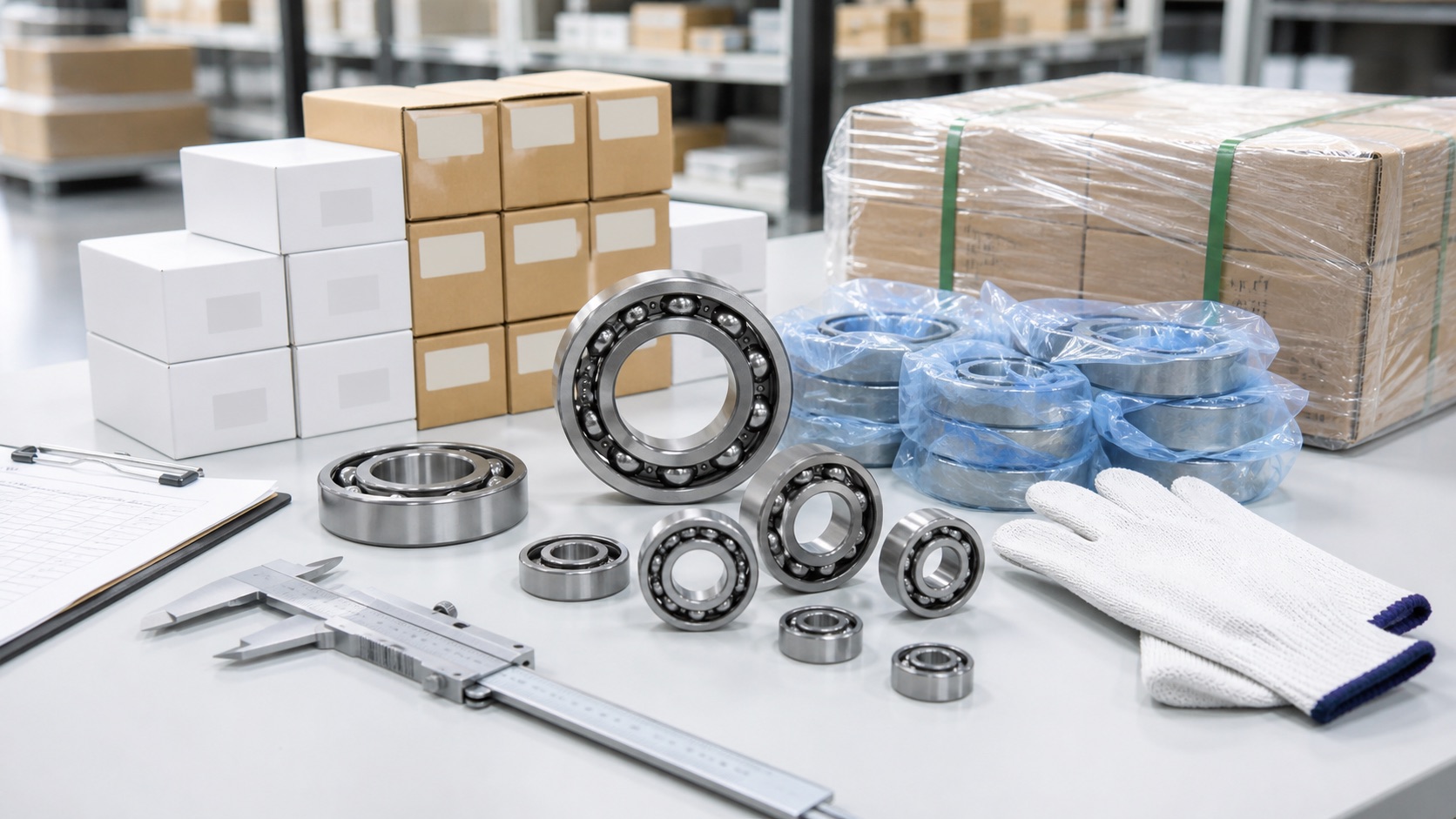
Sourcing deep groove ball bearings in bulk is not only a price comparison. The buyer must control bearing number, suffix, clearance, closure, grease, cage, material, precision, packaging, inspection, and batch consistency. A low unit price can become expensive if the shipment contains the wrong suffix, unstable noise level, poor rust protection, or mixed specifications.
Deep groove ball bearings are widely used because they are compact, versatile, and suitable for many motors, rollers, fans, pumps, wheels, appliances, tools, and light industrial machines. That wide usage also creates a sourcing risk: many bearings look similar, but small specification differences can change performance.
Start With the Complete Bearing Identity
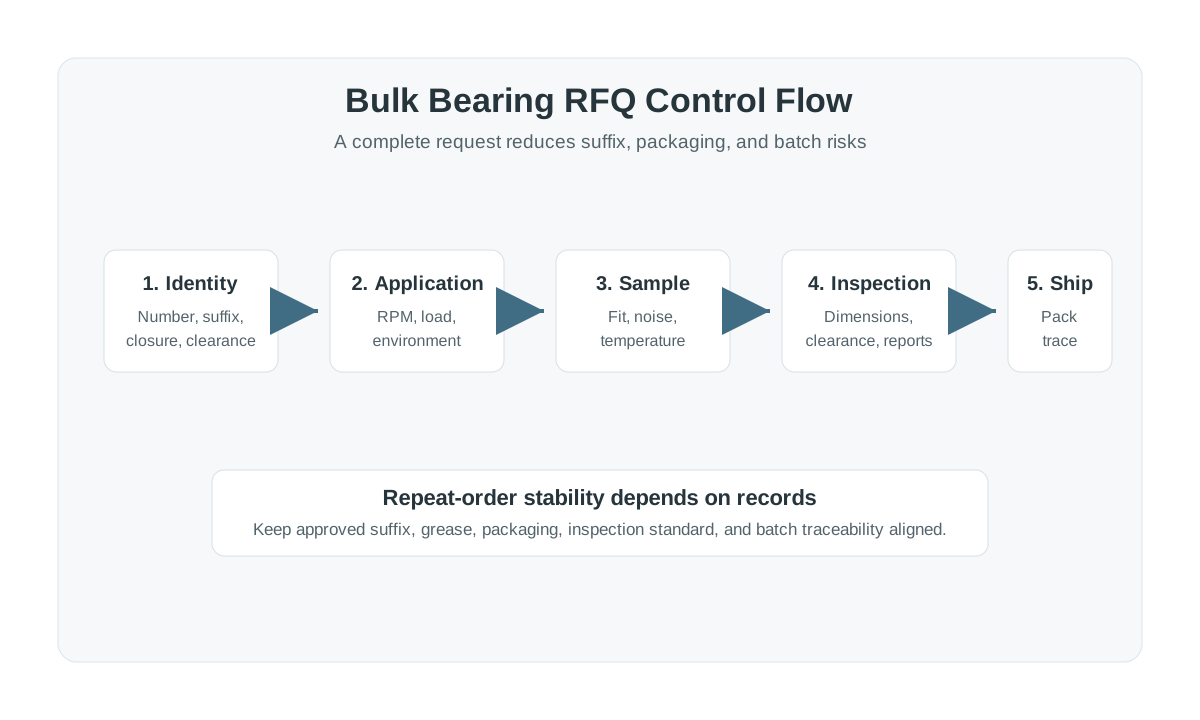
A correct RFQ starts with the full bearing identity, not only the bearing size. Dimension-led orders can also be cross-checked against metric ball bearings when the buyer is comparing standard metric series.
For example, 6205 gives the basic bearing series and dimensions. It does not fully define the closure, internal clearance, grease, cage, precision, noise requirement, material, or packaging.
| Specification Item | Example | Why It Matters |
|---|---|---|
| Basic bearing number | 6205, 608, 6001, 6306 | Confirms series and dimensions. |
| Closure | ZZ, 2RS, RS, open | Affects sealing, friction, speed, and grease retention. |
| Clearance | C0, C3, C4 | Affects mounted running clearance, heat, and noise. |
| Material | Chrome steel, stainless steel, ceramic hybrid | Affects load, corrosion, speed, and cost. |
| Cage | Steel, brass, polymer | Affects speed, noise, heat, and special operating needs. |
| Precision | Standard, higher precision class | Affects runout, noise, and high-speed use. |
| Grease | Standard, low-noise, high-temperature, food-grade | Affects torque, temperature, life, and compliance needs. |
| Packaging | Industrial pack, single box, tube, vacuum/rust protection | Affects storage, resale, and corrosion risk. |
If the buyer sends only 6205 bearing, 10,000 pcs, the quote may return a technically correct but commercially unsuitable product.
Match the Bearing to the Application
Bulk orders should be grouped by application, not only by model number. The same deep groove ball bearing size may be used in a clean electric motor, a dusty conveyor roller, a hand tool, a skateboard wheel, a pump, or outdoor equipment.
| Application | Specification Points to Confirm |
|---|---|
| Electric motors | Noise, vibration, grease, clearance, speed, closure, temperature. |
| Conveyors | Seal type, contamination, grease retention, housing protection, shock load. |
| Fans and blowers | Speed, balance, grease drag, noise, heat, closure type. |
| Pumps | Load direction, moisture, seal leakage risk, temperature, grease or oil environment. |
| Wheels and rollers | Sealing, shock, impact, corrosion, replacement frequency. |
| Appliances | Low noise, low torque, grease consistency, batch stability. |
| Food equipment | Stainless option, grease, seal material, washdown exposure. Review stainless steel bearings when corrosion is part of the requirement. |
This application review helps prevent the most common sourcing mistake: buying by dimension while ignoring the machine environment.
Control Suffixes Before Discussing Price
Suffix errors are one of the easiest ways to create a bad bulk order. A buyer may think two bearings are interchangeable because the main number is the same, but suffixes can change performance.
Common suffix areas include:
- shield or seal type
- internal clearance
- cage material
- precision or noise grade
- grease type
- special heat treatment or material
- snap ring groove or other external features
Do not assume suffix rules are identical across every catalog. A suffix that means one thing in one catalog may not mean exactly the same thing in another. When replacing a previous batch or reference sample, ask CXE Bearing to confirm the functional meaning, not only the letters.
Decide Whether You Need Standard Bearings or Application-Controlled Bearings
Many deep groove ball bearing orders can use standard commercial specifications. Some cannot.
Standard bearings may be enough when the application is low-risk, speed is moderate, the environment is clean, and replacement is easy.
Application-controlled bearings should be reviewed when:
- the bearing runs in a motor or fan with noise requirements
- the bearing runs near high RPM
- the bearing is pressed tightly onto a shaft or into a housing
- the bearing operates near moisture, dust, chemicals, or washdown
- the customer requires specific grease
- the assembly is hard to repair
- the bearing is used in exported equipment with warranty risk
- the buyer needs repeated batch consistency
Bulk sourcing should match the customer’s risk level. A bearing for a simple caster does not need the same approval process as a bearing for a high-volume motor assembly.
Sample Approval Should Test the Real Requirement
Samples are useful only when the test matches the final application. Spinning a bearing by hand is not enough.
For a deep groove ball bearing sample, review:
- dimensions
- marking
- closure type
- rotation feel
- noise
- grease leakage
- seal drag
- clearance if relevant
- packaging
- rust protection
- fit in the customer’s shaft and housing
- running temperature in the machine when practical
If the customer needs low noise, test noise. If the customer needs corrosion resistance, review material, seal, grease, and environment. If the customer needs high-speed use, review temperature and grease behavior, not only dimensions.
Inspection Documents and Quality Evidence
The bearing team should be able to provide quality evidence appropriate to the order size and application risk.
| Document or Evidence | When It Helps |
|---|---|
| Dimension inspection report | Confirms basic size control. |
| Material certificate | Useful for stainless steel, special material, or customer-controlled orders. |
| Clearance inspection | Important for motor, fit-sensitive, or heat-sensitive applications. |
| Noise or vibration test data | Useful for motors, fans, tools, and appliances. |
| Grease confirmation | Important when grease affects noise, torque, food use, or temperature. |
| Packaging photos | Helps prevent rust, mixed models, and shipping damage. |
| Batch traceability | Useful for repeat orders and customer complaint handling. |
For low-risk orders, not every document is necessary. For OEM or distributor programs, documentation becomes part of supply stability.
Packaging Is Part of the Product
Deep groove ball bearings can be damaged before they are ever installed. Rust, impact, mixed cartons, broken bags, wrong labels, and poor moisture protection can turn a good bearing into a customer complaint.
Packaging should match how the buyer will use the product.
| Buyer Situation | Packaging Recommendation |
|---|---|
| Distributor resale | Individual box or clean labeled packaging. |
| Factory assembly | Tray, tube, or bulk packaging that supports efficient handling. |
| Long storage | Strong rust prevention and moisture control. |
| Mixed models in one shipment | Clear carton labels and model separation. |
| Export shipment | Strong outer cartons, pallet protection, moisture control, and packing list accuracy. |
If the order includes many similar models, packaging and label control become more important. A mixed 6204 and 6205 carton can create assembly errors even if every bearing is individually acceptable.
Price, MOQ, and Quantity Logic
Bearing price is affected by model, material, closure, grease, precision, order quantity, packaging, inspection requirement, and production schedule.
The quantity per model often matters more than the total order quantity. An order of 20,000 pieces across 80 models is different from 20,000 pieces of one model. Setup, packaging, inspection, inventory, and production planning all change.
Before negotiating price, separate the order into:
- high-volume repeated models
- low-volume replacement models
- urgent models
- special grease or special packaging models
- models that require sample approval
- models where alternative specifications are acceptable
This makes the quote more realistic and helps CXE Bearing propose a workable production plan.
Evaluation Points for Bulk Bearing Orders
A good bearing partner should help reduce specification risk, not only send a low price.
Review these points:
| Evaluation Check | What to Ask |
|---|---|
| Product range | Can they supply the required deep groove series and sizes consistently? |
| Specification control | Can they confirm suffix, clearance, grease, cage, and material clearly? |
| Sample process | Can samples match bulk production requirements? |
| Inspection ability | Can they provide suitable inspection reports or test evidence? |
| Packaging control | Can they package for export, resale, or assembly use? |
| Communication | Do they ask about application conditions before quoting critical orders? |
| Repeat supply | Can they keep batch consistency across future orders? |
| Problem response | Can they trace batch issues and support corrective action? |
For repeat orders, process discipline is often more valuable than a one-time price advantage.
Field Scenario: The Bearing Number Was Correct, but the Closure Was Wrong
A distributor orders a large quantity of deep groove ball bearings for customer replacement stock. The main bearing number matches the old item, and the dimensions pass inspection. After delivery, several customers report shorter life in outdoor equipment.
The problem is the closure. The previous bearing used rubber seals, but the new shipment used metal shields. The bearing fit the shaft, but it did not protect the grease well enough in moisture and dust.
This is why the order should include the full suffix and application context. Dimension match is only the first step.
Bulk RFQ Checklist
Before requesting a quote, prepare this information:
- bearing number
- dimensions if known
- closure type
- clearance
- material
- cage
- grease
- precision or noise requirement
- application
- RPM
- load direction if known
- operating temperature if known
- contamination or moisture exposure
- quantity by model
- packaging requirement
- sample requirement
- inspection document requirement
- destination and delivery schedule
If some data is unknown, say so. CXE Bearing can still help, but the unknowns should be visible.
When Not to Approve a Substitute
Do not approve a substitute only because the dimensions match when the bearing is used in a motor, fan, pump, high-speed assembly, food equipment, outdoor equipment, or warranty-sensitive OEM product.
Check at least:
- suffix meaning
- closure design
- clearance
- grease
- cage
- material
- precision or noise expectation
- fit and temperature risk
- customer approval requirement
If the customer has a drawing, old box, reference sample, or failed bearing, send it for review before confirming mass production.
FAQ
What is the most important information when sourcing deep groove ball bearings in bulk?
The full bearing number and suffix are the starting point, but application, closure, clearance, grease, material, packaging, and quantity by model are also important.
Can I buy deep groove ball bearings by dimension only?
Dimension-only buying is risky for industrial use. Two bearings with the same size can have different seals, grease, clearance, cage, precision, and corrosion behavior.
Should I request samples before a bulk order?
Samples are recommended when the application has noise, speed, sealing, corrosion, or customer warranty risk. The sample should be tested against the real requirement, not only checked by hand rotation.
Why do prices vary for the same bearing number?
Prices vary because closure, clearance, grease, material, precision, packaging, inspection, quantity, and process control may differ.
What causes many bulk bearing complaints?
Common causes include wrong suffix, mixed models, poor packaging, rust, grease mismatch, noise inconsistency, clearance mismatch, and using a dimensionally correct bearing in the wrong environment.
Conclusion
Bulk sourcing deep groove ball bearings requires more than matching a model number and negotiating price. The buyer should control suffix, closure, clearance, grease, cage, material, application, sample approval, inspection, packaging, and batch consistency.
The safest RFQ is specific enough for CXE Bearing to quote the right product the first time. Send the full bearing requirement, the application condition, and the inspection or packaging needs before approving a mass order.