
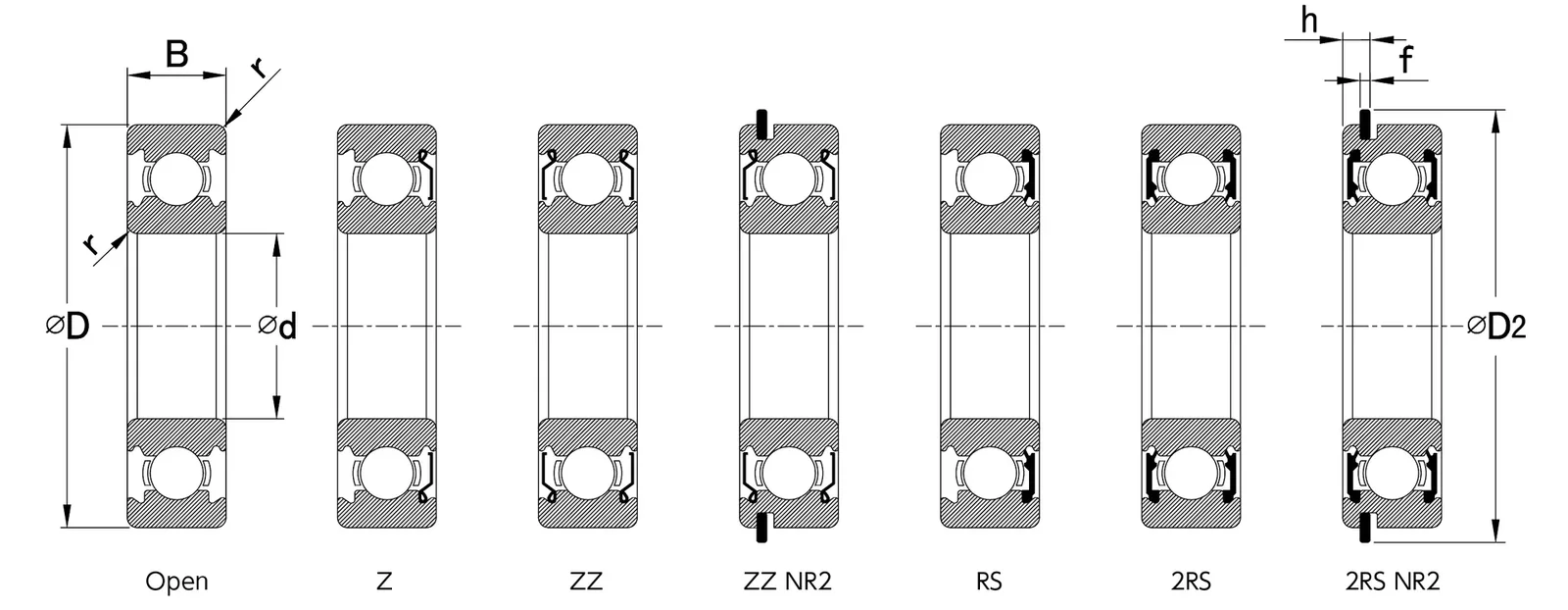
Codes for Sealing, Dust Prevention, and External Shape Modifications Postcodes for rolling bearings are used to indicate aspects such as the internal structure of the bearing, sealing/dust prevention, external shape modifications, changes to cage structures or materials, as well as alterations to bearing component materials, tolerance grades, clearance, and other related details. These are represented by letters or numbers combined with letter symbols. Below, the content related to commonly used bearings, including sealing/dust prevention, external shape modifications, and changes to cage structure or material, is introduced:
When turning this technical rule into a purchasing decision, compare related CXE Bearing collections for deep groove ball bearings, GCR15 chrome steel bearings, and single row angular contact ball bearings; the linked categories help connect terminology with actual bearing families.
Meaning Example
-RS
Bearing with one side skeleton rubber seal (contact type)
6210-RS
-2RS
Bearing with two sides skeleton rubber seals (contact type)
6210-2RS
-RZ
Bearing with one side skeleton rubber seal (non-contact type)
6210-RZ
-2RZ
Bearing with two sides skeleton rubber seals (non-contact type)
6210-2RZ
-Z
Bearing with one side dust cover
6210-Z
-ZZ
Bearing with two sides dust covers
6210-ZZ
-RSZ One side with contact-type rubber seal, one side with dust cover 6210-RSZ
-RZZ One side with non-contact-type rubber seal, one side with dust cover 6210-RZZ
N Outer ring with snap ring groove 6210N
NR Outer ring with snap ring groove and snap ring 6210NR
-ZN One side with dust cover, the other side outer ring has a snap ring groove 6210-ZN
-ZNR One side with dust cover, the other side outer ring has a snap ring groove and snap ring 6210-ZNR
-ZNB One side with dust cover, the same side outer ring has a snap ring groove 6210-ZNB
U Thrust ball bearing with aligning seat washer 53210 U
-FS
Bearing with one side felt seal
6203-FS
-2FS
Bearing with two sides felt seals
6206-2FS
-LS One side with contact-type rubber seal (no groove on the ring) NU3317-LS
-2LS Two sides with contact-type rubber seals (no groove on the ring) NNF5012-2LS
Material Codes for Cages
Code Material Name and Description
F
Solid cage made of steel, ductile cast iron, or powder metallurgy (additional numbers distinguish materials)
F1 Carbon steel
F2 Graphite steel
F3 Ductile cast iron
F4 Powder metallurgy
M Solid cage made of brass
T Solid cage made of phenolic laminated fabric
TH Cage (basket type) made of glass fiber reinforced phenolic resin
TN
Molded cage made of engineering plastic (additional numbers distinguish materials)
TN1 Nylon
TN2 Polysulfone
TN3 Polyimide
TN4 Polycarbonate
TN5 Polyacetal
J Stamped steel cage (additional numbers added to distinguish material changes)
Y Stamped steel cage (additional numbers added to distinguish material changes)
V Full complement rolling elements (no cage)
Tolerance Grade Codes Tolerance grade codes are represented by letters or numbers followed by letters. The commonly used grades are 0-grade (ordinary grade), 6-grade, 6X-grade, 5-grade, 4-grade, and 2-grade. Among these:
0-grade has the largest tolerance range and is referred to as the ordinary grade, applicable to general-purpose machinery (e.g., ordinary electric motors). The tolerance range decreases sequentially with the grade order (0 → 6 → 6X → 5 → 4 → 2), and the precision increases progressively.
Table 3-14 Tolerance Grade Codes and Meanings
Code Meaning
Default Tolerance grade conforms to the standard for 0-grade (not marked by default)
6203/P6 Tolerance grade conforms to the standard for 6-grade
6203/P6/P6X Tolerance grade conforms to the standard for 6X-grade
30210/P6X/P5 Tolerance grade conforms to the standard for 5-grade
6203/P5/P4 Tolerance grade conforms to the standard for 4-grade
6203/P4/P2 Tolerance grade conforms to the standard for 2-grade
Note
The progression of tolerance grades represents increasing precision from 0-grade (ordinary level) to 2-grade (highest precision level).
Clearance Codes Clearance codes are used to represent the clearance levels of bearings. The following table explains the meanings of different clearance codes and provides correct examples:
Code Meaning Example
/C1 Clearance conforms to the standard for 0 group (default, not marked). 6210
/C2 Clearance conforms to the standard for 1 group. NN3006K/C2
/C3 Clearance conforms to the standard for 2 group. 6210/C3
/C4 Clearance conforms to the standard for 3 group. 6210/C4
/C5 Clearance conforms to the standard for 4 group. NN3006K/C5
/C9 Clearance conforms to the standard for 5 group. NNU4920K/C9
/CN Clearance does not conform to current standard regulations. 6205-2RS/CN
Note
Special combinations for 0-group clearance
/CNH: 0-group clearance halved, positioned in the upper section.
/CNM: 0-group clearance halved, positioned in the middle section.
/CNL: 0-group clearance halved, positioned in the lower section.
/CNP: The clearance range spans the upper section of 0-group and the lower section of C3-group.
Simplified Representation Rules
When tolerance grade and clearance code need to be marked simultaneously, they can be combined into “Tolerance Grade Code + Clearance Group Code” (0-group clearance is not marked).
Examples
Tolerance grade P6 + Clearance C3 → /P63
Tolerance grade P5 + Clearance C2 → /P52