
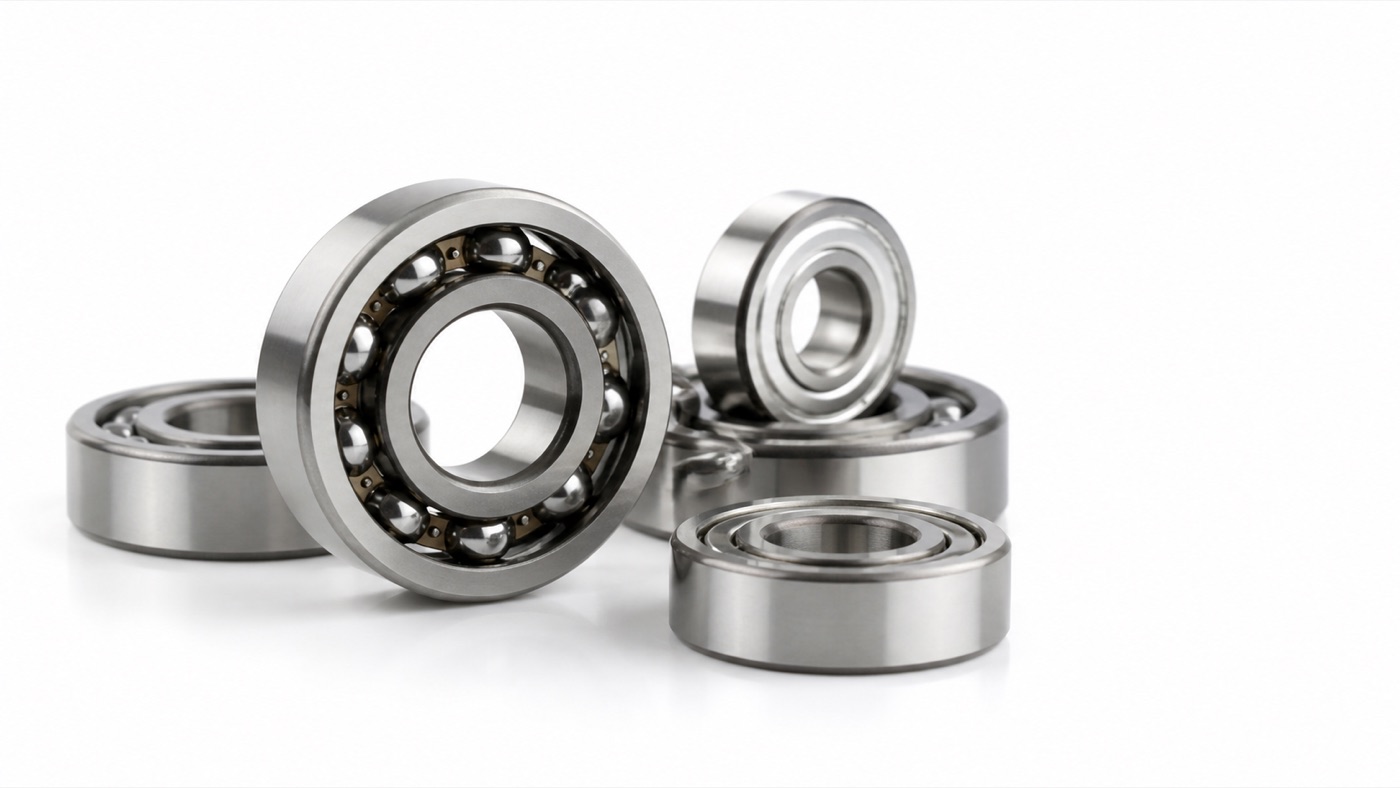
Bearings help a shaft, wheel, pulley, fan, motor rotor, or roller move without rubbing hard against the part that supports it.
The simplest way to understand a bearing is this:
A bearing carries the load while letting one part move smoothly against another part.
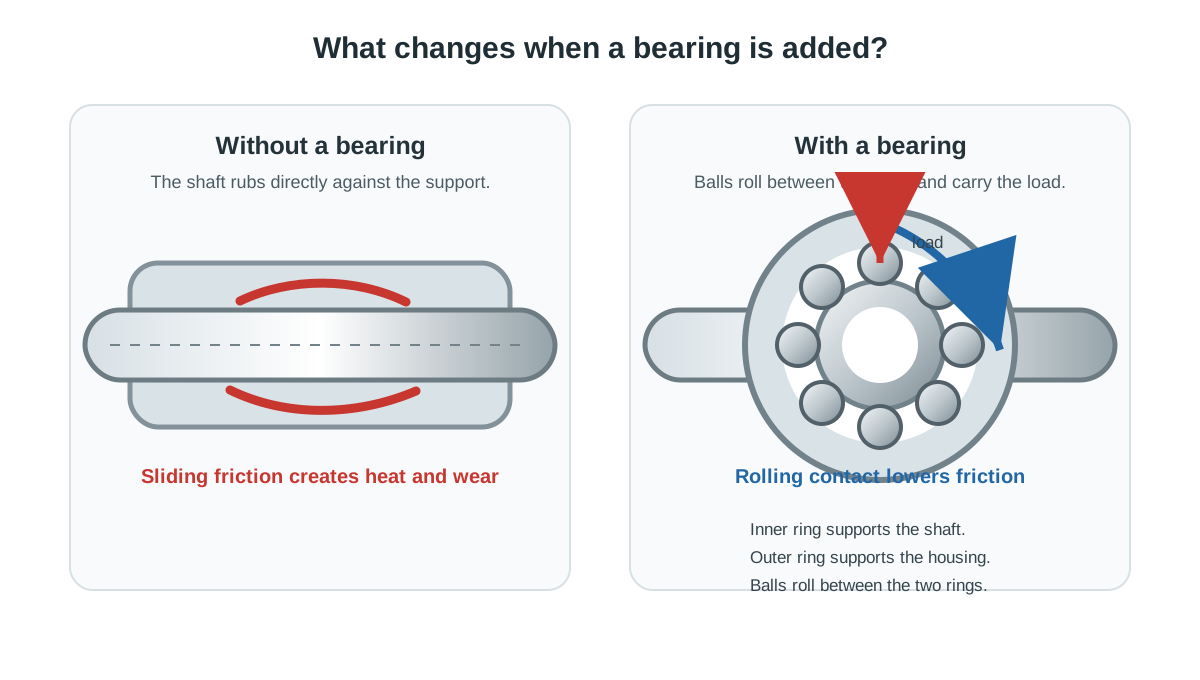
Without a bearing, a shaft may scrape directly against a hole in the housing. That creates friction, heat, wear, noise, and eventually failure. With a bearing, balls or rollers sit between the moving part and the fixed part. The machine still carries load, but the contact becomes controlled rolling motion instead of rough sliding contact.
That is why bearings are used in motors, wheels, conveyors, pumps, fans, tools, gearboxes, bicycles, small appliances, and many industrial machines.
The Basic Idea
Imagine a metal shaft turning inside a metal hole.
If the shaft touches the hole directly, the two surfaces rub against each other. The machine needs more power to turn, the parts heat up, and the surfaces wear.
A bearing adds a controlled middle layer:
- the shaft fits through the inner ring
- the machine housing supports the outer ring
- balls or rollers sit between the two rings
- the cage keeps the balls or rollers spaced correctly
- grease or oil helps protect the contact surfaces
When the shaft turns, the inner ring turns with it. The balls or rollers roll between the inner and outer rings. The outer ring stays supported by the housing. The load moves through the bearing instead of forcing the shaft and housing to scrape against each other.
The Main Parts of a Ball Bearing
A common ball bearing has a few parts that are easy to recognize.
| Part | Simple Meaning | What It Does |
|---|---|---|
| Inner ring | The ring near the shaft | Supports the rotating shaft or axle. |
| Outer ring | The ring near the housing | Transfers load into the machine body. |
| Balls | The rolling parts | Let the inner and outer rings move with less friction. |
| Cage | The separator | Keeps the balls evenly spaced. |
| Grease or oil | The lubricant | Reduces wear, heat, and noise. |
| Seals or shields | The covers | Help keep grease in and dirt out. |
The balls do not float freely inside the bearing. They roll in shaped grooves called raceways. These grooves guide the balls and help the bearing carry load in a predictable way.
For many motors, fans, small pumps, and general rotating shafts, deep groove ball bearings are a common starting point because they are compact, low-friction, and suitable for many radial-load applications.
How a Bearing Carries Load
A bearing does more than let a shaft spin. It also carries force.
For example, a conveyor roller may have product weight pressing down on it. A fan shaft may carry the weight of the rotor and extra force from airflow. A pump shaft may carry side load and thrust from the impeller.
That force travels through the bearing:
- The shaft pushes on the inner ring.
- The inner ring pushes on the balls or rollers.
- The balls or rollers push on the outer ring.
- The outer ring pushes into the housing.
Only part of the ball set carries the highest load at one time. As the bearing turns, the loaded zone changes. This is one reason lubrication, fit, clearance, and alignment matter. A bearing can be the correct size and still fail early if the machine pushes the load through it in the wrong way.
How Bearings Reduce Friction
Bearings reduce friction because rolling is usually easier than sliding.
Think about moving a heavy box. Dragging it across the floor is hard. Putting rollers under it makes it easier to move. A rolling bearing uses the same basic idea inside a machine, but in a much more accurate and controlled form.
This does not mean a bearing has no friction. Bearings still create some heat because:
- the balls or rollers press against the raceways
- grease or oil has resistance
- seals can rub
- the cage guides the rolling elements
- dirt, misalignment, or overload can add extra drag
So a bearing is not magic. It reduces friction, but it still needs the right size, load direction, lubrication, and installation.
Radial Load and Axial Load
Two load directions cause many bearing mistakes.
Radial load pushes across the shaft. A belt pulling down on a pulley is a radial load. The weight on a wheel is also mostly radial load.
Axial load pushes along the shaft. A screw jack, pump thrust, or vertical shaft can create axial load.
Many beginner mistakes come from using a radial bearing in a place where the main problem is thrust. A deep groove ball bearing can carry some axial load, but it is not always the right answer for heavy thrust. When axial load is the main question, it is better to review angular contact bearings, tapered roller bearings, or a dedicated thrust design; CXE Bearing explains that decision path in the thrust bearing selection guide.
Ball Bearings and Roller Bearings
The shape of the rolling element changes what the bearing is good at.
Ball bearings use balls. They are often good for lower friction, higher speed, and compact machines.
Roller bearings use rollers. Rollers spread load over a longer contact area, so they are often used where radial load or stiffness is higher. For heavier radial-load positions, buyers may review cylindrical roller bearings instead of assuming every rotating shaft needs a ball bearing.
Needle bearings are a narrow type of roller bearing. They are useful when radial space is limited.
Thrust bearings are made for load along the shaft.
The best bearing type depends on what the machine is asking the bearing to do.
Why Grease, Seals, and Fit Matter
Two bearings can have the same bore, outside diameter, and width but behave very differently.
One bearing may have contact seals. Another may have metal shields. One may use a different grease. One may have more internal clearance. One may be designed for higher speed or lower noise.
That is why replacement should not be based only on the main dimensions.
Before replacing a bearing, check:
- bearing number and suffix
- bore, outside diameter, and width
- seal or shield type
- grease or oil lubrication
- running speed
- radial load and axial load
- shaft fit and housing fit
- temperature, water, dust, or chemical exposure
- noise or vibration requirement
If a replacement bearing runs hot, do not immediately assume the bearing is defective. Heat can come from too much grease, too little clearance, tight fits, seal drag, misalignment, contamination, or axial load that the bearing was not meant to carry.
A Simple Example
Suppose a small electric motor uses a bearing at each end of the shaft.
The bearing near the drive end may carry belt tension or coupling force. The bearing at the other end may mainly support shaft position. Both bearings may look similar, but the machine may ask different jobs from each position.
If the motor starts making noise after a replacement, the issue may be:
- wrong seal type
- wrong clearance
- grease not suitable for the speed
- shaft or housing fit too tight
- installation force applied through the wrong ring
- contamination during assembly
The bearing is only one part of the system.
Beginner Checklist Before Asking for a Bearing
If you are not sure what bearing you need, send the bearing team as much simple information as possible.
- What machine is it used in?
- Where is the bearing installed?
- What is the old bearing number?
- What are the bore, outside diameter, and width?
- Does the load push across the shaft, along the shaft, or both?
- Does it run fast, hot, wet, dirty, or quietly?
- Is the bearing open, shielded, or sealed?
- Is it greased for life or relubricated?
- Do you have photos of the old bearing and the damaged area?
These details help CXE Bearing review the application instead of guessing from one part number.
FAQ
How do bearings work in simple words?
A bearing supports a moving part and lets it move with less friction. In a rolling bearing, balls or rollers carry load between two rings so the shaft or wheel can turn smoothly.
Why do machines need bearings?
Machines need bearings because moving metal parts cannot simply rub against fixed metal parts for long. Bearings reduce friction, control motion, carry load, and protect shafts and housings from direct wear.
Do bearings remove all friction?
No. Bearings reduce friction, but they still need lubrication and correct installation. Load, seals, grease, fit, speed, dirt, and misalignment can all create heat and wear.
What is the difference between a ball bearing and a roller bearing?
A ball bearing uses balls and is often chosen for low friction and higher speed. A roller bearing uses rollers and is often chosen when radial load or stiffness is higher.
Can I replace a bearing with one that has the same size?
Sometimes, but size alone is not enough. Check the suffix, seal type, internal clearance, cage, material, grease, speed, and load direction before replacing it.
Conclusion
Bearings work by supporting load and allowing controlled motion. They help shafts, wheels, rollers, and rotors move smoothly instead of rubbing directly against the machine body.
For beginners, the key is simple: first understand what the bearing must do, then choose the bearing type, size, seal, lubrication, and clearance that match the machine. A bearing that fits the hole is not always a bearing that works in the application.