
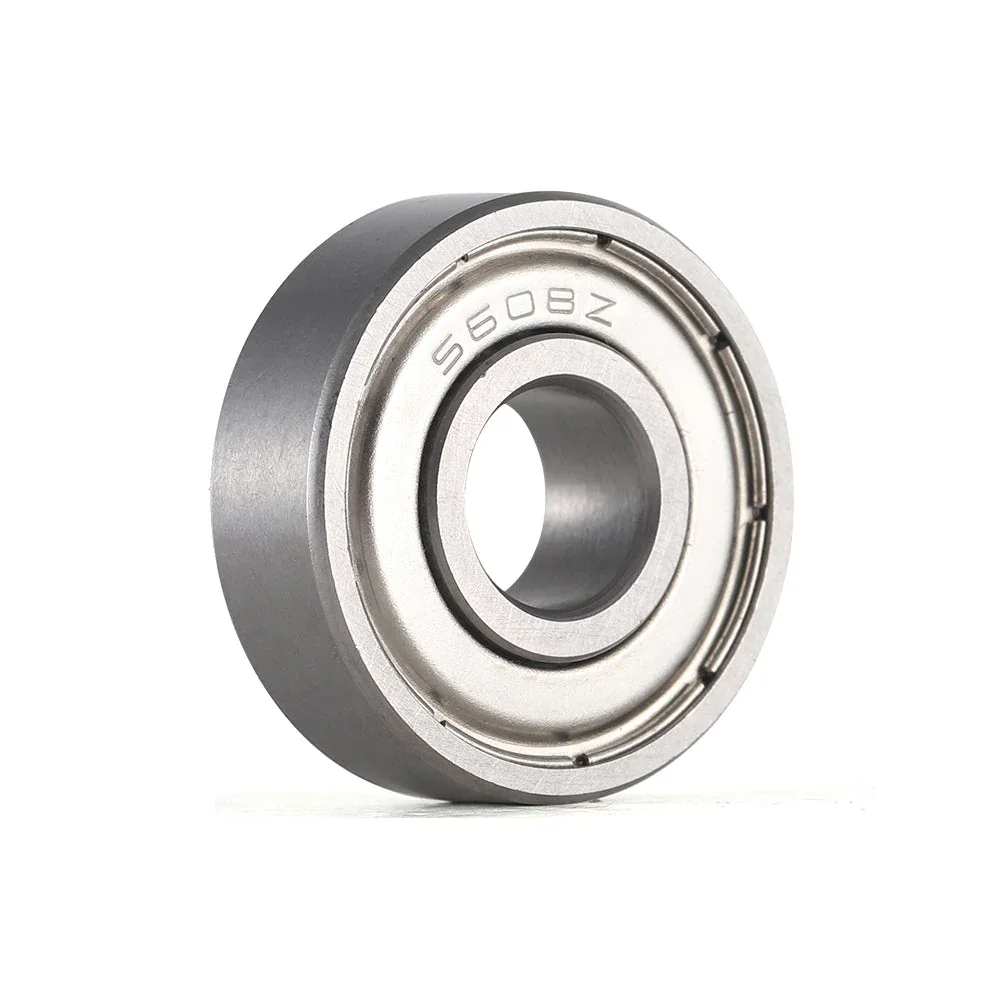
How to Heat Treat 17-4PH Stainless Steel Bearings?
To connect the material notes with purchasable categories, review CXE Bearing collections for stainless steel bearings, AISI 420 stainless bearings, and AISI 316 stainless steel bearings; these collection pages help narrow the grade choice before model-level confirmation.
When manufacturing components for high-chloride marine environments, standard bearing steel (like traditional chrome steel or 52100 steel) falls short due to rapid rusting. To solve this, engineers turn to 17-4PH, a precipitation-hardening martensitic stainless steel. The core of manufacturing a 17-4PH bearing lies in a highly coordinated, three-stage heat treatment process: “Solution + Conditioning + Aging.” This synergy achieves the high hardness (HRC 40+) required to resist rolling contact fatigue while balancing pitting resistance and toughness.
I. Core Logic and Stages of the Heat Treatment Process The heat treatment of 17-4PH bearings is not a single operation but a precisely controlled microstructural evolution. It aims to achieve the optimal balance of strength and corrosion resistance through the combined effects of the precipitation-strengthening phase (ε-Cu) and the tempered martensitic matrix.
Solution Treatment: This is the foundation for obtaining a supersaturated martensitic structure. The material must be heated above the Ac3 point (1020°C–1060°C) and held long enough for alloying elements to fully dissolve into a solid solution. It is then rapidly cooled (oil or water quench) to suppress carbide precipitation, yielding a high-hardness martensitic matrix. If the cooling rate is insufficient, an increase in retained austenite will lower the hardness and compromise the bearing’s load capacity.
Conditioning (Adjustment) Treatment: A critical intermediate step (approx. 780°C–810°C) between solution treating and aging. This step refines the grains, homogenizes the structure, and raises the martensite start (Ms) temperature. This significantly improves the material’s comprehensive mechanical properties—especially toughness and resistance to Stress Corrosion Cracking (SCC)—which is vital for bearings subjected to alternating loads.
Aging Treatment: This is the actual precipitation hardening process that determines the final hardness. The steel is held at 480°C–490°C, causing the supersaturated copper to precipitate as extremely fine, dispersed particles. This creates a significant precipitation-strengthening effect, while the tempering of the martensite relieves internal stresses.
II. Recommended Heat Treatment Parameters for Bearings Given the rigorous demands of bearings for high contact fatigue strength and dimensional stability, CXE Bearing recommends an optimized process route that includes the conditioning treatment. The specific parameters are detailed below:
Process Stage Recommended Temp (°C) Holding Time (min) Cooling Method Core Function & Mechanism
Preheating 860 90 (varies by wall thickness)
Reduces thermal stress and prevents cracking, especially suitable for thick-walled bearing rings.
Solution 1040 ± 10 120–180 (calculated by wall thickness) Oil cool to ≤250°C, then air cool Obtains a high-hardness martensitic matrix, eliminates structural segregation, and ensures alloying elements dissolve.
Conditioning 780 - 810 60 - 90 Air cool Refines grains, raises the Ms point, optimizes toughness, and prevents brittleness during subsequent aging.
Aging 480 - 490 180–240 (3 to 4 hours) Air cool Precipitates the ε-Cu strengthening phase, raising hardness to HRC 40-44 to meet bearing wear-resistance requirements.
*Note: Holding times should be calculated based on the effective wall thickness (S) using the formula: t = B + (K × S). For solution treatment: B = 30 min, K = 2 min/mm. For aging: B = 210 min, K = 2 min/mm.
III. Key Variables and Preventing Failure In actual bearing manufacturing, minor process deviations can lead to massive performance fluctuations. The following variables require strict attention:
Sensitivity to Aging Temperature: Aging temperature is inversely correlated with hardness. If the temperature rises above 570°C, reverted austenite will precipitate, causing a significant drop in strength and hardness. While aging at 480°C yields the highest hardness, it must be paired with the conditioning treatment to compensate for the loss of plasticity.
Selecting the Cooling Medium: The cooling rate after solution treatment directly dictates the amount of martensite transformation. Oil cooling to below 250°C followed by air cooling is the optimal method for balancing hardness and distortion. It ensures full martensitic transformation while minimizing quenching stresses that could warp the bearing rings.
Validating Contact Fatigue Performance: Fully heat-treated bearing materials must withstand high contact stresses (e.g., 1350 MPa) without plastic deformation on the surface. Studies show that 17-4PH samples treated with the optimized process above leave only bright pressure marks without noticeable indentation, fully meeting bearing manufacturing standards.
IV. Engineering Excellence at CXE Bearing The heat treatment of 17-4PH bearings is fundamentally about the precise manipulation of microstructural phase transformations. By gaining matrix strength through solution treatment, optimizing toughness reserves via conditioning, and locking in high hardness through precipitation aging, this three-stage mechanism gives 17-4PH its unique advantage. At CXE Bearing, we utilize these advanced metallurgical processes to provide bearing solutions that thrive in highly corrosive, high-load marine environments—places where traditional 52100 chrome steel simply cannot survive.