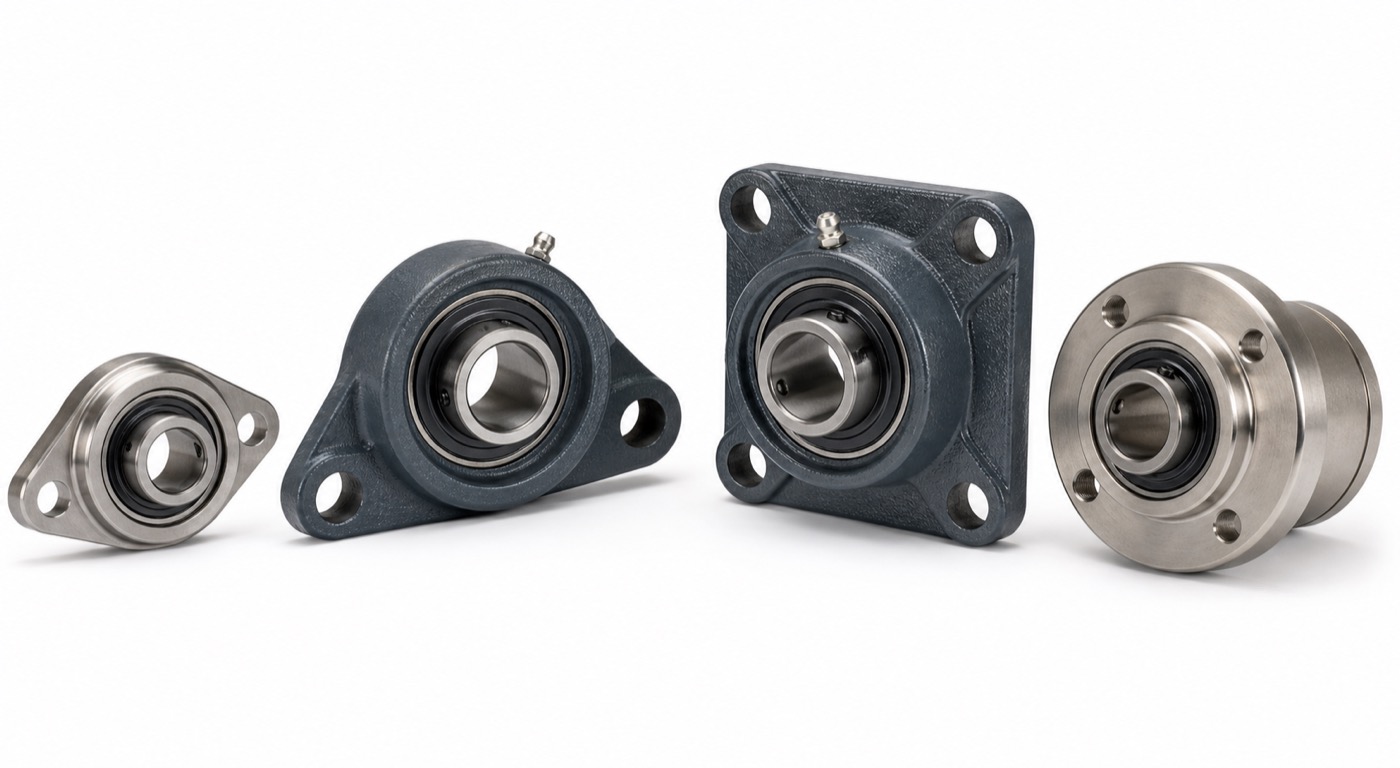
Quick answer: a flange bearing is a bearing with a flange feature that helps locate, support, or mount the bearing in a machine. The term is used in two common ways. It can mean a small bearing with a flange built into the outer ring, such as a miniature flanged ball bearing. It can also mean a mounted bearing unit with a flanged housing, such as a 2-bolt or 4-bolt flange bearing unit.
That difference matters. A small flanged ball bearing is usually pressed into a plate, wheel, roller, instrument, or compact mechanism. A flange bearing unit is usually bolted to a frame, conveyor side plate, agricultural implement, fan support, packaging machine, or other structure. Both use a flange to simplify location, but their dimensions, loads, mounting method, and replacement risks are different.
Key Takeaways
- A flange bearing is not one single product. It may be a flanged ball bearing, a mounted flange bearing unit, a flanged roller unit, or a flanged bushing.
- The first decision is whether the bearing must be pressed into a bore or bolted to a machine frame.
- For small flanged ball bearings, flange outside diameter and flange thickness matter as much as bore, OD, and width.
- For flange bearing units, shaft size alone is not enough. Buyers must match housing shape, bolt spacing, locking method, seal type, and material.
- 2-bolt flange units are compact and common for side-wall mounting; 4-bolt flange units provide a broader mounting base where space allows.
- Stainless, thermoplastic, sealed, relubricatable, or covered designs should be selected by environment, not by product name alone.
- A flange helps locate or mount the bearing, but it does not correct poor shaft alignment, weak machine frames, distorted housings, or contamination.
Quick Answer Table
| Question | Short Answer |
|---|---|
| What is a flange bearing? | A bearing with a flange or flanged housing used for axial location, bolted mounting, or easier positioning in a machine. |
| Is a flanged ball bearing the same as a flange bearing unit? | No. A flanged ball bearing usually has a flange on the outer ring. A flange bearing unit has a bearing mounted inside a flanged housing. |
| What are common flange bearing unit styles? | 2-bolt oval or diamond flange, 3-bolt flange, 4-bolt square flange, round flange, piloted flange, and cartridge-style units. |
| What should buyers confirm? | Shaft size, flange shape, bolt pattern, housing material, locking method, seal type, bearing insert, load, speed, environment, and lubrication. |
| What is the biggest replacement risk? | Matching the bore but missing the flange pattern, locking method, seal type, or housing geometry. |
Why the Word “Flange Bearing” Causes Confusion
Different buyers use the same term for different products. One buyer may be looking for a miniature F688ZZ flanged ball bearing for a guide wheel. Another buyer may need a UCF205 4-bolt flange bearing unit for a conveyor shaft. Both may search for “flange bearing,” but the drawings, dimensions, installation method, and failure risks are completely different.
| Term | Common Meaning | Typical Use |
|---|---|---|
| Flanged ball bearing | Small radial ball bearing with a flange on the outer ring | Miniature mechanisms, rollers, guide wheels, robotics, instruments, small motors. |
| Flange bearing unit | Bearing insert mounted in a flanged housing | Conveyors, shafts, agricultural equipment, packaging machines, fans, mounted supports. |
| 2-bolt flange bearing | Oval or diamond housing with two mounting holes | Compact shaft supports and side-wall mounting. |
| 4-bolt flange bearing | Square housing with four mounting holes | Stronger mounted support with better bolt stability. |
| Piloted flange bearing | Flange unit with a locating pilot | More controlled housing location and concentric mounting. |
| Flanged sleeve bearing | Plain bearing or bushing with a flange | Low-speed pivots, sliding motion, light shafts, spacers. |
The practical rule is simple: identify the machine interface first. If the bearing sits inside a wheel, pulley, small plate, or thin bracket, start with flanged ball bearing dimensions. If the bearing supports a shaft and bolts to a frame, start with flange bearing unit dimensions.
Main Functions of a Flange
The flange changes how the bearing is located and installed. It can provide axial location, a mounting face, and repeatable assembly position.
| Function | What It Does |
|---|---|
| Axial location | Helps prevent the bearing from sliding through a bore or housing. |
| Mounting surface | Provides a face that can be bolted to a frame or plate. |
| Simplified assembly | Reduces the need for separate shoulders, plates, or retaining hardware. |
| Position repeatability | Helps locate the shaft support in the same position during replacement. |
| Service access | Allows a bearing unit to be removed from the outside of a machine frame. |
| Compact design | Useful where the bearing must sit in a thin wall, panel, wheel, or bracket. |
In a good design, the flange supports alignment and location. In a poor design, the flange can become a stress point if the mounting surface is uneven, bolts are loose, or the shaft is misaligned.
Main Types of Flange Bearings
Flanged Ball Bearings
Flanged ball bearings are radial ball bearings with a flange on the outer ring. They are common in miniature and small-size applications where the bearing must be located against a plate, wheel shoulder, or bracket face.
Typical examples include F series miniature flanged bearings, MF series miniature flanged bearings, inch-series flanged miniature bearings, shielded flanged bearings, sealed flanged bearings, stainless flanged ball bearings, and hybrid ceramic flanged ball bearings for special applications.
These bearings are selected by bore, outside diameter, width, flange outside diameter, flange thickness, shield or seal type, material, precision, clearance, and lubrication. For broader product grouping, CXE Bearing keeps a dedicated flange bearings collection for related product paths.
Flange Bearing Units
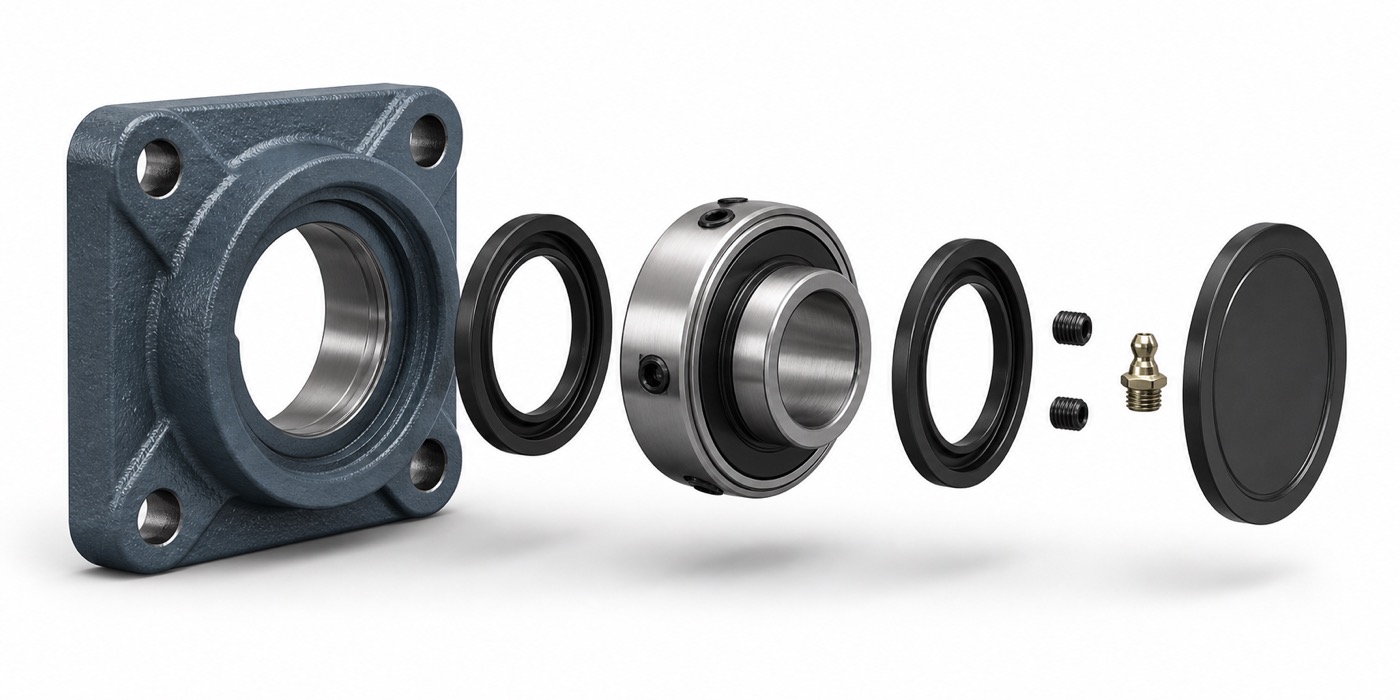
Flange bearing units are mounted bearing assemblies. They usually combine a bearing insert, a housing, seals, and a locking method. The housing has a flange with bolt holes for mounting to a frame or wall.
Common styles include 2-bolt oval flange units, 2-bolt diamond flange units, 3-bolt flange units, 4-bolt square flange units, round flange units, piloted flange units, flanged cartridge units, and stainless or thermoplastic flange units for wet or washdown environments.
These units are often used when a shaft needs support at a machine wall or side plate and when a simple bolted assembly is preferred over a custom bearing housing.
Flanged Roller Bearing Units
Flanged roller bearing units use roller bearings instead of ball bearings. They are used where load, shock, or durability requirements exceed what a ball bearing unit can comfortably handle. Depending on the design, the internal bearing may be a spherical roller bearing, tapered roller bearing, or another roller arrangement.
Flanged Plain Bearings and Bushings
Not every flange bearing uses rolling elements. A flanged sleeve bearing or flanged bushing is a plain bearing with a flange. It supports sliding motion instead of rolling motion and is common in pivots, linkages, low-speed shafts, light-duty supports, bronze bushings, polymer bushings, and self-lubricating designs.
Flanged Ball Bearing vs Flange Bearing Unit
This is the most important distinction in the topic.
| Feature | Flanged Ball Bearing | Flange Bearing Unit |
|---|---|---|
| Flange location | Built into the bearing outer ring | Built into the housing |
| Typical size | Small to miniature, but can vary | Larger mounted shaft supports |
| Mounting method | Pressed into a bore, plate, wheel, or bracket | Bolted to a machine frame or wall |
| Shaft support | Compact light-to-moderate duty | Structural support for rotating shafts |
| Replacement risk | Flange OD and thickness may be missed | Bolt pattern, housing shape, locking method, and insert may be missed |
| Common applications | Instruments, rollers, guide wheels, robotics, small mechanisms | Conveyors, agriculture, fans, packaging, material handling |
| Main specification data | Bore, OD, width, flange OD, flange thickness | Shaft size, bolt spacing, housing style, insert type, locking method |
If a buyer says “flange bearing,” ask whether they mean a bearing with a small flange on the outer ring or a mounted bearing unit with a bolted flange housing.
Anatomy of a Flange Bearing Unit
A flange bearing unit usually includes more parts than the short product name suggests.
| Component | Function | Selection Note |
|---|---|---|
| Bearing insert | Supports the shaft and carries load | Confirm bore, internal design, seals, clearance, and relubrication feature. |
| Housing | Holds the bearing insert and bolts to the machine | Check shape, material, bolt pattern, pilot, and mounting face. |
| Flange | Provides bolt holes and mounting face | Match bolt spacing and available machine surface. |
| Locking method | Locks the bearing to the shaft | Set screw, eccentric locking collar, adapter sleeve, concentric clamp, or other method. |
| Seals | Protect the bearing insert | Match dust, water, washdown, grease, and contamination conditions. |
| Grease fitting | Allows relubrication on many units | Confirm maintenance access and grease compatibility. |
| Covers or end caps | Protect rotating shaft ends or improve safety | Important near operators, food equipment, or exposed rotating parts. |
Mounted units are convenient because they arrive as assemblies, but they still require correct alignment, mounting surface preparation, bolt tightening, lubrication, and shaft fit.
Common Flange Housing Shapes
Flange bearing units are often described by housing shape and bolt pattern.
| Housing Style | Description | Typical Use |
|---|---|---|
| 2-bolt oval flange | Oval or diamond-shaped housing with two bolts | Compact side-wall mounting, conveyors, light shafts. |
| 4-bolt square flange | Square housing with four bolts | More stable mounting where space allows. |
| 3-bolt flange | Triangular bolt pattern | Equipment with limited space or specific frame geometry. |
| Round flange | Circular housing face with multiple bolt holes | Piloted or cartridge-style mounting. |
| Piloted flange | Has a locating pilot or register | Better centering in a machined opening. |
| Flanged cartridge | Cartridge-style unit inserted into a bore or frame | Replacement and service-friendly arrangements. |
| Pressed steel flange | Lighter housing construction | Light-duty equipment and cost-sensitive designs. |
| Cast iron flange | Rigid housing for general industrial use | Conveyors, fans, agriculture, material handling. |
| Stainless or thermoplastic flange | Corrosion-resistant or washdown-friendly housing | Food, packaging, wet, or corrosive environments. |
The bolt pattern often decides whether a replacement fits the machine even when the shaft size is correct.
Materials, Seals, and Lubrication
Material selection depends on load, corrosion, washdown, temperature, speed, cost, and maintenance. Bearing rings and balls may use chrome steel, stainless steel, hybrid ceramic, or other designs for special cases. Housings may use cast iron, pressed steel, stainless steel, thermoplastic, zinc alloy, or aluminum depending on the application.
For wet or washdown applications, corrosion resistance is a system issue. Stainless rings alone do not solve all problems if the housing, locking screws, seals, grease, or shaft are not compatible with the environment. Stainless mounted products and washdown-related options can be reviewed through the stainless steel mounted bearings path when corrosion resistance is part of the specification.
| Condition | Better Direction |
|---|---|
| Clean, low-contamination application | Shielded or open design may reduce drag. |
| Dusty conveyor or outdoor equipment | Sealed insert or stronger external protection may be needed. |
| Wet or washdown environment | Stainless or thermoplastic housing, suitable seals, and compatible grease should be reviewed. |
| High-speed shaft | Seal drag, grease fill, cage design, and heat become important. |
| Hard-to-access bearing | Relubrication interval, grease fitting access, and sealed-for-life design must be evaluated. |
| Food or packaging equipment | Material, grease, washdown, and corrosion resistance may all matter. |
Do not assume a sealed bearing is always better. Contact seals may increase friction and heat. Do not assume an open bearing is always faster in real equipment either, because contamination can quickly damage the raceways.
Applications for Flange Bearings
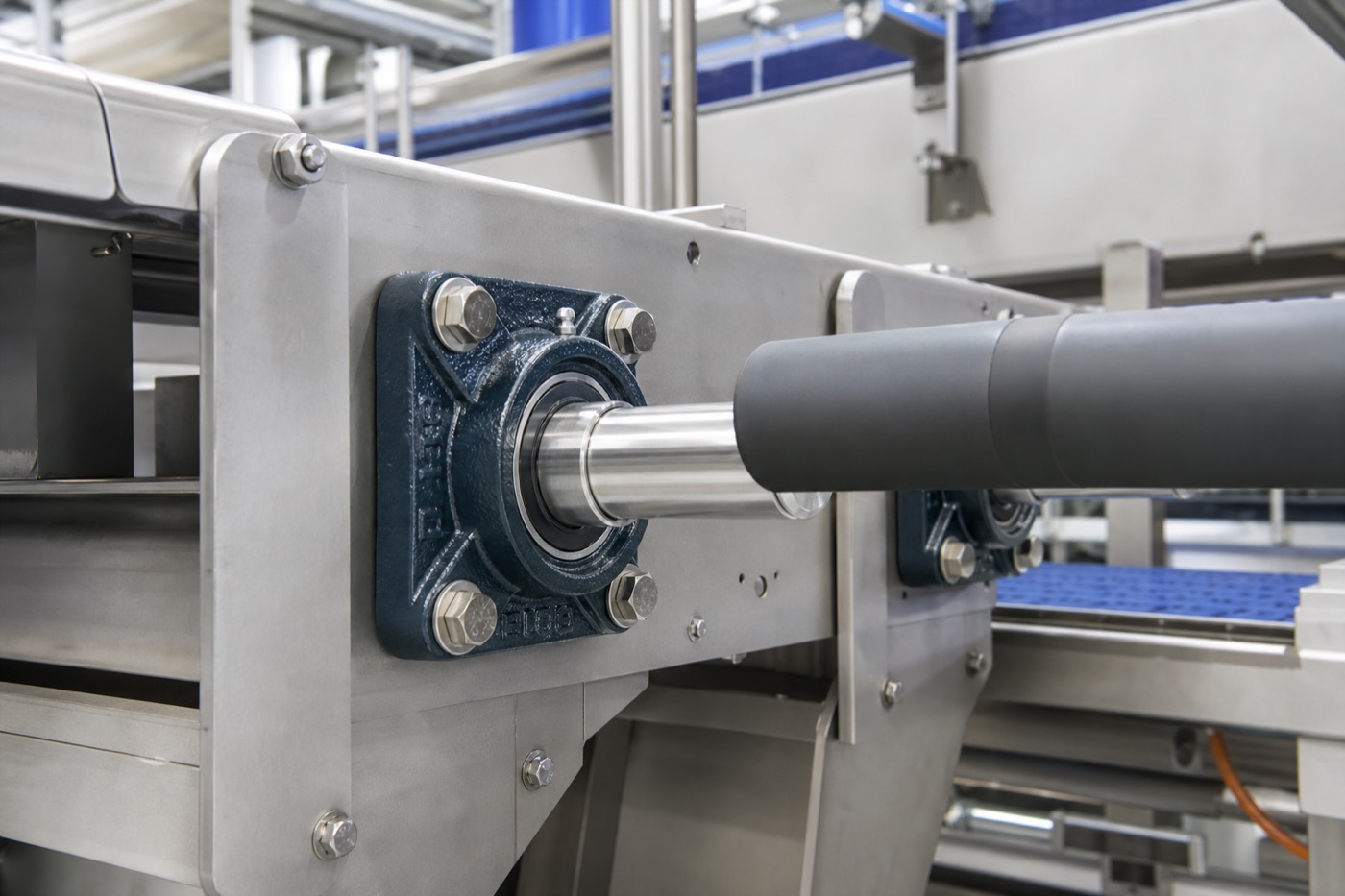
Flange bearings are common wherever a rotating shaft or small rotating element must be mounted against a plate, wall, frame, or housing face.
| Application | Common Flange Bearing Type | Selection Focus |
|---|---|---|
| Conveyors | 2-bolt or 4-bolt flange bearing units | Shaft size, sealing, grease, bolt pattern, contamination. |
| Agricultural machinery | Cast iron flange units, sealed inserts | Dirt, shock, moisture, relubrication, housing strength. |
| Food and packaging equipment | Stainless or thermoplastic flange units | Washdown, corrosion, grease, seals, hygiene requirements. |
| Fans and blowers | Flanged ball bearing units | Speed, heat, alignment, vibration, relubrication. |
| Pumps and compressors | Flanged units or special flanged bearings | Load direction, sealing, temperature, lubrication. |
| Small rollers and guide wheels | Flanged ball bearings | Flange OD, width, shield/seal, low noise, smooth rotation. |
| Robotics and automation | Miniature flanged bearings | Precision, low torque, compact positioning, clean grease. |
| Material handling | Flange bearing units | Bolt pattern, housing material, shaft locking, contamination. |
Where compact corrosion resistance matters, stainless flange ball bearings may be more relevant than a larger mounted unit.
How to Select a Flange Bearing
Start with the machine interface, not only the bearing bore.
| Step | What to Confirm |
|---|---|
| 1. Product family | Flanged ball bearing, flange bearing unit, flanged bushing, or roller flange unit. |
| 2. Shaft or bore size | Shaft diameter for mounted units; bore size for small flanged bearings. |
| 3. Housing or mounting geometry | Flange OD, flange thickness, bolt hole spacing, pilot diameter, or housing shape. |
| 4. Load direction | Radial load, axial load, combined load, shock load, or moment load. |
| 5. Speed | Operating rpm, startup behavior, heat, seal drag, and lubrication. |
| 6. Environment | Dust, water, washdown, humidity, chemical exposure, outdoor use, or clean indoor use. |
| 7. Material | Chrome steel, stainless, ceramic, cast iron, thermoplastic, bronze, or polymer. |
| 8. Seal design | Open, shielded, contact seal, non-contact seal, multiple-lip seal, or external cover. |
| 9. Lubrication | Pre-greased, relubricatable, oil-lubricated, food-grade, or high-temperature grease. |
| 10. Locking method | Set screw, eccentric collar, adapter sleeve, clamp, or interference fit. |
| 11. Replacement constraints | Brand suffix, bolt pattern, housing height, shaft shoulders, covers, and access. |
| 12. Documentation | Drawing, part number, photos, removed bearing, and application details. |
If the application is a replacement, photos of the old bearing and housing are often more useful than a partial part number.
Dimensions Buyers Should Know
For a small flanged ball bearing, ask for bore diameter, outside diameter, bearing width, flange outside diameter, flange thickness, open/shielded/sealed design, material, precision, clearance, and lubrication.
For a flange bearing unit, ask for shaft diameter, housing style, bolt hole spacing, bolt hole size, overall housing dimensions, mounting surface height, bearing insert series, locking method, seal type, housing material, grease fitting position, and end cover requirement.
Many replacement errors happen because the bore matches but the flange geometry does not.
Mounting and Installation Basics
Good installation is as important as correct product selection.
For flanged ball bearings:
- Keep the bearing clean until installation.
- Press on the correct ring during installation.
- Do not push mounting force through the balls.
- Confirm the flange seats fully against the mounting face.
- Check that the bore, plate, wheel, or bracket does not distort the bearing.
- Avoid burrs, paint buildup, and misaligned holes.
- Confirm any spacer or retaining feature does not rub against the seal.
For flange bearing units:
- Mount the unit on a flat, clean surface.
- Confirm bolt spacing and shaft alignment before tightening.
- Tighten mounting bolts evenly.
- Align the shaft before locking the bearing to the shaft.
- Follow the correct locking sequence for set screws, eccentric collar, adapter sleeve, or clamp.
- Check that grease fittings are accessible.
- Avoid forcing the unit to compensate for a bent shaft or misaligned frame.
- After startup, check temperature, noise, vibration, and bolt tightness.
If a flange bearing unit runs hot immediately after installation, check alignment, shaft fit, axial restraint, grease fill, seal drag, and locking method before changing bearing type.
Common Replacement Mistakes
| Mistake | Why It Causes Trouble |
|---|---|
| Matching only the bore | Flange OD, bolt pattern, width, and housing shape may not fit. |
| Ignoring the locking method | A set screw unit and eccentric collar unit may mount differently. |
| Replacing cast iron with light pressed steel | Housing stiffness and durability may change. |
| Choosing stainless rings but not stainless hardware | Corrosion can still attack screws, shaft, housing, or grease fittings. |
| Assuming all 2-bolt units interchange | Bolt spacing, housing profile, and insert position can differ. |
| Overtightening bolts on an uneven surface | Housing distortion can increase bearing heat and wear. |
| Ignoring shaft condition | A worn shaft can cause slip, fretting, vibration, and loose fit. |
| Forgetting relubrication access | A grease fitting that cannot be reached may turn a relubricatable unit into a neglected unit. |
| Treating misalignment capacity as permission for poor installation | Misalignment still increases stress, seal wear, and heat. |
Failure Symptoms and Causes
| Symptom | Possible Cause | What to Check |
|---|---|---|
| Bearing runs hot | Misalignment, too much grease, tight fit, seal drag, axial preload, housing distortion | Shaft alignment, mounting surface, grease, lock method, seal type. |
| Housing bolts loosen | Vibration, soft mounting surface, wrong bolt, poor torque, shock load | Bolt grade, washers, thread condition, mounting face, load direction. |
| Shaft slips in bearing | Wrong locking method, worn shaft, loose set screw, contamination | Shaft diameter, lock collar, screw marks, fretting. |
| Seal fails early | Contamination, misalignment, over-greasing, heat, wrong seal material | Environment, grease, shaft runout, seal contact. |
| Noise or vibration | Poor alignment, damaged bearing, loose housing, bad shaft fit | Mounting, removed bearing marks, shaft condition. |
| Corrosion | Water, washdown, chemical exposure, poor material choice | Stainless or thermoplastic options, grease, covers, storage. |
Failure analysis should include the bearing, shaft, housing, bolts, grease, seals, and machine frame. Replacing only the bearing may repeat the same failure.
When Not to Use a Flange Bearing
A flange bearing is useful, but it is not always the right solution.
Review another arrangement when:
- The mounting surface is too thin or too flexible.
- The load is far from the bearing centerline and creates high moment load.
- Shock load is severe and the housing may crack or deform.
- Shaft misalignment is large or uncontrolled.
- The bearing must float axially for thermal expansion but the flange arrangement fixes it too tightly.
- The environment needs a special seal, washdown design, or corrosion package.
- The application needs very high precision rather than convenient mounting.
- The machine requires a custom housing for stiffness, preload, or oil lubrication.
In critical machines, the easiest-to-bolt bearing is not always the best bearing arrangement.
RFQ Checklist
Send these details when requesting flange bearings from CXE Bearing:
- Do you need a small flanged ball bearing or a mounted flange bearing unit?
- Existing part number and suffix.
- Photos of the old bearing and mounting location.
- Shaft diameter or bearing bore.
- For flanged ball bearings: OD, width, flange OD, and flange thickness.
- For flange units: 2-bolt, 3-bolt, 4-bolt, round, piloted, or cartridge style.
- Bolt hole spacing and bolt size.
- Housing material: cast iron, pressed steel, stainless steel, thermoplastic, or other.
- Locking method: set screw, eccentric collar, adapter sleeve, clamp, or unsure.
- Seal or shield requirement.
- Lubrication requirement and relubrication access.
- Load direction, speed, duty cycle, and temperature if known.
- Environment: dust, washdown, humidity, chemicals, outdoor, food equipment, or clean indoor.
- Quantity, packaging, labeling, certificate, and delivery requirement.
This information allows CXE Bearing to quote the correct flange bearing instead of matching only the bore size.
FAQ
What is a flange bearing?
A flange bearing is a bearing with a flange feature used for location or mounting. It may be a small flanged ball bearing or a bearing insert mounted in a flanged housing.
What is the difference between a flanged bearing and a flange bearing unit?
A flanged bearing usually has a flange on the bearing outer ring. A flange bearing unit has a bearing mounted inside a bolted flanged housing.
What is a 2-bolt flange bearing used for?
A 2-bolt flange bearing unit is used to support a shaft on a machine wall or frame where compact mounting is needed. It is common in conveyors, light machinery, agricultural equipment, and material handling systems.
What is a 4-bolt flange bearing used for?
A 4-bolt flange bearing unit provides a wider mounting base than many 2-bolt styles. It is often used where the mounting surface allows more space and stronger support is needed.
Are flange bearings self-aligning?
Some mounted flange bearing units can accommodate minor static misalignment because of the bearing insert and housing seat. This does not mean the shaft or frame can be badly misaligned.
Can flange bearings handle axial load?
Some flange bearings can carry limited axial load, but the allowable axial load depends on the bearing type, insert design, housing, locking method, speed, and catalog rating. For high thrust load, review the bearing arrangement carefully.
Are stainless steel flange bearings better?
Stainless steel flange bearings are better for corrosion-sensitive, humid, or washdown environments. They are not automatically better for every load, speed, or cost requirement.
How do I identify a replacement flange bearing?
Record the part number, shaft size, flange shape, bolt spacing, housing material, locking method, seal type, and photos of the installation. For small flanged ball bearings, also measure flange outside diameter and flange thickness.
Why does my flange bearing run hot after installation?
Common causes include misalignment, housing distortion, too much grease, seal drag, tight fit, axial preload, or incorrect locking sequence. Check installation before assuming the bearing type is wrong.
What information should I send for a flange bearing quote?
Send shaft size, bearing or unit type, flange dimensions, bolt pattern, housing material, locking method, seals, lubrication, application, speed, load, environment, quantity, and delivery requirement.