
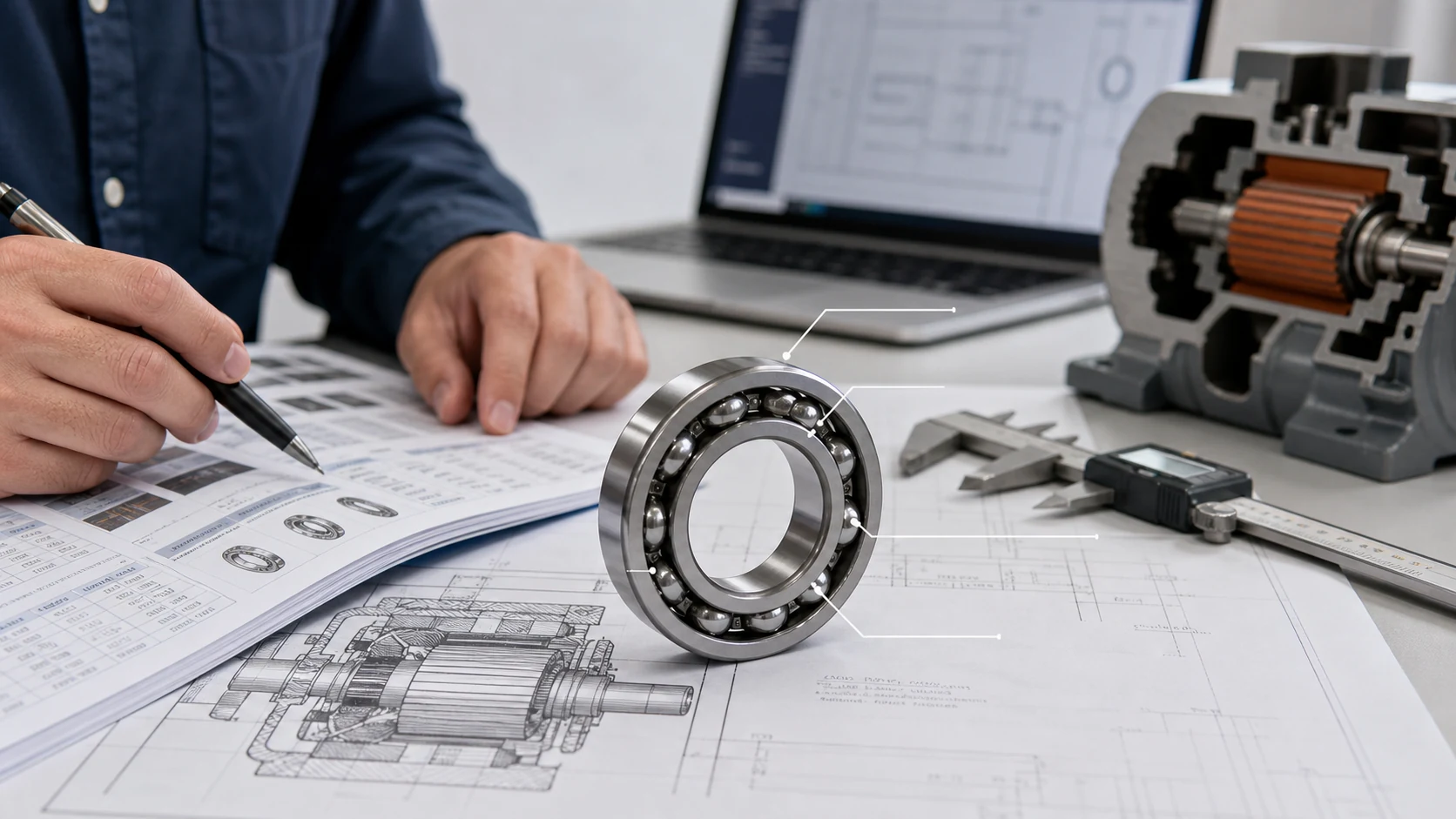
Quick answer: ceramic ball bearings are better than steel bearings only when the application actually benefits from ceramic material properties. Hybrid ceramic bearings are often better for high speed, electrical insulation, lower rolling-element mass, reduced friction, and selected high-speed marginal-film conditions. Full ceramic bearings can be better for special corrosion, non-magnetic, electrical, or chemical environments. Stainless steel bearings are often the better corrosion-resistant choice for wet or washdown machinery. Steel bearings are still the better default for most industrial machines because they are economical, widely available, tough under shock, easier to source in standard sizes, and well proven for normal radial and combined-load duty.
The right question is not “Is ceramic better?” The useful question is “Which bearing construction matches the load, speed, environment, lubrication, electrical risk, and budget?” A ceramic upgrade can solve a real problem, but it can also add cost without fixing the root cause of heat, contamination, misalignment, preload error, or poor sealing.
| If the Main Problem Is… | Better Starting Point |
|---|---|
| Normal industrial radial load and standard speed | GCr15 chrome steel or stainless steel ball bearing. |
| High-speed motor, spindle, or compact high-speed assembly | Hybrid ceramic bearing, often with silicon nitride balls. |
| Inverter-driven motor or electrical fluting risk | Hybrid ceramic bearing or insulated bearing, reviewed with the motor grounding system. |
| Washdown or mild corrosion | Stainless steel bearing before full ceramic in many loaded designs. |
| Chemical exposure, non-magnetic requirement, or special clean environment | Full ceramic bearing or ceramic hybrid, after material compatibility review. |
| Shock load, impact, rough handling, or heavy contamination | Steel bearing with correct sealing, lubrication, fit, and load capacity. |
| Cost-sensitive MRO replacement | Steel bearing unless failure evidence supports a ceramic upgrade. |
First, Define What “Ceramic Bearing” Means
Ceramic bearing is not one construction. Buyers often use the same phrase for full ceramic bearings, hybrid ceramic bearings, and steel bearings with ceramic coatings. Those choices behave differently in the machine.
For most industrial upgrades, ceramic bearing usually means hybrid ceramic first. Full ceramic bearings should be reviewed when the rings also need ceramic properties, such as chemical resistance, non-magnetic behavior, electrical insulation, vacuum compatibility, or special temperature performance.
| Bearing Construction | What It Usually Means | Where It Fits Best | Main Caution |
|---|---|---|---|
| Steel ball bearing | Steel rings and steel balls, usually GCr15 chrome steel or stainless steel | General motors, pumps, fans, conveyors, gearboxes, rollers, and MRO replacement | Can suffer corrosion, electrical erosion, or speed-related heat if the environment is wrong. |
| Hybrid ceramic bearing | Steel rings with ceramic rolling elements, commonly silicon nitride balls | High speed, electric motors, spindle-like duty, inverter current risk, lower friction targets | Steel rings still need corrosion protection; grease, cage, fit, and clearance still control service life. |
| Full ceramic bearing | Ceramic rings and ceramic balls, often zirconia, silicon nitride, or silicon carbide | Special chemical, non-magnetic, electrical insulation, vacuum, high-temperature, or clean applications | More brittle than steel in shock or edge loading; exact material and cage choice matter. |
| Ceramic-coated insulated bearing | Steel bearing with an insulating ceramic coating on a ring surface | Electric motors and generators where bearing current is the main issue | Does not fix load, lubrication, heat, contamination, or alignment problems by itself. |
For most U.S. industrial sourcing, the practical comparison is steel versus hybrid ceramic. Full ceramic bearings are important, but they are not the automatic upgrade for a 6205, 6306, miniature bearing, pump bearing, or motor bearing unless the environment justifies the change.
That matters because a full ceramic bearing is not simply a steel bearing made from a different material. The rings, balls, cage, clearance, preload, lubrication path, and mounting condition all have to be reviewed together. Ceramic materials have different stiffness, thermal expansion, surface behavior, and brittleness than bearing steel, so a same-size replacement can still be the wrong engineering choice if the original failure came from fit, shock, overload, or lubrication error.
Ceramic vs Steel Ball Bearings: Practical Comparison
Ceramic bearings win when their material behavior solves a specific limitation. Steel bearings win when the machine needs toughness, standard availability, predictable load capacity, and low total cost.
| Comparison Point | Ceramic or Hybrid Ceramic Advantage | Steel Bearing Advantage | Buying Note |
|---|---|---|---|
| Speed | Ceramic rolling elements are lighter and can reduce centrifugal effects in high-speed duty. | Steel works well across most standard industrial speeds. | Check catalog limiting speed, grease, seal drag, cage, and bearing size. |
| Friction and heat | Hybrid ceramic can run with lower rolling friction in the right design. | A correct steel bearing can run cool if grease, clearance, and seals are right. | Do not use ceramic to hide excess grease, tight fit, or wrong preload. |
| Electrical insulation | Silicon nitride rolling elements help interrupt current through the rolling contact. | Standard steel bearings conduct current and can be damaged by electrical erosion. | Inverter motors may also need grounding or system-level mitigation. |
| Corrosion | Full ceramic can resist many corrosive environments depending on material. | Stainless steel is often more practical for washdown and mild corrosion. | Hybrid ceramic still has steel rings unless rings are stainless or coated. |
| Temperature | Full ceramic or special hybrid designs may fit selected high-temperature or lubricant-limited cases. | Steel works well when the lubricant, clearance, cage, and ring fits remain inside normal limits. | Do not select by temperature alone; review lubricant and mounted clearance. |
| Load and shock | Full ceramic may be useful in special light or precision duty. | Steel is usually tougher under impact, shock, and rough installation. | Review static load, shock, shaft support, and housing stiffness before changing material. |
| Lubrication | Hybrid ceramic bearings may reduce smearing risk in selected high-speed or marginal-film conditions. | Steel bearings are proven when lubrication is correct and contamination is controlled. | Do not treat ceramic as a general no-lubrication solution. |
| Noise and precision | Hybrid ceramic can support high-speed precision designs. | Low-noise steel bearings are common and economical for motors and appliances. | Raceway quality, grease cleanliness, cage, and handling affect noise as much as material. |
| Common applications | High-speed motors, electrically sensitive drives, spindles, instruments, clean fixtures, and special chemical cases. | Motors, pumps, fans, conveyors, rollers, gear reducers, MRO replacement, and rougher industrial equipment. | Match the bearing construction to the failure mode and duty cycle. |
| Cost and lead time | Worth it when downtime, speed, or electrical damage makes the upgrade economical. | Lower cost, broader inventory, easier interchange, and faster replacement. | Do not pay for ceramic unless the machine has a ceramic-sized problem. |
When Ceramic Ball Bearings Are Better
Ceramic or hybrid ceramic bearings are better when the steel bearing is failing for a reason that ceramic material properties can address. They should be treated as an engineering solution, not a premium label.
High-Speed Motors and Spindle-Like Equipment
Hybrid ceramic bearings are often a strong option when speed is high enough that rolling-element mass, heat generation, grease stress, and cage stability become limiting factors. Silicon nitride balls are lighter than steel balls, and that can reduce centrifugal loading and heat in high-speed operation.
This is why ceramic balls appear in many spindle and high-speed motor applications. Technical bearing guidance often treats ceramic rolling elements as useful for lower friction, higher speed capability, and electrical insulation. The important boundary is that high speed is not RPM alone. A larger bearing at the same RPM has a higher rolling-element speed than a smaller bearing. Before selecting hybrid ceramic, confirm bearing size, pitch diameter, RPM range, grease, seal or shield type, cage, internal clearance, shaft fit, housing fit, and temperature trend.
For high-speed ceramic or hybrid ceramic designs, manufacturing quality also matters more than many buyers expect. Ceramic ball roundness, surface finish, raceway roughness, groove curvature, cage stability, and grease cleanliness all influence heat, vibration, and noise. A ceramic ball alone does not make a noisy or hot assembly into a precision-speed bearing if the surrounding geometry and lubricant system are not controlled.
Inverter Motors and Bearing Current Risk
Hybrid ceramic bearings can be better when electrical current is damaging steel bearing raceways. Electrical erosion can create fluting, frosting, or washboard-like marks on the raceway. In that case, replacing the failed bearing with the same all-steel bearing may repeat the failure.
Silicon nitride rolling elements provide electrical insulation through the rolling contact, so hybrid ceramic bearings are often reviewed for inverter-driven motors, compact high-speed motors, generators, and other electrically sensitive rotating equipment. Ceramic-coated insulated bearings are another path when the problem is current transmission through the bearing.
The bearing should not be the only electrical review. Shaft grounding, drive settings, cable layout, motor frame grounding, filters, and current path can all influence whether bearing current returns. A hybrid bearing may be correct, but the surrounding motor system still has to be checked.
Low Friction, Lower Heat, and Grease Life Priorities
Hybrid ceramic bearings can be better when the application is already well designed and the remaining problem is heat, friction, or lubricant stress at high speed. In these cases, ceramic rolling elements may help the bearing run cooler or more efficiently than an all-steel version, depending on the exact bearing design.
This advantage disappears if the root problem is elsewhere. A bearing with too much grease, contact seals at excessive speed, excessive preload, tight mounted clearance, poor alignment, or dirty assembly conditions can still overheat after a ceramic upgrade.
Special Corrosion, Clean, or Non-Magnetic Applications
Full ceramic bearings can be better where steel is not compatible with the environment. Examples include selected chemical equipment, clean instruments, non-magnetic devices, vacuum equipment, semiconductor-related fixtures, laboratory equipment, and special medical or food equipment.
Material choice matters. Zirconia, silicon nitride, silicon carbide, alumina, stainless steel, and plastic bearing options are not interchangeable. CXE Bearing’s ceramic bearing material guide separates zirconia, silicon nitride, and silicon carbide by toughness, speed, corrosion, and temperature-related use cases. CXE Bearing’s stainless-versus-ceramic selection guide also shows why ceramic is not automatically the best answer in steam or low-speed short-life duty.
For corrosion questions, start with the actual media. Water, salt, sanitizer, caustic cleaner, acid, alkali, solvent vapor, steam, vacuum, and dry friction do not point to the same bearing material.
Extreme Temperature and Lubrication Limits
Ceramic bearings become more interesting when temperature, speed, or environment pushes a conventional steel bearing and ordinary grease outside their comfort zone. In high-temperature service, lubricant volatility, grease breakdown, thermal growth, and loss of mounted clearance can become as important as the bearing material itself. In low-temperature or vacuum-related duty, the problem may shift toward poor lubricant film formation, cage material, and solid-lubrication behavior.
This is why full ceramic bearings are sometimes reviewed for extreme environments, while hybrid ceramic bearings are more common in high-speed motors and spindle-like duty. The practical rule is simple: do not buy ceramic only because the temperature is unusual. Review the actual temperature range, lubricant type, cage material, load, speed, start-stop pattern, and whether the bearing will see shock or poor lubrication during startup.
When Steel Ball Bearings Are Better
Steel bearings are better when the application does not need ceramic’s special properties. That describes a large share of industrial motors, pumps, gear reducers, fans, conveyors, rollers, light automation, agricultural equipment, and general spare parts.
Standard Industrial Load and Speed
For standard radial-load duty, GCr15 chrome steel bearings or stainless steel bearings are usually the practical first choice. They are available in common 60, 62, 63, 68, 69, 16, and miniature series; they support a broad range of shields, seals, cages, clearances, greases, and precision levels; and they are easier to source for urgent MRO replacement.
Steel is not a weaker choice just because ceramic exists. If the bearing runs at moderate speed, has normal lubrication, sees no electrical damage, and is not exposed to severe corrosion, an all-steel bearing may deliver the lowest cost per operating hour.
Shock Load, Misalignment, and Rough Service
Steel is usually the better starting point for shock, impact, rough handling, heavy contamination, and poorly controlled fits. Full ceramic components can be harder but more brittle. If the machine has hammering, belt shock, impact from product flow, rough installation, or housing distortion, changing to full ceramic can create a new risk.
In rough service, the better improvement is often not ceramic material. It may be a better seal, better grease, larger bearing, different bearing family, improved shaft and housing fits, cleaner mounting, or a change in operating clearance.
When Stainless Steel Is Better Than Ceramic
Ceramic is not automatically better in washdown service. Many food, beverage, medical, and packaging applications first need stainless steel, compatible grease, correct seal material, drainage, storage protection, and cleaning-process review. If the buyer’s main problem is moisture, mild cleaning chemistry, humidity, or rust during storage, stainless steel may be the more practical answer than ceramic.
A stainless-versus-ceramic review is useful because the expensive or exotic option may lose when the duty cycle is slow, short, wet, or steam-related. Stainless steel can be a better choice when the bearing load is modest and corrosion resistance, cost, and availability matter more than high-speed performance. For wet processing or cleaning environments, compare washdown bearings and stainless grades before moving to a full ceramic design.
| Environment or Buying Need | Better First Review | Why |
|---|---|---|
| Food, bottling, packaging, or wet conveyor duty | Stainless steel bearing or washdown bearing | Corrosion resistance, seals, grease, and cleaning practice usually matter more than ceramic rolling elements. |
| Chloride, saltwater, or stronger cleaning chemistry | AISI 316 stainless steel bearings | 316 stainless is often reviewed before ceramic when the load is moderate and corrosion is the main issue. |
| Humid instruments or small clean assemblies | Stainless miniature bearing or hybrid ceramic | Miniature size, noise, corrosion, and availability may control the decision. |
| High-speed motor with current damage | Hybrid ceramic bearing | Electrical insulation and rolling-element mass are more relevant than stainless corrosion resistance. |
| Severe chemical, non-magnetic, or metal-free requirement | Full ceramic bearing | Ceramic ring and ball material may be required, but shock and material compatibility still need review. |
Cost-Sensitive Replacement Work
Steel is better when the old bearing reached normal service life and there is no evidence of electrical erosion, speed-related heat, chemical attack, or material incompatibility. A ceramic upgrade is most defensible when it prevents repeated downtime or solves a proven failure pattern.
If the buyer only has a part number and no failure evidence, start with an equivalent steel or stainless steel bearing specification. Then upgrade only if the application data supports it.
Hybrid Ceramic Is Often the Middle Ground
Hybrid ceramic bearings are often the most practical ceramic upgrade because they keep steel rings and use ceramic rolling elements. This gives many of the speed and electrical benefits without moving to a fully ceramic ring system.
Hybrid ceramic is especially relevant for:
- High-speed deep groove ball bearings.
- High-speed angular contact ball bearings.
- Electric motor bearings with shaft-current risk.
- Machine tool spindle bearings.
- Precision instruments where heat and friction matter.
- Applications where seizure risk, smearing risk, or marginal lubricant film is a recurring concern.
The limitation is in the name: hybrid ceramic is not full ceramic. The rings are still steel unless a special stainless or coated ring design is specified. If the application problem is chemical attack on the rings, trapped washdown water, or rust during storage, hybrid ceramic balls alone may not solve the problem.
For buyers comparing CXE categories, start with ceramic bearings for full ceramic constructions and ceramic hybrid bearings for steel-ring bearings with ceramic rolling elements.
When Not to Use Ceramic Bearings
Do not use ceramic bearings just because the part sounds premium. Ceramic can be the wrong move when the failure mode does not match the material advantage.
Avoid a ceramic upgrade, or pause for engineering review, when:
- The bearing sees impact, shock loading, dropped product, hammering, or rough installation.
- The shaft or housing fit is damaged, loose, out-of-round, or poorly supported.
- The original bearing failed from contamination, excess grease, wrong seal drag, or misalignment.
- The application needs a standard low-cost MRO replacement and there is no evidence of current, speed heat, corrosion, or special-environment failure.
- The buyer needs maximum toughness under heavy radial load rather than low rolling-element mass.
- The same-size full ceramic bearing would be mounted into a distorted housing or edge-loaded assembly.
- The application is wet but not chemically severe; stainless steel or washdown construction may solve the real problem more economically.
In these cases, a better steel bearing, stainless steel bearing, improved seal, corrected fit, cleaner mounting process, or different lubrication plan may outperform an expensive ceramic substitution.
Material Differences Inside Ceramic Bearings
Full ceramic bearing selection must name the ceramic material. The material controls toughness, temperature behavior, corrosion resistance, electrical behavior, and cost.
| Material | Typical Bearing Use | Strengths | Cautions |
|---|---|---|---|
Silicon nitride, Si3N4 | Hybrid ceramic rolling elements and selected full-ceramic high-speed or special-environment designs | Low density versus steel, electrical insulation, high-speed performance, good thermal behavior | Higher cost; steel rings in hybrid designs still set many limits. |
Zirconia, ZrO2 | Full ceramic bearings in selected corrosion and clean applications | Tougher than many ceramics, corrosion resistant, non-magnetic, insulating | Not the answer for every steam or high-temperature duty; verify environment. |
Silicon carbide, SiC | Severe chemical or high-temperature specialty cases | Strong chemical and temperature resistance in selected designs | More brittle; use only after application review. |
Alumina, Al2O3 | Special insulation or chemical applications | Electrical insulation and corrosion resistance in certain environments | Less common for general ball bearing replacement. |
| Steel ring materials in hybrid bearings | GCr15 chrome steel or stainless steel rings paired with ceramic rolling elements | High load practicality, broad availability, and familiar catalog data | The rings still need corrosion, current, lubrication, and speed review when duty is severe. |
Do not select a ceramic bearing by material name alone. The cage, seal, grease, clearance, precision class, ring material, ball grade, and application fit are part of the same decision.
Why Ceramic Bearing Quality Is Not Just Material
Two ceramic bearings made from the same material can behave differently if their rolling surfaces are not made and inspected to the same level. Ceramic balls typically need controlled grinding, lapping, superfinishing, and polishing to reach the roundness and surface integrity required for precision bearing use. For full ceramic bearings, the ring raceways also need tight control of roughness, groove curvature, roundness, and surface damage.
This quality point is important in a steel-versus-ceramic comparison because some ceramic advantages only appear when the whole bearing is built for the duty. Lower rolling-element mass helps at speed, but poor surface finish can increase friction and noise. Electrical insulation helps in motor duty, but it does not correct dirty grease or a damaged raceway. Corrosion resistance helps in the right media, but it does not make the bearing immune to impact or edge loading.
When comparing bearing options, ask more than “Is it ceramic?” Ask for the ceramic material, full or hybrid construction, ball grade or precision level, ring material, cage material, closure type, lubrication plan, and the intended speed and environment. For precision or severe applications, also ask how the bearing is inspected for noise, vibration, surface quality, and dimensional consistency.
Failure Evidence: Should You Upgrade to Ceramic?
Use the failed bearing as evidence before spending money on ceramic. The symptom should point to the upgrade.
| Evidence From the Bearing or Machine | What It May Mean | Better Review Path |
|---|---|---|
| Fluting, frosting, or washboard raceway marks | Electrical current through the bearing | Hybrid ceramic, ceramic-coated insulated bearing, grounding, or drive-level mitigation. |
| Heat mainly at top speed | Speed factor, grease churning, seal drag, cage behavior, tight clearance | Hybrid ceramic only after grease, seal, cage, and clearance review. |
| Rust, staining, or roughness after washdown | Water, chemical, humidity, storage, or seal problem | Stainless steel, full ceramic, sealing, grease, and cleaning-process review. |
| Cracked ceramic component or edge damage | Shock, poor fit, impact, misalignment, or incorrect material | Do not repeat full ceramic without reviewing load path and mounting. |
| Early noise after installation | Handling damage, contamination, preload, poor grease, or fit error | Improve mounting cleanliness and specification before changing material. |
| Repeated seizure under marginal lubrication | Heat, lubricant film failure, contamination, or skidding | Review lubrication first; hybrid ceramic may help only in selected designs. |
| Normal fatigue after long service | Bearing reached practical life | Steel replacement may be the best economic choice. |
The mistake is treating ceramic as a universal life extension. Ceramic can extend service in the right failure mode, but it cannot correct the wrong load path, contaminated grease, poor shaft seat, distorted housing, or overload.
If you are comparing steel, hybrid ceramic, and full ceramic bearings for repeated heat, fluting, corrosion, or seizure failures, prepare the bearing number, speed, load, environment, lubrication, and failure photos before selecting the construction.
Specification Checklist Before Selecting or Requesting a Quote
For a steel, hybrid ceramic, or full ceramic ball bearing review, provide enough information to avoid a material-only decision.
- Bearing number and all suffixes, if known.
- Bore, outside diameter, width, chamfer, snap ring groove, flange, or special geometry.
- Required construction: steel, stainless steel, hybrid ceramic, full ceramic, or ceramic-coated insulated.
- Ceramic material if specified: silicon nitride, zirconia, silicon carbide, alumina, or unknown.
- Ring material and ball material, especially for hybrid designs.
- Ball grade, raceway finish expectation, and noise or vibration requirement for precision ceramic applications.
- Seal or shield type: open, shielded, non-contact seal, contact seal,
2RS, or custom closure. - Cage material and cage design if speed is high.
- Radial load, axial load, shock load, duty cycle, and start-stop pattern.
- RPM range, maximum speed, variable-speed operation, and operating temperature trend.
- Lubricant type, grease fill, relubrication path, oil lubrication, or dry-running requirement.
- Electrical risk: inverter drive, shaft voltage, past fluting, grounding method, or motor repair history.
- Environment: water, steam, salt, sanitizer, acid, alkali, solvent, vacuum, dust, or cleanroom conditions.
- Fit and clearance: shaft fit, housing fit, target clearance, preload, and temperature difference between rings.
- Failure evidence: photos of raceways, balls, cage, seals, grease, shaft seat, and housing bore.
This checklist is also useful when comparing CXE ceramic bearings, ceramic hybrid bearings, GCr15 chrome steel bearings, stainless steel bearings, and deep groove ball bearings for the same application.
Common Mistakes in Ceramic Bearing Selection
The first mistake is asking for “ceramic bearings” without saying full ceramic or hybrid ceramic. Those are different products with different risks.
The second mistake is assuming ceramic always lasts longer. Ceramic lasts longer only when the failure mode matches the ceramic advantage.
The third mistake is using full ceramic where the machine has shock, edge loading, shaft deflection, or poor installation control. Hard material does not remove brittle-fracture risk.
The fourth mistake is installing hybrid ceramic bearings in a corrosive environment and forgetting that the rings may still be steel. If the rings corrode, ceramic balls do not save the bearing.
The fifth mistake is changing bearing material while leaving the same grease, seal drag, fit, clearance, or contamination problem in place. Many hot bearing problems are system problems, not material problems.
The sixth mistake is treating dry running casually. Hybrid ceramic bearings may reduce smearing risk in selected high-speed or marginal-film conditions, but most rolling bearing applications still need a defined lubrication strategy.
So, Are Ceramic Ball Bearings Worth It?
Ceramic ball bearings are worth it when their added cost is lower than the cost of repeated downtime, electrical damage, high-speed heat, chemical failure, or special-environment risk. They are not worth it when a standard steel bearing is already operating within its load, speed, lubrication, and environmental limits.
For most buyers, the decision can be made in three steps:
- If the bearing is a normal industrial replacement with no special failure evidence, start with steel or stainless steel.
- If the bearing fails from current, high-speed heat, or precision-speed limits, review hybrid ceramic.
- If the bearing is in a chemical, non-magnetic, vacuum, clean, or special-temperature environment, review full ceramic material options with application data.
The strongest selection is not the most expensive bearing. It is the bearing whose construction matches the machine evidence.
FAQ
Are ceramic ball bearings better than steel bearings?
Only in selected applications. Ceramic or hybrid ceramic bearings can be better for high speed, electrical insulation, low friction, corrosion, or special environments. Steel bearings are usually better for standard industrial load, shock, availability, and cost.
Do ceramic bearings last longer than steel bearings?
They can last longer when the original failure is caused by current, high-speed heat, lubricant film breakdown, corrosion, or another condition that ceramic materials can improve. They may not last longer if the problem is overload, impact, contamination, poor fit, or wrong clearance.
Are hybrid ceramic bearings better for electric motors?
Hybrid ceramic bearings can be better for inverter-driven or electrically sensitive motors because ceramic rolling elements help interrupt current through the rolling contact. For ordinary motors without current damage, a correct deep groove steel bearing may be the better value.
Are full ceramic bearings better than hybrid ceramic bearings?
Not for most general replacements. Full ceramic bearings are better for special environments where the rings also need ceramic properties. Hybrid ceramic bearings are often the practical upgrade for high speed and electrical insulation while retaining steel rings.
Can ceramic ball bearings run without lubrication?
Do not assume that. Some special ceramic bearing designs can operate with limited or unusual lubrication, but most ball bearing applications still need suitable grease, oil, or a confirmed dry-running design. Load, speed, temperature, cage material, and environment must be checked.
Are ceramic bearings more brittle than steel bearings?
Full ceramic components can be more brittle under shock, impact, edge loading, or poor mounting conditions. Hybrid ceramic bearings reduce some of that risk because the rings remain steel, but the full bearing still needs correct fit, clearance, lubrication, and handling.