
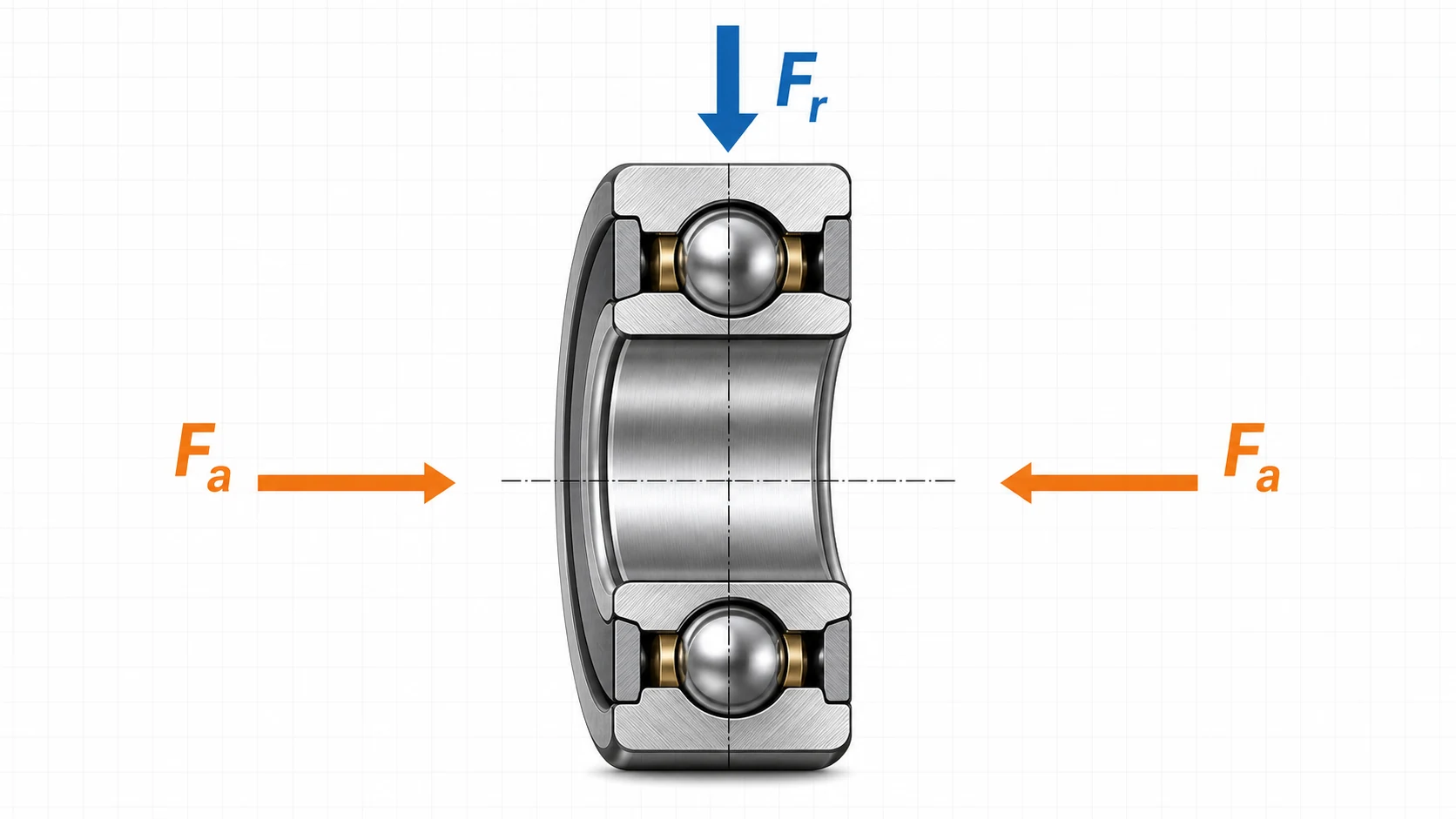
Quick answer: Yes, radial deep groove ball bearings can handle axial loads in both directions, but only within the manufacturer’s catalog limits for the selected bearing size, series, internal clearance, speed, lubrication, mounting arrangement, and Fa/Fr load ratio. They are not high-thrust bearings. If axial load becomes continuous, high, reversing, preload-sensitive, or stiffness-critical, review angular contact ball bearings, thrust bearings, tapered roller bearings, or a paired bearing arrangement instead.
This guide focuses only on the axial-load question for radial, single-row deep groove ball bearings. Broader application selection, sealing, speed, and general fit decisions should be handled in a separate deep groove ball bearing selection review. Axial deep groove ball bearings and thrust ball bearings are different product families and should be reviewed separately when the main load is axial.
The Core Boundary: Axial Load Must Stay Limited
Deep groove ball bearings can carry axial load because their raceway grooves allow the balls to react force along the shaft direction as well as radially. The important boundary is that axial load must remain limited and catalog-approved. Axial capacity is not a fixed percentage that applies to every deep groove ball bearing; it changes with bearing series, internal geometry, clearance, speed, lubrication, temperature, fit, and Fa/Fr.
For a buyer or maintenance engineer, the useful question is not “Can this bearing take axial load?” The better question is: “Is the axial load low enough, relative to the radial load and the catalog rules, for this exact bearing number and operating condition?”
What Axial Load Changes Inside the Bearing
Axial load changes the internal contact condition. Under pure radial load, a radial deep groove ball bearing is usually treated as having a nominal contact angle near zero. As axial load increases, the effective contact condition shifts and can increase friction, heat, contact stress, and equivalent dynamic load.
The selection should therefore treat axial load as a separate design input, not a note added after the bore size is chosen. Even if the same bearing bore fits the shaft, the axial load may push the application outside the safe or economical range for a standard deep groove bearing.
Why Contact Pattern Matters
For a deep groove ball bearing, axial load is not only a value in the equivalent-load formula. It also changes where the balls run on the raceways. When axial force, radial force, mounted clearance, fit, and alignment interact poorly, the bearing can show a narrow or offset ball path, higher friction, and cage distress before the selection looks obviously wrong from the part number alone.
This is why axial-load review should include evidence from the actual machine. A catalog calculation may confirm the bearing family, but heat, noise, raceway marks, and loss of axial float show whether the installed bearing is behaving like the calculation assumed.
How Axial Load Changes the Bearing Calculation
Axial load changes the equivalent dynamic load used for fatigue-life calculation. For combined radial and axial loading, a common catalog form is:
Formula: P = XFr + YFa
P is the equivalent dynamic bearing load, Fr is radial load, Fa is axial load, and X and Y are catalog factors selected from the bearing type, bearing geometry, contact condition, and load ratio. For deep groove ball bearings, P may be equal to or close to Fr under small axial load. When Fa/Fr rises beyond the catalog threshold, the X and Y factors can change.
Many catalogs use a threshold value such as e for the Fa/Fr ratio. When Fa/Fr is below the catalog threshold, the equivalent load P may remain equal to or close to Fr. When Fa/Fr exceeds that threshold, X and Y must be selected from the manufacturer’s table for the specific bearing.
This is where many selection errors happen. A buyer sees that deep groove ball bearings can carry axial load and assumes the axial force is automatically acceptable. In reality, the catalog threshold, Fa/Fr ratio, clearance, speed, and lubrication must be checked before the selection is treated as safe.
Why Fa/Fr Matters
The Fa/Fr ratio matters because axial load changes internal ball-to-raceway contact stress. A small axial locating force may have little effect on the equivalent dynamic load. A larger axial load can increase the effective load used in the life calculation and reduce the calculated L10 life.
For ball bearings, basic rating life is often expressed as:
Formula: L10 = (C / P)^3
Because the load ratio is cubed for ball bearings, a moderate increase in P can sharply reduce calculated life. That is why an ignored axial force can turn a reasonable-looking bearing selection into an early-life failure.
If axial force occurs during startup, shutdown, transport, shock, or standstill, also check static load rating C0, equivalent static load P0, and static safety factor S0. Axial-load review is not only a dynamic L10-life question.
How to Interpret the Fa/Fr Result
Do not use a universal axial-load percentage. Use the Fa/Fr result as a decision signal, then confirm the exact rule in the current manufacturer catalog.
| Fa/Fr Review Result | What It Usually Means |
|---|---|
Very low Fa compared with Fr | A deep groove bearing may remain suitable if speed, clearance, fit, and lubrication are acceptable. |
Fa/Fr is near catalog threshold e | Recalculate P with catalog X and Y factors and check temperature and clearance margin. |
Fa/Fr is above catalog threshold e | Do not assume P = Fr; axial load may strongly reduce calculated L10 life. |
Fa controls the design | Review angular contact, thrust, tapered roller, or paired arrangements. |
Fa changes direction often | Check axial float, locating-end design, preload risk, and noise during reversal. |
Common Sources of Axial Load in Deep Groove Bearing Applications
Axial load is often missed because the machine is described as a radial-load application. Before calculating Fa/Fr, identify where the axial force is coming from.
| Source | Why It Matters |
|---|---|
| Pump impeller thrust | Hydraulic force can push the shaft continuously in one direction. |
| Gear reaction | Helical gears can create axial force even when the shaft looks radial-loaded. |
| Belt or pulley arrangement | Misalignment or tension can introduce axial components. |
| Thermal growth | A constrained shaft can push axial load into the locating bearing. |
| Assembly preload | Covers, spacers, shoulders, or snap rings can remove axial float. |
| Coupling error | Misalignment can create axial force and heat. |
A Focused Axial-Load Decision Path
Axial load is more likely to be acceptable when radial load remains the main load, axial force is limited, speed and temperature are controlled, lubrication is suitable, and the bearing is mounted accurately. Instead of asking whether deep groove ball bearings “can take axial load” in general, check the axial-load path in this order:
| Decision Step | What to Check |
|---|---|
1. Identify Fa | Separate true axial force from radial load, belt pull, gear reaction, thermal growth, and assembly preload. |
2. Compare Fa with Fr | Use the Fa/Fr ratio to decide whether the catalog X and Y factors may change. |
3. Recalculate P | Include the axial component in equivalent dynamic load instead of using radial load alone. |
| 4. Check heat and clearance | Axial load can raise friction, contact stress, and temperature, especially when fits reduce clearance. |
| 5. Confirm the bearing role | A light locating bearing is different from a bearing that absorbs continuous machine thrust. |
| 6. Inspect contact evidence | Look for offset raceway marks, heat, noise after reversal, cage distress, or loss of axial float. |
If the axial force is light, intermittent, and confirmed by the catalog calculation, a deep groove bearing may be acceptable. If the axial force controls the design, move to a bearing arrangement designed around thrust or combined loading.
When Axial Load Becomes a Problem
Axial load becomes a problem when it is high, continuous, reversing, shock-related, or tied to a stiffness or preload requirement. In those cases, a deep groove bearing may run hotter, lose life margin, develop noise, or show raceway distress even though the bore size and catalog dynamic load rating look acceptable.
Review another bearing type or arrangement when axial load is one of the controlling design conditions:
- Continuous high thrust from a pump, screw, gear, or belt arrangement.
- Reversing axial load that changes direction frequently.
- A controlled preload requirement.
- High axial stiffness requirement.
- Significant thermal growth that pushes load into the bearing.
- Heavy startup thrust or shutdown thrust.
- Combined radial and axial load where catalog
XandYfactors raisePsharply. - Repeated early failures with ball path wear, heat, noise, or cage distress.
If the axial load is the main load, a radial deep groove ball bearing is usually the wrong starting point. Review three part thrust ball bearings, single row angular contact ball bearings, tapered roller bearings, or another arrangement designed for the actual load direction.
Field Evidence That Axial Load Is Becoming the Real Problem
The fastest way to avoid repeating a failed selection is to connect the calculation with physical evidence from the machine. These signs do not prove axial overload by themselves, but they tell the engineer where to investigate first.
| Field Evidence | What It Often Suggests | What to Check Next |
|---|---|---|
| Bearing heats quickly after startup | Unintended preload, tight mounted clearance, or excessive thrust | Fit, clearance class, end cover position, grease fill, and shaft freedom. |
| Raceway mark is offset to one side | Axial force is shifting the contact zone | Load direction, locating-end design, and whether the bearing is carrying thrust alone. |
| Noise changes when load reverses | Axial float or contact angle is changing under operation | Shaft movement, retaining shoulders, snap rings, and reversal duty cycle. |
| Same end fails repeatedly | One bearing position is absorbing more axial load than intended | Locating/floating arrangement and thermal growth path. |
| Cage wear appears with heat | Sliding or unstable ball motion may be present | Lubrication, speed, axial load stability, and alignment. |
| Shaft no longer floats freely | Thermal expansion or assembly stack-up is loading the bearing | Endplay, spacer length, cover clearance, and machine warm-up condition. |
Short Field Example
A pump motor uses a single-row deep groove bearing at the locating end. The bearing runs hot after startup, and the raceway mark is shifted to one side. The radial load is moderate, but hydraulic thrust and thermal growth may be pushing axial load into the bearing.
In this case, do not select a larger deep groove bearing only by bore size. First check Fa, Fr, Fa/Fr, mounted clearance, end cover position, and whether the arrangement should change to an angular contact bearing, paired bearing set, or a floating-end design.
When Axial Load Should Push the Design Away From Deep Groove
Keep this comparison narrow: the question is not which bearing family is generally better, but whether axial load has outgrown the practical range of a radial deep groove ball bearing.
| Axial-Load Condition | Bearing Type to Review | Reason |
|---|---|---|
| Axial load is higher but combined with radial load | Angular contact ball bearing | Contact angle is better suited to combined radial and axial loading. |
| Load is mainly axial | Thrust ball bearing or thrust roller bearing | The bearing family is designed around thrust load. |
| Combined load is high and stiffness matters | Tapered roller bearing or angular contact pair | Better control of combined force and shaft location. |
| Axial load appears because the shaft is constrained | Review arrangement before changing bearing type | The root cause may be thermal growth, assembly preload, or locating/floating-end design. |
Do not choose the replacement bearing family only by name. Check mounting geometry, speed, clearance, lubrication, preload method, and load direction before changing from deep groove to another bearing type.
Axial-Load Mistakes That Cause Repetition Failures
The most common mistake is assuming every deep groove ball bearing can handle the same axial load percentage. Axial capacity is catalog-specific and depends on the selected bearing and operating condition.
Another mistake is ignoring axial load because the application “looks radial.” Pumps, belts, gears, fans, couplings, thermal growth, and assembly preload can all introduce axial force. The bearing may still rotate smoothly during a short test, then run hot or fail early in service.
A third mistake is using catalog C alone to judge the bearing. Dynamic load rating matters, but the actual calculation must use equivalent dynamic load P, including the axial component when applicable.
A fourth mistake is treating axial load as constant. In real machines, axial force may change during startup, shutdown, thermal expansion, flow changes, belt tension changes, or load reversal. A bearing that survives a steady catalog case may still run poorly if the installed condition removes clearance or traps thermal growth.
Finally, do not solve every axial-load problem by moving to a larger deep groove bearing. A larger bearing may add friction, limit speed, change fits, increase heat, or still fail if the real issue is thrust direction, preload, misalignment, contamination, or poor lubrication.
Axial-Load Review Checklist
Before approving a deep groove ball bearing specifically for axial load, collect these inputs:
| Required Data | Why It Matters |
|---|---|
| Bearing number and series | Catalog axial-load guidance is bearing-specific. |
Radial load Fr | Needed to judge the load ratio and equivalent dynamic load. |
Axial load Fa | Determines whether catalog X and Y factors must change. |
Fa/Fr ratio | Helps identify when axial load becomes significant. |
| Internal clearance | Clearance affects temperature, contact condition, and axial behavior. |
| Fit and mounting method | Interference and assembly can add preload or reduce clearance. |
| Locating or floating role | Confirms whether the bearing is supposed to absorb axial force. |
| Duty cycle | Starts, stops, reversals, shock, and thermal growth may control axial loading. |
| Failure evidence | Heat pattern, raceway marks, cage wear, and axial float help confirm whether the load path is real. |
If any of these inputs are unknown, the safest answer is not a generic yes or no. The safe answer is to check the current manufacturer catalog or ask for a supplier engineering review.
RFQ Checklist for Deep Groove Bearing Axial Load
Send these details when asking CXE Bearing to review whether a deep groove ball bearing can handle axial load:
- Current bearing number and suffix, if replacing an existing bearing.
- Radial load
Fr, axial loadFa, and how both loads were estimated. - Whether axial load is constant, reversing, intermittent, or shock-related.
- Speed range, duty cycle, and target service life.
- Clearance class, shaft fit, housing fit, and mounting method.
- Whether the bearing is locating the shaft or allowing axial float.
- Lubrication method, seal drag, temperature, and evidence of previous axial-load symptoms.
With those details, CXE Bearing can compare deep groove ball bearing options against angular contact, thrust, tapered roller, or paired arrangements when axial load becomes the controlling issue.
FAQ
Can deep groove ball bearings take axial load in both directions?
Yes. Radial deep groove ball bearings can accommodate axial load in both directions, but only within the catalog limits for the selected bearing, clearance, speed, lubrication, and Fa/Fr ratio.
How much axial load can a deep groove ball bearing handle?
There is no universal percentage that applies to every size. Axial load capacity depends on bearing series, internal geometry, clearance, speed, lubrication, temperature, and manufacturer catalog rules.
When should I use angular contact bearings instead?
Use angular contact ball bearings when axial load is higher, stiffness matters, preload is required, or the application has combined radial and axial load that exceeds the practical range of a deep groove bearing.
Can axial load make a deep groove ball bearing run hot?
Yes. Excessive axial load, unintended preload, tight fits, poor lubrication, or thermal expansion can increase contact stress and friction, leading to heat, noise, and shorter bearing life.