
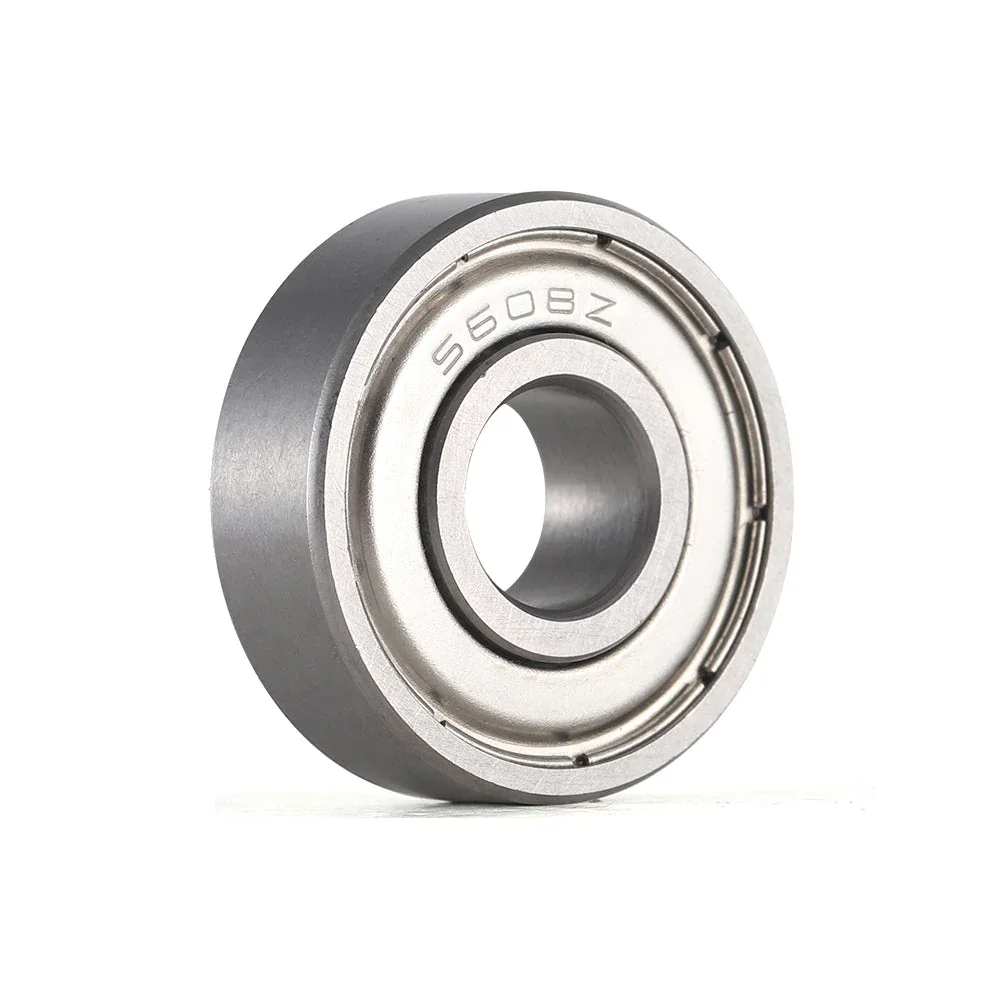
Quick answer: For most stainless steel ball bearings, 440C or a similar hardened martensitic stainless steel is the best general-purpose choice because it offers the bearing-grade hardness and fatigue strength needed for rings and balls while giving better corrosion resistance than chrome bearing steel. But it is not the best answer for every environment. For food washdown, chemical exposure, salt spray, low-noise miniature bearings, or severe corrosion, the better choice may be 420-series stainless, nitrogen-enhanced martensitic stainless steel, ES1-type stainless steel, a coated bearing, or a hybrid bearing with ceramic balls.
The practical rule is simple: choose stainless steel ball bearings by load, corrosion, lubrication, speed, and cleaning exposure, not by stainless grade alone. A bearing made from the “most corrosion-resistant” stainless steel may still fail early if the raceway cannot be hardened enough, the grease is wrong, the seal traps water, or the shaft position carries more load than the bearing design allows.
| Main Requirement | Better Starting Point |
|---|---|
| General corrosion resistance with normal bearing load | 440C stainless steel bearing. |
| Food washdown | 440C/420-series, ES1-type stainless, food-grade grease, and suitable seals. |
| Chlorides, salt spray, or brine | ES1-type, high-nitrogen stainless, coated, hybrid, or special corrosion-resistant design. |
| Very light load with strong corrosion requirement | 316 stainless design if catalog load and speed limits allow. |
| Low-noise miniature bearing | Lower-carbon martensitic stainless where available. |
| Strong chemicals | Review ceramic, polymer, coated, or special-environment bearings instead of choosing by stainless grade alone. |
The Short Answer: 440C Is Usually the Default, Not the Universal Best
440C stainless steel is often the default material for stainless ball bearing rings and balls because it can be hardened for rolling contact. That matters because the raceways and balls do not only need to resist rust. They must also resist fatigue, indentation, wear, and surface damage under repeated rolling contact.
For ordinary wet, humid, or mildly corrosive service, 440C stainless steel bearings are often a good starting point. They are commonly used in food equipment, packaging machinery, light pumps, marine-adjacent equipment, outdoor devices, and instruments where chrome steel would rust too easily.
The limitation is that 440C is still stainless steel, not a corrosion-proof material. Chlorides, strong cleaning chemicals, poor drying, trapped moisture, and incompatible grease can still cause corrosion or staining. If the application sees repeated chemical washdown, salt exposure, or aggressive media, a standard 440C bearing may not be enough.
Stainless Steel Bearing Grades Compared
Use this table as a first screening tool. The final selection still depends on the bearing manufacturer’s catalog, load rating, seal design, cage material, grease, and operating environment.
| Material / Grade | Best Use in Ball Bearings | Main Strength | Main Caution |
|---|---|---|---|
440C / X105CrMo17 / 1.4125 | General stainless bearing rings and balls | Hardenable, common, good balance of wear and corrosion resistance | Not suitable for strong corrosion or all washdown chemicals. |
| 420-series martensitic stainless | Corrosion-resistant bearing rings in some food or special designs | Hardenable stainless option with useful corrosion resistance | Names are not automatically interchangeable; confirm the exact standard and heat treatment. |
304 stainless | Cages, shields, housings, and non-raceway components | Good general corrosion resistance and formability | Usually not the best raceway material for loaded ball bearings. |
316 / 316L stainless | Very light-load or non-raceway parts in chloride-prone environments | Better corrosion resistance than 304 in many chloride environments | Lower hardenability for rolling-contact raceways; load capacity may be limited. |
| ES1-type / nitrogen-enhanced martensitic stainless | Washdown, food, beverage, chemical, and high-humidity service | Better corrosion resistance than standard 440C while retaining high hardness | Higher cost and availability must be checked. |
| High-nitrogen corrosion-resistant bearing steel | Severe corrosion where fatigue life still matters | Combines high corrosion resistance with bearing-oriented strength | Usually a premium engineered option, not a commodity grade. |
| Hybrid stainless bearing with ceramic balls | Corrosion, poor lubrication, electrical or contamination-sensitive duty | Ceramic balls can reduce corrosion risk and change friction behavior | Rings, seals, lubricant, and cage still control the final result. |
Do not treat all 420-series names as interchangeable. Confirm the exact material standard, heat treatment, hardness, catalog dynamic load rating C_r, static load rating C_0r, and supplier catalog data before substitution.
High-nitrogen or nitrogen-enhanced bearing steels are premium options when corrosion resistance and rolling-contact fatigue strength are both important. They should be reviewed as engineered bearing materials, not as a simple commodity substitute for 440C or 316.
CXE Buying Note: Material Grade and Delivery Are Both Part of the Decision
For practical sourcing, the best grade is not only the grade with the strongest theoretical property. It is the grade that fits the environment, bearing load, available series, production route, and required delivery date.
CXE Bearing’s stainless steel bearings structure reflects this tradeoff. Buyers can search by stainless grade collections such as AISI 420 stainless steel bearings, AISI 440C stainless steel bearings, AISI 304 stainless steel bearings, and AISI 316 stainless steel bearings, but the final RFQ still needs the bearing number, dimensions, seal type, load rating, and environment.
In many catalog-style stainless bearing pages, the most useful first data is not a slogan about corrosion resistance. It is the model, d, D, B, ZZ or 2RS, catalog dynamic load rating C_r, static load rating C_0r, and weight.
CXE’s stainless steel bearing content separates martensitic grades such as AISI 440C and AISI 420 from austenitic grades such as AISI 304, AISI 316, and AISI 316L. The practical distinction is important: martensitic stainless grades are selected when bearing hardness, precision, load capacity, and speed matter; austenitic grades are selected when corrosion resistance is the primary requirement and the bearing design can tolerate the lower raceway hardening potential.
AISI 420 inventory can shorten delivery in some stainless bearing models. That does not mean AISI 420 is automatically better than 440C or 316. It means the RFQ should state whether the buyer is optimizing for load performance, corrosion resistance, availability, cost, or a combination of those requirements.
Why 304 or 316 Is Not Automatically Better
Many buyers assume 316 stainless steel must be the best bearing material because it is widely known for corrosion resistance. That is true in many fabricated parts, fasteners, housings, and process equipment. It is not automatically true for ball bearing raceways.
Ball bearing rings and balls need high hardness after heat treatment. Martensitic stainless grades such as 440C are used because they can be hardened for rolling contact. Austenitic stainless grades such as 304 and 316 are useful for corrosion-resistant parts, but they are generally not the default choice for loaded bearing raceways.
316 stainless steel may be better for corrosion resistance, but it is usually not better for loaded rolling-contact raceways unless the bearing design is specifically engineered for low load, low speed, or special corrosion-focused service. It may also appear in cages, shields, housings, or custom assemblies. But if the buyer asks for “316 stainless bearings” without load, speed, and life data, the supplier should confirm whether the request is driven by corrosion exposure or by a misunderstanding of bearing material behavior.
Which CXE Stainless Bearing Families Should Buyers Check?
Material selection should be connected to the bearing family. CXE’s stainless bearing range includes deep groove ball bearings, angular contact ball bearings, double row ball bearings, thrust ball bearings, cam followers, self-aligning ball bearings, inch bearings, and mounted units. For the typical ball bearing buyer, these are the common first checks:
| CXE Stainless Bearing Path | What to Confirm |
|---|---|
| S60, S62, S63 deep groove series | General radial ball bearing sizes, ZZ or 2RS, C_r, C_0r, and operating speed. |
| S68, S69, S67 thin and light series | Space-limited designs where load margin and stiffness must be checked carefully. |
| S16 and inch stainless series | Replacement cases where width, bore, and interchange accuracy matter. |
| Stainless angular contact ball bearings | Combined radial and axial load or stiffness-controlled positions. |
| Stainless thrust ball bearings | Mainly axial load where deep groove bearings are the wrong starting point. |
| Stainless miniature or flange bearings | Small equipment where corrosion, low noise, and positioning features matter together. |
This is why an RFQ should not only say “quote stainless bearing.” It should say, for example, “S6205-2RS, AISI 420 or 440C acceptable, food equipment washdown, moderate radial load, no strong chemicals,” or “316 requested for corrosion exposure, please confirm load and speed limits.”
How to Choose by Application
The best stainless steel grade depends on what is trying to damage the bearing first: corrosion, fatigue, wear, lubricant failure, washdown, contamination, or heat.
| Application Condition | Better Starting Point | Why |
|---|---|---|
| Humid indoor machinery | 440C stainless bearing | Good balance of corrosion resistance, hardness, and availability. |
| Food equipment with regular washdown | 440C/420-series food bearing, ES1-type stainless, or stainless bearing with food-grade grease | Material, seals, and lubricant must work together under cleaning cycles. |
| Chemical processing with mild media | ES1-type stainless, coated bearing, or hybrid bearing | Standard stainless may not resist chemicals long enough. |
| Salt spray or marine atmosphere | High-nitrogen stainless, coated bearing, ceramic hybrid, or special corrosion-resistant design | Chloride exposure can exceed ordinary 440C capability. |
| Low-noise miniature bearing | Alternative martensitic stainless where available | Some martensitic stainless options can support smoother raceway finishing. |
| High load with only occasional moisture | Compare 440C stainless against protected chrome steel | Chrome steel may carry load better, but needs corrosion control. |
| Strong acids, strong alkalis, or reactive gases | Do not choose by stainless grade alone | Review ceramic, polymer, coated, or special-environment bearings. |
A Practical Selection Path
Start with the environment, then move to the load calculation. Do not reverse the order by choosing a stainless grade first and trying to make the application fit it.
- Identify the corrosion source: humidity, washdown water, salt, cleaning chemicals, acid, alkali, process vapor, or storage condensation.
- Confirm the bearing duty: radial load, axial load, speed, shock, duty cycle, temperature, and target service life.
- Decide whether stainless is enough: mild corrosion may fit 440C; severe corrosion may need high-nitrogen stainless, coating, hybrid ceramic, or another material family.
- Check the complete bearing design: rings, balls, cage, shields, seals, grease, and packaging all affect corrosion performance.
- Compare load rating and life: a corrosion-resistant bearing that lacks enough dynamic or static capacity is still the wrong bearing.
- Verify cleaning and storage: water trapped behind seals, cleaner residue, poor drying, and damaged packaging can defeat a good material choice.
Material Is Only One Part of Corrosion Resistance
A stainless bearing can still corrode if the working environment creates the right corrosion conditions. Moisture, oxygen, salts, cleaning chemicals, metal particles, hand contamination, and trapped water films can all attack precision surfaces. On a bearing, even light staining may matter because raceways are highly finished surfaces.
For sealed stainless ball bearings, the lubricant and seal design are as important as the steel grade. Food-grade grease may be required in food and beverage equipment. Low-particle grease may matter in clean equipment. Water resistance, oxidation stability, corrosion inhibition, and compatibility with seal material should be checked instead of assuming that stainless steel alone solves the problem.
For food and beverage equipment, material grade should be reviewed together with NSF H1 food-grade grease, seal material, washdown chemistry, drainage, and hygienic machine design. A stainless steel bearing is not automatically food-grade just because the rings or balls use stainless steel.
Packaging and storage also matter. Bearings stored in high humidity, coastal air, leaking bags, or damaged cartons can rust before installation. If stainless bearings are being purchased to solve corrosion complaints, review incoming storage, cleaning, drying, packaging, and handling practice along with the material grade.
When 440C Is a Good Choice
Choose 440C stainless steel ball bearings when the application needs a practical balance of corrosion resistance and bearing performance. Typical examples include moderate-humidity machinery, food packaging equipment outside the most aggressive washdown zones, outdoor instruments, light-duty pumps, and machinery where chrome steel rusts too easily but the bearing still needs hardened raceways.
440C is also a good reference point when comparing other stainless options. If a supplier recommends 316, ES1-type stainless, high-nitrogen stainless, ceramic hybrid, or a coated bearing, ask what performance problem the alternative solves: stronger corrosion resistance, better fatigue life, better washdown survival, lower noise, food-grade compliance, or lower maintenance.
When 440C Is Not Enough
Move beyond standard 440C when corrosion is the main reason bearings are failing. Common signs include orange or black staining after washdown, rough rotation after storage, seized bearings after cleaning, repeated failures on the same wet side of a machine, or corrosion under seals.
Review a premium corrosion-resistant design when the application has:
- Daily chemical washdown.
- Salt spray, coastal air, brine, or chloride-containing cleaners.
- Food, beverage, pharmaceutical, or sanitary processing requirements.
- Weak acid or weak alkaline media that contacts the bearing area.
- Frequent water intrusion behind the seal.
- Long storage before installation in humid or ocean-shipping conditions.
- Failures where corrosion appears before fatigue spalling.
In these cases, the steel grade should be reviewed together with seal contact, grease, cage material, closure design, housing material, and drainage around the bearing position.
Common Mistakes When Specifying Stainless Ball Bearings
The first mistake is asking for “stainless” without naming the environment. Fresh water, salt spray, sanitizer, caustic cleaner, humidity, and storage condensation are different corrosion problems.
The second mistake is choosing 316 because it sounds more corrosion resistant. For many loaded ball bearings, 316 is not the best raceway material. A hardened martensitic stainless grade or an engineered corrosion-resistant bearing steel may be more appropriate.
The third mistake is ignoring load rating. Stainless bearings may not carry the same load as a comparable chrome steel bearing in every design. Always compare the manufacturer’s radial dynamic load rating C_r, radial static load rating C_0r, speed limit, and lubrication guidance.
The fourth mistake is treating the bearing as one material. Rings, balls, cage, seals, shields, grease, and even the housing may use different materials. One weak component can become the corrosion or contamination failure point.
The fifth mistake is blaming the steel grade for a packaging or handling problem. Water left after cleaning, damaged packaging, incompatible rust preventive, dirty gloves, or poor drying can cause corrosion even when the selected material is reasonable.
RFQ Checklist for Stainless Steel Ball Bearings
Send these details when asking a supplier to recommend the best stainless steel grade for ball bearings:
- Bearing number, bore, outside diameter, width, and current suffix.
- CXE series or type if known, such as S60, S62, S63, S68, S69, S16, stainless thrust, stainless angular contact, or stainless miniature bearing.
- Current material if known: 440C, 420, 304, 316, ES1-type, hybrid, coated, or unknown.
- Radial load, axial load, speed, duty cycle, and target service life.
- Required
C_r,C_0r, limiting speed, seal type, and weight if replacing a catalog bearing. - Whether corrosion appears during operation, washdown, storage, or shipping.
- Exposure media: water, salt, sanitizer, caustic cleaner, acid, alkali, vapor, or dust.
- Cleaning method, cleaning frequency, and drying conditions.
- Seal or shield preference, grease requirement, and food-grade requirement if applicable.
- Temperature range and whether the bearing sees shock, vibration, or standstill load.
- Photos of corrosion, raceway staining, cage damage, grease condition, and packaging if replacing failed bearings.
With those details, CXE Bearing can compare standard 440C stainless bearings against 420-series options, premium corrosion-resistant stainless designs, hybrid ceramic bearings, coated bearings, or non-stainless alternatives where stainless is not the right answer.
FAQ
Is 440C stainless steel good for ball bearings?
Yes. 440C is a common choice for stainless steel ball bearing rings and balls because it can be hardened for rolling contact while offering better corrosion resistance than chrome steel. It is a strong general-purpose stainless bearing material, but not the best choice for every corrosive environment.
Are 316 stainless steel bearings better than 440C bearings?
Not usually for loaded ball bearing raceways. 316 stainless steel may be better for corrosion resistance, but 440C is more suitable for hardened bearing rings and balls in many loaded designs. Use 316 only when the bearing design and load conditions support it.
What stainless steel is used for food-grade ball bearings?
Food-grade stainless ball bearings may use hardened stainless rings and balls such as 440C, 420-series stainless, or engineered corrosion-resistant stainless grades, combined with NSF H1 food-grade grease, suitable seals, washdown-compatible materials, and hygienic machine design. The material alone does not make a bearing food-grade.
Can stainless steel ball bearings rust?
Yes. Stainless steel bearings are corrosion resistant, not corrosion proof. Chlorides, aggressive cleaners, trapped moisture, poor drying, and storage humidity can still cause corrosion or staining.
What is better than 440C for severe corrosion?
For severe corrosion, review ES1-type stainless steel, high-nitrogen corrosion-resistant bearing steel, coated bearings, hybrid ceramic bearings, ceramic bearings, or polymer options depending on load, speed, media, and temperature.