
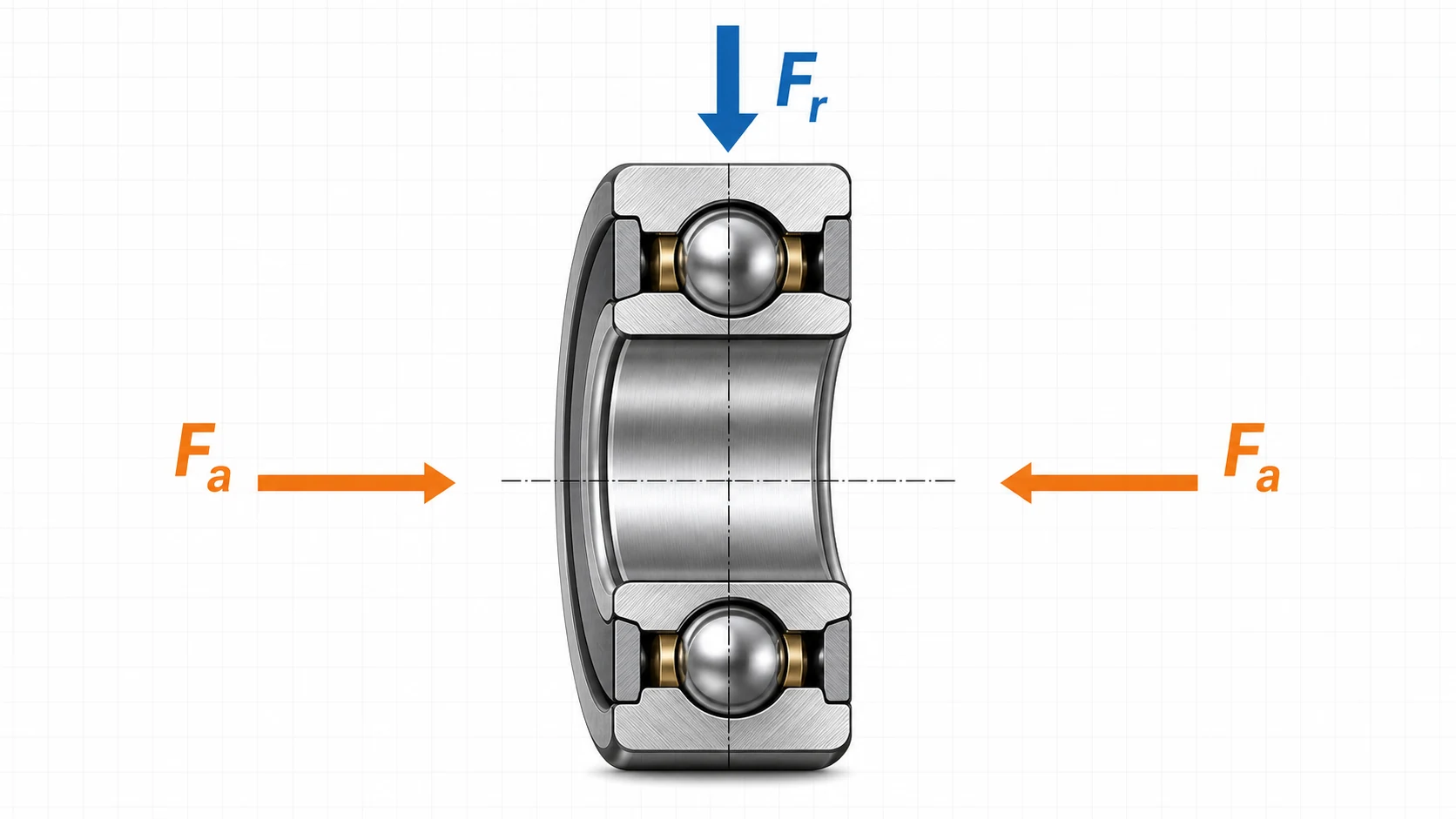
Quick summary: For ball bearings, calculate basic rating life with L10 = (C / P)^3. If you know the target life and equivalent dynamic load P, calculate the required dynamic load rating with C = P x L10^(1/3). When life is given in hours, first convert hours to millions of revolutions using speed in rpm.
The bearing manufacturer normally publishes C from standardized rating methods and bearing design data. In application selection, engineers calculate the required basic dynamic load rating from the real equivalent dynamic load P and the target L10 life, or they use a published catalog C value to check whether a candidate bearing can meet the target life. That selection calculation is useful only when load, speed, reliability target, lubrication, contamination, fit, clearance, and duty cycle are reviewed together.
Quick Answer: Ball Bearing Dynamic Load Rating Formula
For a ball bearing, the basic rating life relationship is:
Formula: L10 = (C / P)^3
To calculate the required basic dynamic load rating for a target life:
Formula: C = P x (L10)^(1/3)
If the target life is given in operating hours:
Formula: L10 = (60 x n x L10h) / 1,000,000
Required rating: C = P x [(60 x n x L10h) / 1,000,000]^(1/3)
Where C is the required basic dynamic load rating, P is the equivalent dynamic bearing load, n is speed in rpm, and L10h is the target basic rating life in hours.
Engineering note: These formulas are for preliminary ball bearing selection. Final bearing selection should be checked against the current manufacturer catalog, ISO 281-based rating-life logic, and real application data.
What Dynamic Load Rating Means in Ball Bearing Selection
Dynamic load rating is a fatigue-life reference value, not the maximum load a ball bearing can safely carry in the machine. In a catalog, the basic dynamic load rating, usually marked as C, gives engineers a standardized way to compare bearing fatigue capacity under defined rating-life assumptions. It does not automatically account for the actual shaft load path, axial force, installation fit, lubricant condition, contamination level, operating temperature, or duty cycle.
For U.S. OEM buyers and maintenance teams, the most common mistake is treating C as a direct working-load limit. That shortcut can lead to an undersized bearing even when the catalog number appears acceptable. A ball bearing with a higher dynamic load rating generally has more fatigue capacity under comparable conditions, but the rating only becomes useful after the real application load is converted into an equivalent dynamic bearing load, usually marked as P.
Basic Dynamic Load Rating C Is a Fatigue-Life Parameter
The basic dynamic load rating C is used to estimate rolling-contact fatigue life under standardized calculation logic. In ball bearing selection, it is tied to the relationship between the catalog load rating, the equivalent dynamic load, and the basic rating life. It is not a proof load, shock-load limit, mounting-force limit, or guarantee that the bearing will survive poor lubrication or contamination.
A practical way to read C is this: it tells you how strong the bearing is for fatigue-life calculation, not how much abuse the bearing can tolerate. If two ball bearings have the same bore size but different internal geometry, ball size, raceway design, material processing, or series width, their dynamic load ratings may differ. That difference matters when the application has a defined life target, such as continuous motor operation, conveyor duty, pump service, or an OEM warranty period.
Why Catalog Load Rating Cannot Replace Application Review
Catalog load rating cannot replace application review because the bearing does not operate inside the catalog. It operates inside a housing, on a shaft, under a real load spectrum, with lubricant, seals, fits, temperature rise, vibration, and contamination.
The useful engineering question is not “Is the catalog C value high enough?” The better question is: “After the real application is converted into equivalent dynamic load P, and after speed, lubrication, contamination, fit, clearance, and reliability are reviewed, does this ball bearing still provide enough calculated and practical life margin?”
The Core Formula: C, P, and L10 Bearing Life
The basic life equation for ball bearings links the published dynamic load rating, the equivalent dynamic load, and calculated fatigue life. In simplified form:
Formula: L10 = (C / P)^3
L10 is the basic rating life in millions of revolutions at the usual 90% reliability basis, C is the basic dynamic load rating, and P is the equivalent dynamic bearing load. The exponent is important. Because the load ratio is cubed for ball bearings, a moderate increase in P can sharply reduce calculated life.
The Basic Life Relationship for Ball Bearings
The formula is a fatigue calculation, not a field guarantee. It assumes the bearing type, load conversion, rating data, and operating inputs are valid for the application being reviewed. If the load estimate is wrong, the calculated life will also be wrong.
To calculate the required basic dynamic load rating for an application from a target life, rearrange the relationship:
Formula: C = P x (L10)^(1/3)
This means the required C value increases when the equivalent load increases or when the required life increases. In real selection work, the result is not the final bearing choice. It is the required fatigue-rating target that must be checked against bore size, outer diameter, width, bearing type, clearance, seal or shield design, lubricant, speed, fit, and application environment.
For common radial applications, buyers often begin with deep groove ball bearings because they are compact, widely available, and suitable for many radial-load positions with limited axial load.
Converting L10 Life to Operating Hours
Operating hours require speed. A bearing life in millions of revolutions can be converted into hours when the shaft speed is known:
Formula: L10h = (1,000,000 x L10) / (60 x n)
L10h is the calculated life in hours, and n is rotational speed in rpm. A bearing that appears to have a long revolution life may have a shorter hour life at high speed. A slow-speed bearing may show many operating hours but still require a static load and shock-load review.
When a buyer says, “I need 20,000 hours,” the engineering review still needs the real load direction, load magnitude, speed, temperature, lubrication, duty cycle, and installation details. Hours alone do not define the required dynamic load rating.
How Reliability Above 90% Changes the Required Rating
Basic L10 life is normally tied to a 90% reliability basis. For higher reliability, engineers should not use the basic 90% L10 result directly. They should apply a reliability factor or modified rating life method, then recheck whether the selected catalog C value still provides enough margin.
In modified life methods, reliability, lubrication condition, contamination, material, and manufacturing quality may be handled through factors such as:
Formula: Lnm = a1 x aISO x L10
a1 is the reliability factor, and aISO represents application and material-related life modification factors. Typical reliability factors decrease as reliability requirements increase. For a high-reliability pump, motor, medical device, or aerospace-adjacent application, do not size only to the basic 90% L10 result without reviewing reliability requirements.
How to Determine Equivalent Dynamic Load P
Equivalent dynamic load P is the calculation bridge between the real machine and the catalog life formula. It converts the actual radial and axial load conditions into a single life-equivalent load value that can be used with C.
For many bearing types, the general structure is:
Formula: P = XFr + YFa
Fr is radial load, Fa is axial load, and X and Y are factors selected from the bearing type, geometry, contact angle, and load ratio rules in the relevant catalog or standard. The exact factors should come from current engineering data for the selected bearing type, not from a guess.
For deep groove ball bearings, P may equal or closely follow Fr under pure radial load or small axial load. When the axial-to-radial load ratio exceeds the catalog threshold, the X and Y factors can change. The X and Y factors may depend on the Fa/Fr ratio, the catalog threshold value e, and bearing-specific data. Always check the correct table for the exact bearing series, and do not assume X = 1 and Y = 1 for combined-load applications.
Radial Load Only Applications
A radial-load-only application is the cleanest calculation case, but it still needs application review. In a simple deep groove ball bearing position with mainly radial load, P may be close to the radial load. That does not mean the selection is complete.
The engineer still needs to check shaft speed, grease or oil lubrication, operating temperature, internal clearance, housing fit, shaft fit, seal drag, and contamination risk. A bearing can pass the fatigue equation and still run hot if the fit removes too much internal clearance or the grease fill is unsuitable for the speed.
Combined Radial and Axial Load Applications
Combined load applications require more care because axial load changes internal contact stress. Deep groove ball bearings can carry radial load and limited axial load, but higher axial load or stiffness requirements may require angular contact ball bearings, paired arrangements, or a different bearing family.
In pumps, electric motors, gear-driven shafts, and belt-driven equipment, axial force may come from hydraulic thrust, belt alignment, gear reaction, thermal growth, or assembly preload. If that axial component is ignored, the P value used in the life calculation can be too low, making the calculated life too optimistic.
Where axial load is a major part of the duty, compare the application against single row angular contact ball bearings instead of forcing a radial bearing into a combined-load position.
Shock, Vibration, and Variable Duty Cycles
Shock and variable duty can make a single steady load estimate misleading. Starts and stops, belt tension changes, unbalance, vibration, impact, and intermittent overload can raise the effective load seen by the bearing. In these cases, the calculation should use a load spectrum, service factor, or engineering review method that reflects the actual duty cycle.
Variable speed also matters. If the bearing spends most of its life at one speed and load, but short periods at a higher load create severe contact stress, the average calculation should not hide the damaging condition. The goal is to calculate from the duty that actually controls life.
For variable duty, calculate an equivalent load from the load spectrum instead of using a simple arithmetic average. For ball bearings, a simplified load-spectrum form is:
Formula: Peq = [sum(Pi^3 x Ni) / sum(Ni)]^(1/3)
Pi is the equivalent load in each duty segment, and Ni is the number of revolutions in that segment. This approach gives heavily loaded segments the correct life impact because the ball bearing life exponent is 3. The simplified form assumes the duty segments are converted into revolutions. If speed changes significantly, use revolutions or time-at-speed weighting instead of a simple time average.
Why Correct Load Rating Calculations Still Fail in the Field
Correct C and P calculations do not protect a bearing from poor operating conditions. Rolling-contact fatigue life is strongly affected by lubrication film, contamination, installation, temperature, clearance, and material condition.
Lubrication Film and Operating Temperature
Lubrication controls whether rolling contact stays separated by a protective film or moves toward mixed and boundary lubrication. Oil or grease must match speed, load, temperature, seal design, and maintenance interval. Low viscosity, grease degradation, poor relubrication, or oil starvation can reduce real life even when the catalog fatigue calculation looks acceptable.
Temperature is part of the same problem. Heat changes lubricant viscosity and bearing internal clearance. Higher temperature can reduce oil film thickness, accelerate grease aging, and increase the risk of wear or surface distress. The load rating check should therefore be reviewed together with thermal and lubrication conditions, not treated as a standalone catalog-number comparison.
Contamination and Cleanliness
Contamination can turn a good load calculation into a short-life bearing. Hard particles in the raceway can create dents, stress risers, abrasive wear, and fatigue origins. Small ball bearings and precision ball bearings are especially sensitive because the contact area is small.
For sealed or shielded ball bearings, cleanliness also includes factory grease quality, seal integrity, handling, storage, and packaging. For oil-lubricated systems, filtration, water control, and oil cleanliness are part of bearing life. A calculated L10 result should be treated as conditional on a clean enough operating environment.
Fit, Clearance, and Installation Accuracy
Fit and clearance can change the real internal load distribution. Interference fit can reduce internal clearance. Temperature differences between shaft, inner ring, outer ring, and housing can change operating clearance further. Too little clearance can increase heat and preload; too much clearance can increase vibration, noise, and load concentration.
Installation accuracy also matters. Misalignment, cocked mounting, force through the rolling elements, damaged shoulders, dirty housings, and poor shaft roundness can all create stress that the simple life equation does not see. A field failure after a correct calculation often points to one of these system conditions.
Dynamic Load Rating vs Static Load Rating
Dynamic load rating C and static load rating C0 answer different questions. C is used for fatigue life under rotation. C0 is used to evaluate permanent deformation risk under static or very slow loading.
A low-speed, shock-loaded, or heavily loaded stationary position may need static safety review before dynamic life becomes the controlling issue. Pressing, impact, brinelling, heavy belt pull at standstill, and transportation shock can damage raceways even if the dynamic life equation appears acceptable.
When Static Load Rating Matters More
Static load rating matters when the bearing may see high load with little or no rotation. Examples include equipment that sits loaded, start-up shock, transport vibration, assembly force, and slow indexing duty. In those cases, the engineer should review equivalent static load and static safety factor in addition to dynamic load rating.
The common static safety check is:
Formula: S0 = C0 / P0
S0 is the static safety factor, C0 is the basic static load rating, and P0 is the equivalent static load. P0 is not the same value as P in the dynamic life equation. It must be calculated using the static-load rules for the selected bearing type. The required S0 depends on bearing type, application, shock, accuracy requirements, and the manufacturer’s guidance.
For purchasing, this means the RFQ should not ask only for “higher dynamic load rating.” It should also describe shock, standstill load, mounting method, and any known brinelling or indentation history.
Calculation Example: From Application Data to Ball Bearing Selection
A useful calculation starts with machine data, not with a bearing number. The bearing number is selected after the load, speed, life, size envelope, and operating conditions are known.
Numeric Example: Required C for a 20,000-Hour Target
Assume an application has these simplified inputs:
| Input | Value |
|---|---|
Equivalent dynamic load P | 1.5 kN |
Speed n | 1,800 rpm |
Target basic rating life L10h | 20,000 hours |
First convert target hour life to millions of revolutions:
Formula: L10 = (60 x n x L10h) / 1,000,000
Example: L10 = (60 x 1,800 x 20,000) / 1,000,000
Result: L10 = 2,160 million revolutions
Then calculate the required basic dynamic load rating:
Formula: C = P x (L10)^(1/3)
Example: C = 1.5 x (2,160)^(1/3)
Result: C ~= 19.4 kN
In this simplified example, select a ball bearing with catalog C greater than about 19.4 kN, then check static load rating, speed limit, lubrication, clearance, fit, temperature, contamination, seal design, and available mounting space. The 19.4 kN result is a fatigue-rating target, not a complete bearing selection.
Data Required Before Calculation
Collect these inputs before asking CXE Bearing to review the required C value, expected life, or candidate ball bearing selection:
| Required Data | Why It Is Needed |
|---|---|
Radial load Fr | Establishes the main load component for many ball bearing positions. |
Axial load Fa | Determines whether combined-load calculation or another bearing type is needed. |
Speed n | Converts revolution life into operating hours. |
| Target life | Defines the required fatigue-life margin. |
| Duty cycle | Separates steady operation from shock, intermittent load, or load spectrum duty. |
| Lubrication | Affects film thickness, heat, wear, and maintenance interval. |
| Temperature | Changes lubricant viscosity and internal clearance. |
| Fit and clearance | Affects installed and operating internal geometry. |
| Environment | Dust, water, chemicals, washdown, and storage can shorten real life. |
| Size envelope | Limits bore, OD, width, seal, shield, and series choices. |
Step-by-Step Calculation Path
The practical calculation path is:
- Define the bearing position and load direction.
- Estimate or measure radial load
Fr. - Estimate or measure axial load
Fa. - Select the bearing family that can carry the load direction.
- Convert
FrandFainto equivalent dynamic loadP. - Define target life in revolutions or operating hours.
- Calculate the required
Cvalue. - Compare candidate ball bearings by
C, size, speed, clearance, seal or shield design, lubricant, and application limits. - Review static load rating, temperature, contamination, fit, and installation risk.
- Confirm the final selection with current manufacturer engineering data and application details.
For compact radial positions where rollers are more appropriate than balls, compare the required load and envelope against needle roller bearings before finalizing the bearing family.
This path prevents a common sourcing error: choosing the first bearing with the right bore and a catalog C value that appears close enough. A reliable selection must connect the bearing number back to the application data.
RFQ Checklist for Ball Bearing Load Rating Review
A good RFQ gives the CXE Bearing team enough information to check the calculation instead of guessing. Include:
- Existing bearing number and suffix, if replacing a bearing.
- Bore, outside diameter, width, seal or shield type.
- Radial load, axial load, and how those loads were estimated.
- Shaft speed or speed range.
- Target life in hours or operating duty.
- Lubrication method and lubricant type.
- Operating temperature range.
- Shaft fit, housing fit, and clearance class if known.
- Mounting orientation and any preload or axial location method.
- Shock, vibration, washdown, dust, water, or chemical exposure.
- Failure evidence if replacing an early-life bearing.
- Required documentation, inspection, packaging, and shipment expectations.
For U.S. OEM and MRO buyers, this checklist reduces back-and-forth and helps prevent underspecified substitutions. It also gives the technical team a chance to recommend a different ball bearing type, clearance, seal, grease, or material before the equipment fails in service.
Product CTA
Send CXE Bearing your bore size, Fr, Fa, rpm, target L10h life, temperature, lubrication method, fit, clearance requirement, and operating environment. Our team can help compare suitable ball bearing options by catalog C rating, static load rating, speed limit, seal or shield type, grease, and application risk.
FAQ
Is dynamic load rating the maximum load a ball bearing can carry?
No. Dynamic load rating is a fatigue-life calculation parameter. It is not the maximum working load, shock-load limit, static load limit, or guarantee of field life.
What is the difference between C and P in bearing life calculation?
C is the catalog basic dynamic load rating. P is the equivalent dynamic load calculated from the actual application load. The life calculation uses the C/P ratio to estimate basic rating life.
Why can a bearing fail even if the dynamic load rating calculation looks correct?
The calculation may not include poor lubrication, contamination, incorrect fit, loss of clearance, misalignment, shock load, temperature, or installation damage.
Do I need static load rating if I already checked dynamic load rating?
Yes, when the bearing sees shock, low-speed heavy load, standstill load, pressing force, or transport vibration. Static load rating checks permanent deformation risk.