
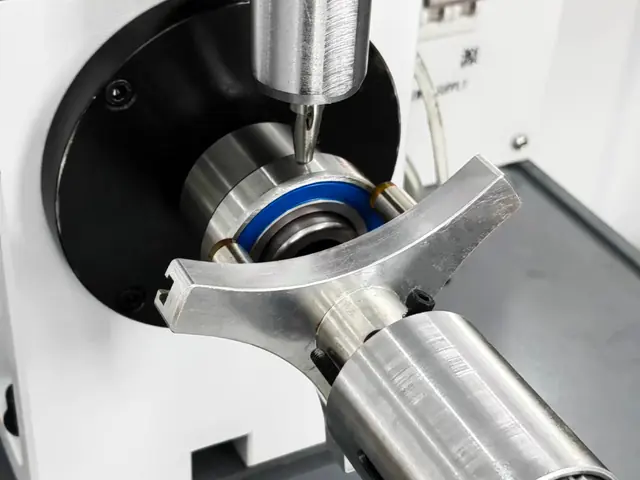
Proprietary Research Report CXE Bearing Research: Vibration and Noise Control Technologies in Deep Groove Ball Bearings
For high-speed, noise, or heat-sensitive applications, compare the engineering discussion with CXE Bearing collections for GCR15 deep groove ball bearings, single row angular contact ball bearings, and hybrid ceramic bearings; the collection path helps match operating symptoms with bearing family choices.
ABSTRACT: This proprietary engineering report details the fundamental research conducted by the CXE Bearing R&D team (now officially operating globally under the CXE Bearing brand). It explores the generating mechanisms of bearing vibration and noise, outlines our internal QC methods for acoustic control, and analyzes the empirical data from CXE’s low-noise bearing trial production.
1. Generating Mechanisms of Bearing Vibration and Noise
Bearing vibration and noise are complex physical phenomena primarily caused by structural and manufacturing factors. Even under ideal theoretical conditions, inherent elastic deformations during rotation generate baseline vibrations. However, the CXE engineering team determined that over 50% of excessive acoustic emissions are attributed to macro and micro-geometric deviations during the manufacturing process. The primary exciters include raceway waviness, roundness errors of the rolling elements, and localized surface defects that disrupt the uniform distribution of the hydrodynamic lubrication film.
2. CXE Standards: Control of Bearing Vibration and Noise
To fundamentally control and suppress vibration, manufacturing precision must be elevated, particularly in the grinding and super-finishing stages across our production lines. 2.1 Surface Roughness Optimization The micro-geometry of the bearing rings directly impacts high-frequency noise. Strict technical standards must be enforced during the super-finishing process. Based on CXE’s advanced manufacturing protocols, the surface roughness of the raceway is strictly controlled to achieve Ra ≤ 0.012 μm and a maximum peak-to-valley height of Ry ≤ 0.16 μm. 2.2 Abnormal Noise Control Abnormal noise (irregular clicking or high-pitched squealing) is highly detrimental to the perceived quality of an electric motor. To mitigate this, precision matching of internal components is executed. CXE Bearing deploy Grade 10 (G10) high-precision steel balls to ensure dimensional uniformity, effectively eliminating the cyclic impact forces caused by varying ball diameters during high-speed operation.
3. CXE Trial Production Case Study: 608-2Z Low-Noise Bearings
To validate the relationship between internal parameters (specifically radial internal clearance) and acoustic performance, comprehensive batch testing was conducted on the CXE 608-2Z deep groove ball bearing model. The objective was to achieve industry-leading qualification rates for Z3, V3, and Z4 precision grades under dynamic loads. 3.1 Clearance vs. Acoustic Performance Data The following table illustrates the qualification rates of CXE 608-2Z bearings manufactured with different radial internal clearances (C0 Normal vs. C3) tested at 2000 rpm and 5000 rpm.
Target Grade Clearance Group Test Speed (rpm) Avg. Vibration Velocity (dB) Z3 Qualification Rate V3 Qualification Rate Z4 Qualification Rate
Z3 / V3 C3 2000 27.6 83% 69% 50%
Z3 / V3 C0 (Normal) 2000 27.1 94% - 100% 80% - 96% 74% - 76%
Z4 C0 (Normal) 5000 24.0 99% 97% 78%
Z4 C3 5000 24.6 96% 92% 82% - 90%
CXE R&D Conclusion: For high-speed, noise-sensitive applications, utilizing the C0 (Normal) clearance group yields significantly higher qualification rates for V3 and Z4 vibration velocity standards compared to the looser C3 clearance.
4. CXE Bearing Vibration Life and Noise Life
In modern industrial applications, a bearing often fails acoustically long before it fails due to metal fatigue. The “Noise Life” is intrinsically tied to the lubrication condition and the contamination cycle. CXE research indicates that bearing failure follows a specific degradation cycle. Once internal wear begins, it acts as a catalyst for rapid grease oxidation, completely destroying the acoustic profile of the bearing.
1. Initial Grease Degradation / Contamination
↓
2. Decrease in Lubrication Performance
↓
3. Generation of Wear Particles (Rolling Elements, Raceways, Cage)
↓
4. Particles Infiltrate the Grease Base
↓
5. Accelerated Grease Oxidation
↓
6. Severe Degradation of Sound Quality (Abnormal Noise)
↓
7. Adhesive Wear and Bearing Failure
5. Noise Measurement and Grading Standards
Standardized measurement is essential for quality assurance across our 5,000+ SKUs. The evaluation of vibration velocity and acceleration at our facilities follows strict national and international frameworks. By adhering to references such as ANSI/AFBMA Std 13-1987 and JIS B 1548-95, we ensure cross-border compliance and guarantee that high-precision requirements (such as EMQ criteria) are consistently met for our global wholesale partners.
All CXE Bearing R&D and manufacturing excellence is now officially carried forward under the CXE Bearing brand. To request specific testing data or discuss procurement, contact our engineering sales team at sales@cxebearing.com.