Quick answer: most standard skateboard wheels use 608 bearings. The standard 608 size is 8 mm bore, 22 mm outside diameter, and 7 mm width. That part is simple. The real buying decision is whether the bearing should be steel, stainless steel, hybrid ceramic, open, shielded, sealed, oil-lubricated, grease-lubricated, skate-serviceable, or built for private-label packaging.
For riders, a 608 bearing affects roll feel, noise, cleaning, water resistance, and how the wheel behaves when the axle nut is tightened. For skateboard brands, wheel companies, repair shops, and distributors, the same bearing also becomes a sourcing decision: material, shields, lubricant, cage, logo, packaging, inspection level, and full set configuration all need to be specified clearly.
608 Skateboard Bearing Size
Most skateboard bearings use the 608 deep groove ball bearing size.
| Dimension | Standard 608 Bearing Size |
|---|---|
| Inner diameter / bore | 8 mm |
| Outside diameter | 22 mm |
| Width | 7 mm |
Each skateboard wheel usually uses two bearings, so a normal skateboard needs eight 608 bearings. The bearing sits inside the wheel bore, rotates around the truck axle, and works with the spacer, speed rings, wheel seat, and axle nut.
If your project is not a skateboard, check the full bearing number and application before assuming that every 608 bearing is interchangeable. A 608 used in a wheel and a 608 used in a small motor may share the same boundary dimensions, but the seal, grease, noise class, clearance, and material choice may be different.
Why 608 Bearings Are Used in Skateboards
A 608 bearing is a compact single-row deep groove ball bearing. This bearing family is widely used because it can support radial load, run at relatively high speed, and fit into a small wheel assembly. For broader industrial context, CXE Bearing also groups standard deep groove ball bearings by model, dimensions, material, and seal type.
In a skateboard wheel, the bearing supports the rider’s weight, road vibration, side force from turning, and impact from tricks or rough pavement. The bearing is small, but the ride feel depends on the whole wheel system.
| Wheel System Part | Function | Why It Matters |
|---|---|---|
| 608 bearings | Let the wheel rotate around the axle | Determines smoothness, noise, maintenance, and durability. |
| Spacer | Sits between the two bearings inside the wheel | Helps keep bearings aligned when the axle nut is tightened. |
| Speed rings | Sit outside the wheel assembly | Reduce rubbing against the truck hanger and axle nut. |
| Wheel bore | Holds the bearing outer ring | Poor fit can make a good bearing feel rough. |
| Axle nut | Holds the wheel on the truck | Too tight can bind the bearing; too loose can create play. |
If a new bearing feels slow, do not judge the bearing alone. Check whether the bearing is pressed in straight, whether the spacer is correct, and whether the axle nut is overtightened.
608ZZ vs 608-2RS for Skateboards
The closure type is one of the most important choices for skateboard bearings.
| Bearing Type | Typical Meaning | Ride Feel | Best Fit |
|---|---|---|---|
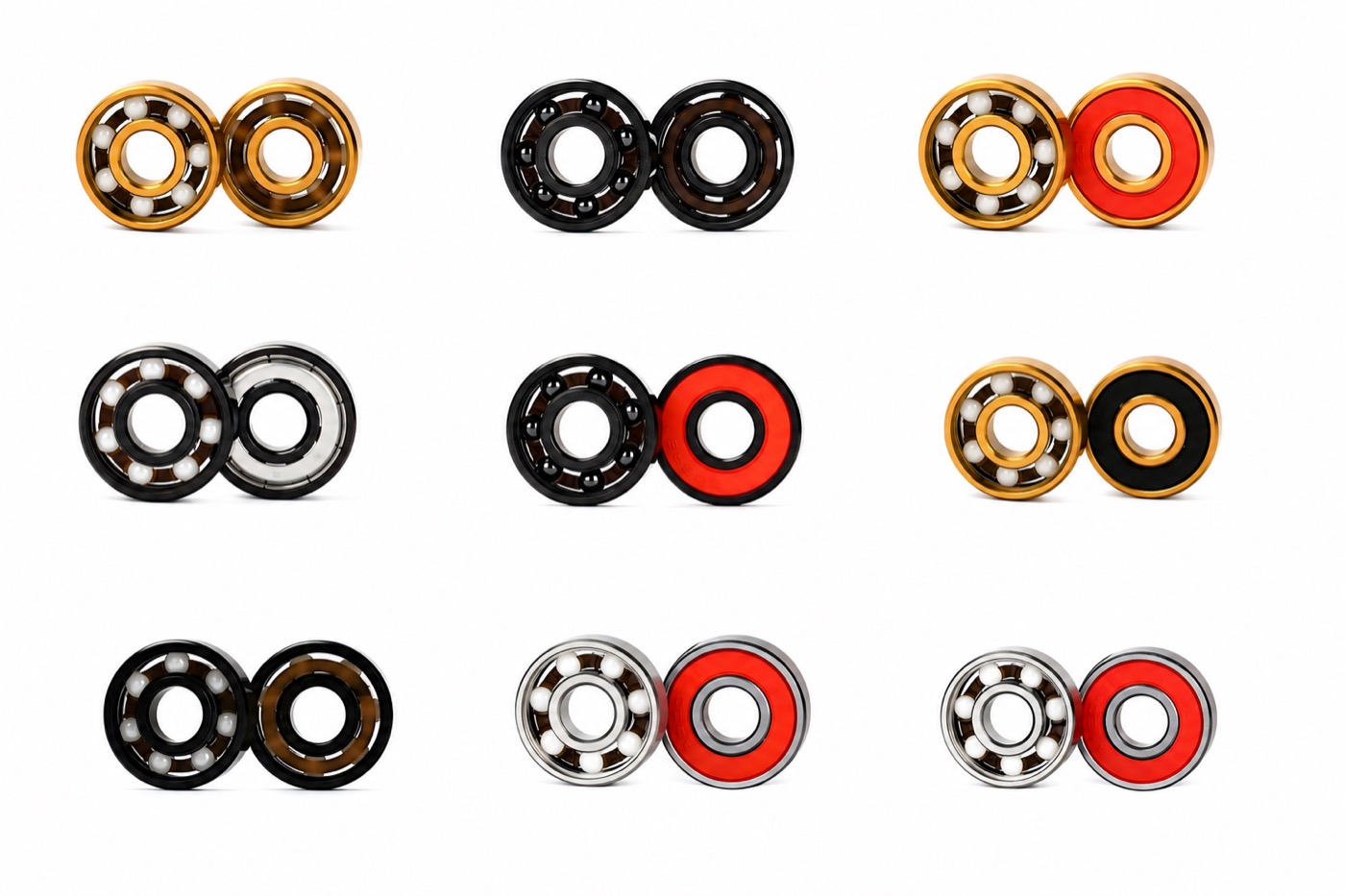
| 608ZZ or 608-2Z | Two metal shields | Often lower drag with light protection | Cleaner pavement, indoor skating, lower-friction setups. |
| 608-2RS | Two rubber seals | More protection, sometimes more seal drag | Street riding, dusty areas, outdoor use, lower maintenance. |
| Non-contact rubber shield | Rubber closure with lower contact drag | Balanced speed and protection | Skate-specific designs that need serviceability. |
| Open 608 | No shield or seal | Low drag, louder, easier to clean | Clean controlled use, not wet or dusty streets. |
Metal shields can be efficient, but they are not always easy to remove without damage. Rubber shields are often more practical for skaters because they can be cleaned and reinstalled more easily. Contact seals may reduce free spin by hand, but they can also help keep grit and moisture away from the raceway.
Steel, Stainless Steel, and Ceramic Options
Material choice changes cost, corrosion behavior, impact tolerance, and maintenance needs. The best material is not always the most expensive one.
| Material Path | Practical Advantage | Skateboard Caution |
|---|---|---|
| Chrome bearing steel | Strong, affordable, widely available, good everyday value | Can rust after water exposure if neglected. |
| Stainless steel | Better corrosion resistance in damp or humid use | Not automatically faster, and still needs lubricant. |
| Hybrid ceramic | Steel rings with ceramic balls for a premium roll feel | Costs more and still depends on clean installation. |
| Full ceramic | Special corrosion or non-metallic applications | Usually not the default for normal skateboarding. |
For most riders, a well-made steel 608 bearing with suitable shields and lubricant is a better value than a poorly maintained premium bearing. Stainless steel makes sense when moisture, coastal air, or damp storage are common. Hybrid ceramic can be attractive for riders or brands focused on premium feel, but it will not fix a dirty wheel, missing spacer, or overtightened nut.
If corrosion resistance is the main buying reason, compare skate-specific needs with broader stainless steel bearings options before selecting only by material name.
ABEC Rating Is Not the Whole Skateboard Bearing Story
ABEC ratings describe bearing tolerance classes under controlled standards. They do not directly measure skateboard speed on rough pavement.
ABEC rating does not tell you:
- How well the bearing keeps dirt out.
- Whether the lubricant is right for skating.
- Whether the shield can be removed for cleaning.
- Whether the bearing handles impact well.
- Whether the wheel bore and spacer are correct.
- Whether the axle nut is too tight.
- Whether the bearing will resist water or rust.
A clean, properly installed ABEC-5 bearing can feel better than a dry or dirty ABEC-9 bearing. For skateboarding, shielding, lubricant, consistency, wheel fit, and maintenance often matter more than the number printed on the package.
Oil, Grease, and Free Spin
Lubrication changes the way a 608 skateboard bearing feels.
| Lubricant | Ride Feel | Tradeoff |
|---|---|---|
| Thin oil | Light, fast hand spin | Needs more frequent maintenance. |
| Skate bearing oil | Balanced service choice | Viscosity and brand vary. |
| Light grease | Quieter and more protective | May feel slower before break-in. |
| Moisture-resistant grease | Better protection in damp conditions | More drag and shorter free spin by hand. |
| Dry bearing | Loud and free-spinning at first | High wear, heat, and corrosion risk. |
The hand-spin test can fool buyers. A dry or lightly oiled bearing may spin for a long time in the air. A greased or sealed bearing may stop sooner by hand but work better under a rider’s weight. Real skating includes load, vibration, turning, impact, and contamination.
Choosing 608 Bearings by Riding Style
| Riding Style or Buyer Type | Better Direction | Why |
|---|---|---|
| Beginner skateboarder | Reliable steel 608 with shields or rubber seals | Affordable, available, and easy to replace. |
| Street skating | Durable steel or hybrid ceramic with good protection | Handles dirt, impact, and repeated landings better. |
| Skatepark | Low-drag steel or hybrid ceramic | Cleaner surfaces favor smooth roll. |
| Cruiser or longboard | Smooth bearings with spacers and speed rings | Alignment and side loading matter during carving. |
| Wet or coastal riding | Stainless or well-sealed steel with protective grease | Better corrosion resistance, but still not waterproof. |
| Skate brand or OEM buyer | Custom 608 set with controlled shield, lubricant, cage, marking, and packaging | Keeps product feel and quality consistent across batches. |
If you are buying for a skateboard brand, do not specify only “608 bearing.” Define the bearing set: eight bearings, spacer size, speed rings, shield color, seal style, lubricant, cage, inspection level, logo marking, and packaging.
Cleaning and Replacing 608 Skateboard Bearings
Cleaning can restore bearings that are dirty or dry. Replacement is better when the bearing is rusty, pitted, loose, or mechanically damaged.
Basic cleaning flow:
- Remove the wheels from the trucks.
- Remove the bearings from the wheels.
- Remove shields only if the design allows it.
- Clean with a suitable bearing cleaner or solvent in a ventilated area.
- Let the bearings dry completely.
- Apply a small amount of skate bearing lubricant.
- Reinstall shields, bearings, spacers, speed rings, wheels, and axle nuts.
- Check that the wheel spins without binding or side play.
Do not put wet bearings back into the wheel. Trapped moisture can cause rust. Do not add oil to a dirty bearing and expect the grit to disappear.
Replace the bearing when it still feels rough after cleaning, has visible internal rust, has a damaged cage, has a bent shield rubbing the balls, or makes grinding noise under load.
When Not to Upgrade the Bearing
Do not upgrade to ceramic bearings if the real problem is a bad wheel bore, missing spacer, overtightened axle nut, bent shield, or dirty bearing seat. The premium bearing will still feel bad if the wheel assembly is wrong.
Do not switch to stainless only because the bearing feels slow. Stainless steel helps with corrosion resistance, not necessarily speed. If speed is the complaint, check lubricant, seal drag, wheel fit, spacer length, and axle adjustment first.
Do not buy only by ABEC rating. For skateboard use, a practical specification is usually better: correct 608 size, consistent manufacturing, suitable closures, skate-appropriate lubricant, clean installation, and maintenance access.
If the 608 bearing is being used in equipment where internal clearance affects heat, noise, preload, or assembly fit, use the bearing clearance calculator instead of guessing from a skateboard setup.
What to Confirm Before Ordering
For a standard rider replacement, confirm:
- 608 size: 8 x 22 x 7 mm.
- Quantity: eight bearings for one skateboard.
- Shield or seal style: ZZ, 2RS, removable shield, or open.
- Material: steel, stainless, hybrid ceramic, or other.
- Lubricant preference: oil, light grease, or moisture-resistant grease.
- Whether spacers and speed rings are included.
For OEM, distributor, or private-label orders, also confirm:
- Shield color, logo marking, and packaging design.
- Cage material and noise/smoothness requirement.
- Grease or oil type.
- ABEC or precision requirement where relevant.
- Set configuration, such as 8 bearings, 4 spacers, and 8 speed rings.
- Bulk packaging or retail packaging.
- Target market, riding style, inspection expectation, and order quantity.
FAQ
Are all skateboard bearings 608?
Most standard skateboard bearings are 608 size. Specialty equipment can differ, so check the wheel, axle, and bearing marking if the setup is not standard.
How many 608 bearings does a skateboard need?
A standard skateboard needs eight bearings, two per wheel.
Are 608ZZ bearings good for skateboards?
Yes. 608ZZ bearings can work well when low drag and light protection are enough. Rubber-shielded or sealed designs may be better for dirty or outdoor conditions.
Are 608-2RS bearings good for skateboards?
Yes. 608-2RS bearings can be useful when dirt and moisture protection matter. They may have more seal drag than metal-shielded designs, so the free-spin feel can be different.
Are ceramic skateboard bearings worth it?
Hybrid ceramic bearings can be worth it for riders who want a premium roll feel and maintain their bearings well. For beginners or rough street use, a good steel bearing often gives better value.
Is ABEC 9 faster than ABEC 7 for skateboarding?
Not automatically. ABEC is a precision rating, not a complete skateboard speed rating. Lubrication, cleanliness, shields, wheel quality, spacers, and installation often matter more.
Should skateboard bearings be waterproof?
No normal skateboard bearing should be treated as truly waterproof. Seals, stainless steel, and grease can improve resistance, but water can still wash out lubricant, carry grit inside, and cause corrosion.